1.7131 - AT A GLANCE
What kind of steel is the 1.7131?
The 1.7131, also known under its chemical discription 16MnCr5 or as the EC80, is a versatile case-hardening steel. The combination of hardness, toughness and wear resistance make this steel grade a good choice for applications that need a hard surface and a tough core.
Properties
The 1.7131 is a cold work and plastic mould steel which belongs to the group of case-hardening steels. As a case-hardner it is often used for mechanically stressed parts but can also be hardened through.
- Case-hardening steel
- Plastic mould steel
- Cold work steel
- Good machinability
- Good cold-forming
- Good polishability
- Through-hardenability
- Hard suface, tough core → good tensile strength
- EDM machinable
- Nitridable
- Etchable
Applications
With its good combination of hardness and toughness the 1.7131 can be used in many industries and many more applications. It is possible to through-hardened or case-hardened this steel grade which is very important for mechanically stressed parts.
- Mechanical engineering
- Jig construction
- Plant construction
- Apparatus engineering
- Plastic processing
- Plastic moulds
- Synthetic resin moulds
- Base plates
- Bending bars
- Guide columns
- Gear parts
- Joint parts
- Shafts
- Gears
- Rods
- Bevel gears Crown Wheels
- Piston pins
- Camshafts
- Bolts
- Pins
- Cardan joints
1.7131 Standard values
Chemical composition:
| C | Si | Mn | P | S | Cr |
|---|---|---|---|---|---|
| 0.14 - 0.19 | 0.0 - 0.4 | 1.0 - 1.3 | 0.0 - 0.025 | 0.0 - 0.035 | 0.8 - 1.1 |
Chemical designation:
16MnCr5, (EC80)
Working hardness (surface):
58-60 HRC
Delivery condition:
max. 217 HB
1.7131 Physical Properties
What group of steel does the 1.7131 belong to?
- Case hardening steel
- Plastic mould steel
- Cold work steel
- High grade structural steel
Is the 1.7131 stainless steel?
In the classical sense the 1.7131 is not a stainless steel. To fit in the category of stainless steels a steel has to have a mass fraction of at least 10,5 % of chromium, this material grade has a mass fraction of 0,8 – 1,1 %.
Is the 1.7131 corrosion resistant?
The 1.7131 has some corrosion resistance. To be corrosion resistant a steel has to have a mass fraction of 10,5 % of chromium, the 1.7131 has a chromium content of 0,8 – 1,1 %.
Is the 1.7131 magnetisable?
As a ferro magnetic material the 1.7131 is magnetisable and can be clamped on magnetic plates for machining.
1.7131 Wear resistance
On a scale where 1 is low and 6 is high the 1.7131 receives a 5 for its wear resistance.
1.7131 Technical properties
Is the 1.7131 a knife steel?
The 1.7131 has a moderate amount of carbon with 0,14 – 0,19 % and therfore has a moderate hardness as well.. A knife steel needs a high hardness and edge retention as well as corrosion resistance. The 1.7131 is mainly used as a case hardening steel.
1.7131 Working hardness
The working hardness for the 1.7131 is in the range of 58 – 60 HRC.
1.7131 Density
At room temperature the densityy for the 1.7131 is at 7,85 g/cm3.
1.7131 Tensile strength
The 1.7131 has a tensile strength of approx. 720 N/mm2. A tensile test is carried out to obtain this information, which shows how much load is required to stretch or elongate a sample before it breaks.
1.7131 Machinability
On a scale where 1 is low and 6 is high the 1.7131 receives a 5 for its machinability.
1.7131 Heat conductivity
At room temperature the heat conductivity of the 1.7131 is at 44,0 W/(m*K).
1.7131 Thermal expansion coefficient
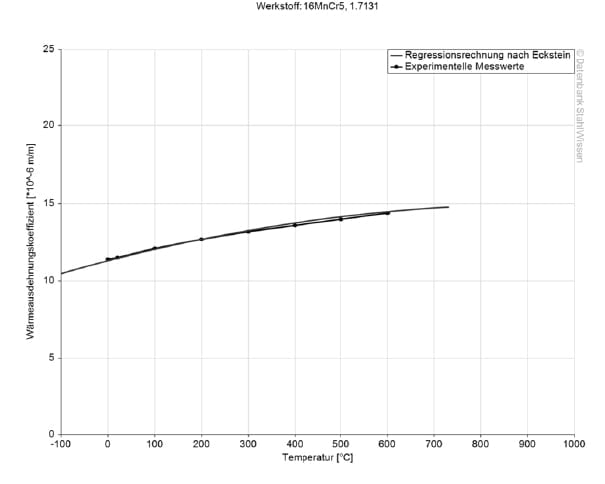
The thermal expansion coefficient indicates how much the material can expand or contract when temperatures change. This is very important information, especially when working with high temperatures or when there are significant temperature fluctuations during use.
Medium thermal expansion coefficient
Value tempered
10-6m/(m*K)
At a temperature of
11.5
20 – 100 °C
12.5
20 – 200 °C
13.3
20 – 300 °C
13.9
20 – 400 °C
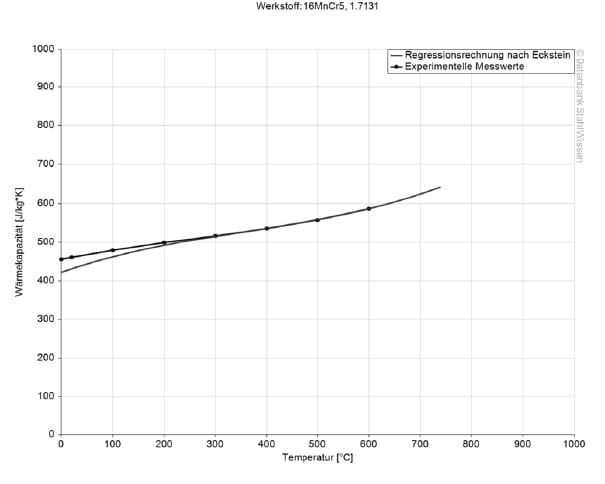
1.7131 Specific heat capacity
The specific heat capacity indicates how much heat is required to heat a certain amount of material by 1 Kelvin.
1.7131 Specific electrical resistance
The specific electrical resistance for the 1.7131 can be found in the following table. Electrical conductivity is the reciprocal of specific resistance.
Specific electrical resistance
Value (Ohm*mm²)/m
At a temperature of
0.16
20 °C
HEART AND SOUL IN STEEL!
1.7131 Procedure
1.7131 Heat treatment
The heat treatment is used to determine material properties. It should therefore always be carried out with care. Properties such as strength, toughness, surface hardness and temperature resistance are determined, which in turn can extend/improve the service life of parts, tools and components.

Heat treatment includes solution annealing, soft annealing, normalising, stress relief annealing, but also tempering, hardening and quenching or tempering.
1.7131 Annealing
To anneal the 1.7131 heat it to a temperature of 650 – 700 °C and let it cool down afterwards in the furnace.
1.7131 Stress relieving
To eliviate internal stresses the 1.7131 is heated to a temperature of 650 – 680 °C and then cooled down slowly again.
1.7131 Normalising
To normalise the 1.7131 heat it evenly to a temperature of 850 – 880 °C and let it cool down in air afterwards.

1.7131 Tempering
The tempering temperature is chosen to determine the hardness and properties of steel grades.

Tempering eliviates inner stresses but also evens out the balance between the hardness and toughness.
The 1.7131 is evenly heated to a temperature of 150 – 200 °C and held for 1 hour per 20 mm of thickness but at a minimum of 2 hours.
1.7131 Carburising
To carburise the 1.7131 it is evenly heated to a temperature of 880 – 980 °C and then quenched.
During this process carbon diffuses into the surface of the steel and by quenching it the carbon gets trapped in the surface. The carbon used for this process can be solid, fluid or a gas.
Afterwards the steel has a hard surface due to the added carbon and a tough core as the core contains less carbon than the surface. This combination gives the steel good component tensile strength and a longer service life.
1.7131 Hardening (core hardening)
To core harden 1.7131, it is heated evenly to a temperature of 850–900 °C and then quenched.
1.7131 Hardening (case hardening)
For case hardening, the 1.7131 is heated evenly to a temperature of 780–820 °C and then quenched.
1.7131 Quenching
After core or case hardening the material can be quenched in the following media:
- Oil
- Hot basin (150 – 250 °C)
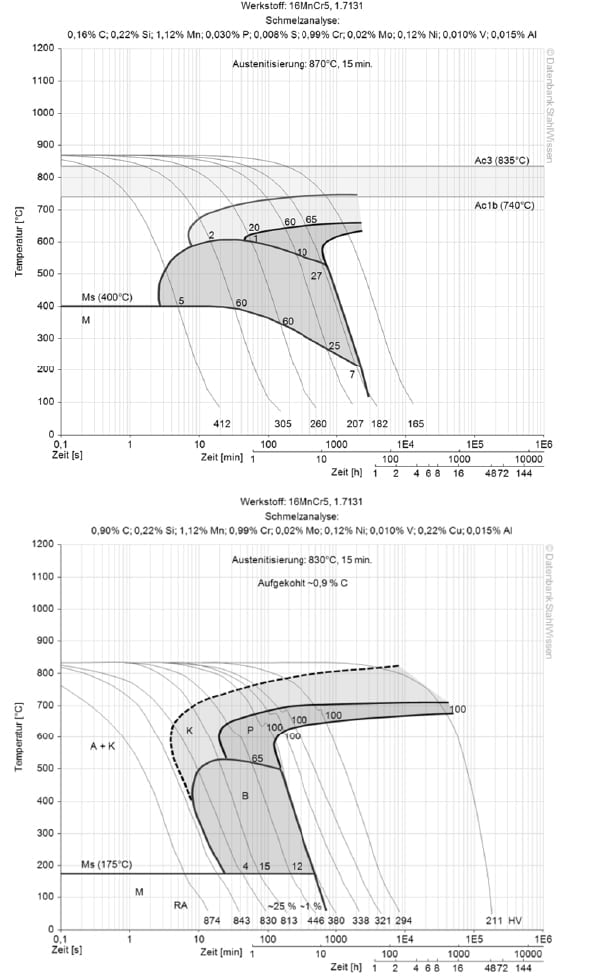
1.7131 Continuous TTT-Diagram
This diagram shows micro-changes over time at different temperatures. These are important in heat treatment because they provide information about the optimal conditions for processes such as hardening, annealing and normalising.
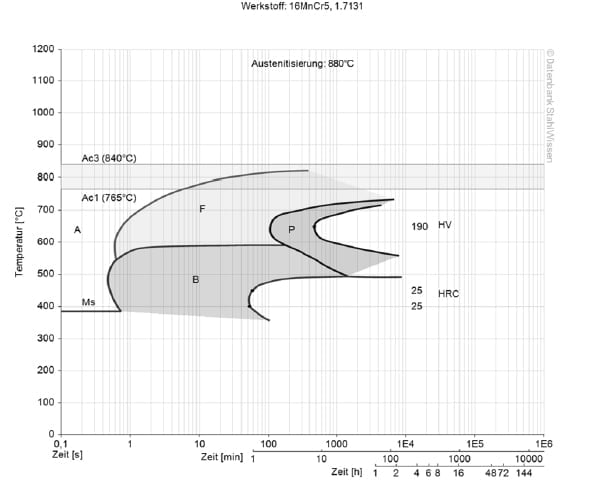
1.7131 Isothermal TTT-diagram
This diagram shows the structural changes at micro level over time at a constant temperatur. It shows at which temperatures after what time the different phases like perlit, martensite or bainite start to form.
1.7131 Surface treatment
1.7131 Nitriding
In this process, nitrogen is diffused into the surface of the 1.7131 to create a harder surface. This improves wear resistance and corrosion resistance.
1.7131 Carbonitriding
This process causes nitrogen and carbon to diffuse into the surface of the metal, giving it greater hardness and wear resistance.
1.7131 PVD and CVD coating
Both of these processes deposit a thin, hard layer onto the surface of the material to give it a harder surface with better wear resistance, improved corrosion resistance and reduced friction.
- PVD – physical vapour deposition
- CVD – chemical vapour deposition
1.7131 Hard chrome plating
In this process, the 1.7131 is electroplated with a layer of chrome in a galvanic bath. This gives it better wear resistance and corrosion resistance. Chrome plating also changes the appearance of the components, as it applies a decorative and tarnish-resistant layer that can be polished to a high shine.
1.7131 Processing
1.7131 Electrical Discharge Machining (EDM)
In general, a material is eroded in order to produce workpieces from a single piece. Erosion can be used to produce dies or more complex shapes. There are various methods of eroding different materials, such as wire erosion, spark erosion or die-sink erosion.
1.7131 Forging
To forge the 1.7131 heat it to a temperature of 850 – 1050 °C and forge it in that range.
1.7131 Welding
The 1.7131 can only be welded to a limited extent.