PREMIUM HSS 1.3343 Steel
HS6-5-2C

AISI / SAE M2

PREMIUM HSS 1.3343 Steel
HS6-5-2C

HS6-5-2C
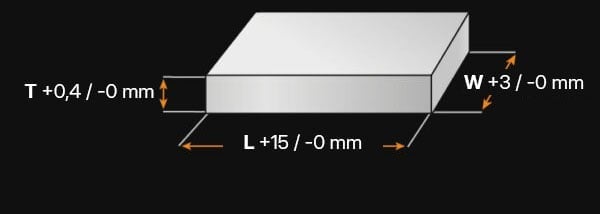
€co-Präz® [€co/BA]
-flat-
Toleranzen-1.png
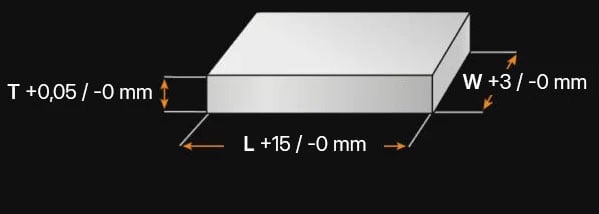
€co-Präz® [€co]
-flat-
Toleranzen-1.png
PRS
-round-
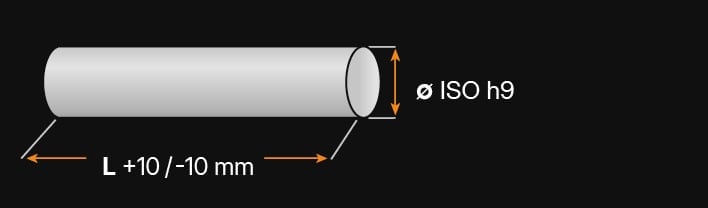
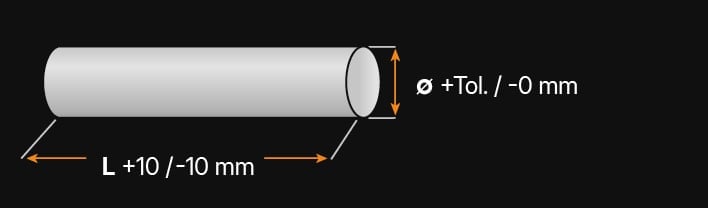
Toleranzen.png
PRS/BA
-round-
Toleranzen.png

1.3343  - AT A GLANCE

What kind of steel is the 1.3343?

High speed steel 1.3343 is one of the most used high speed steels, it is suitable for cold forming tools e.g. cold extrusion rams, its elevated wear resistance makes it suitable for e.g. plastic molds and can also be used for certain hot work applications. The added tungsten and molybdenum give this high speed steel the excellent combination of toughness, wear resistance, red hot hardness and the good edge retention, which make it suitable to a wide variety of applications.

Properties

HSS 1.3343 is ideal to use for high speed and high wear applications. It has great wear resistance, high impact toughness and good compression strength. 

Care should to be taken when the material is EDM’ed or welded as these processes can lead to brittleness in those areas and can lead to entry points for rust as well as weak spots where the material can crack. With a good surface treatment the material can be made even harder on the surface as well as reduce friction which is needed when using the material for example for taps or drills. With the right maintenance and use this material can be used for a large variety of applications.

Practically, this means:

  • High wear resistance
  • High impact strength
  • Good compressive strength
  • High heat resistance
  • Good edge strength
  • Nitridable
  • Can be eroded, but caution is advised
  • Working hardness is 62 – 65 HRC

Applications

The 1.3343 has good cutting abilities up to 600°C without loosing its hardness compared to a normal cold work steel that looses its hardness at around 200°C. The base for those abilities ly within its alloys as well as its martensitic micro structure.

  • Machining tools
  • Milling cutters
  • Spiral drills
  • Taps
  • Reamers
  • Broaching tools
  • Rotary blades
  • Chisels
  • Gear shaper cutters
  • Circular saw segments
  • Metal saw
  • Woodworking tools
  • Die plates
  • Countersinks
  • Chaseres
  • Cold extrusion punches
  • Dies
  • Punches
  • Plastic moulds with high wear resistance

1.3343 Standard values

Chemical composition:

C Si Mn P S Cr Mo V W
0.86 - 0.94 0.0 - 0.45 0.0 - 0.4 0.0 - 0.03 0.0 - 0.03 3.8 - 4.5 4.7 - 5.2 1.7 - 2.1 5.9 - 6.7

Chemical designation:
HS6-5-2C

Working hardness:
62-65 HRC

Delivery condition:
max. 270 HB

1.3343Physical Properties

  • Martensitic high speed steel
  • Plastic mould steel
  • Cold work steel
  • Hot work steel

To be classified as a stainless steel the material has to have a mass fraction of a minimum of 10,5 % of chromium. With a chromium content of 3,8 – 4,5 % the HSS 1.3343 is not a classic stainless steel.

Although the 1.3343 has some corrosion resistance, it is susceptible to oxidation in humid and corrosive environments. Corrosion resistance can be improved by coating the material, limiting exposure to corrosive environments, and following good maintenance routines and storage practices to prevent corrosion.

As a ferromagnetic material, high-speed steel 1.3343 is magnetisable and suitable for magnetic clamping technology.

1.3343 Technical properties

The working hardness for high speed steel 1.3343 is at 62 – 65 HRC.

The typical density for high speed steel 1.3343 is 8,12 g/cm3 at room temperature.

For high speed steel 1.3343 the tensile strength is approx. 920 N/mm2. The tensile strength indicates the maximum load capacity. To obtain this information, a tensile test is carried out to show how much force is required to stretch or elongate a sample before it breaks.

In annealed condition, 1.3343 is considered a steel with ‘medium’ machinability and moderate grindability.

On a scale where 1 is low and 6 is high, the material 1.3343 receives a 2.

On a scale where 1 is low and 6 is high the HSS 1.3343 receives a 6 for its wear resistance.

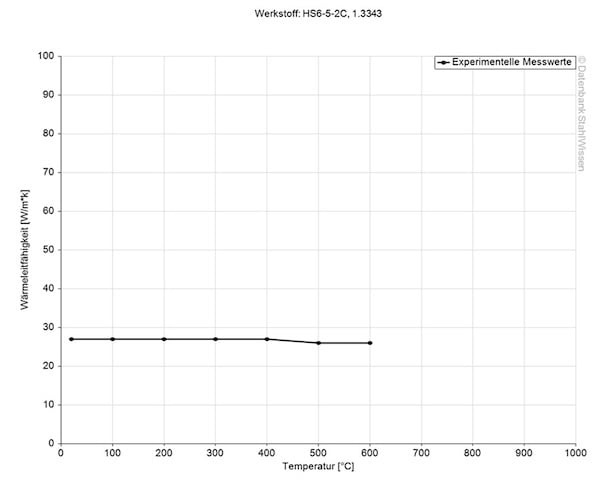
The heat conductivity for material grade 1.3343 at a temperature of 20 °C is at 32,8 W/(m*K).

Heat conductivity

Value W/(m*K)

At a temperature of

32.8

20 °C

23.5

350 °C

25.5

700 °C

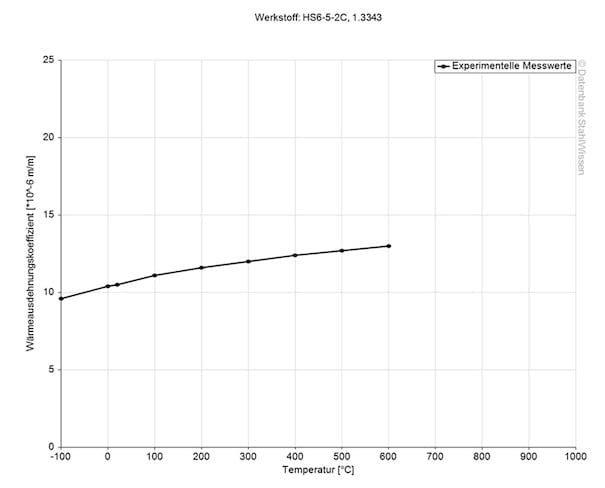
This diagram shows how much the 1.2363 can expand or contract when temperatures change. This can be very important when working with high temperatures or significant temperature fluctuations.

Specific electrical resistivity

Value 10-6m/(m*K)

At a temperature of

10.8

20 – 100 °C

11.8

20 – 200 °C

12.0

20 – 300 °C

12.5

20 – 400 °C

The following table shows the specific electrical resistance of the HSS 1.3343.

Specific eletrical resistance

Value (Ohm*mm2)/m

At a temperature of

0.524

20 °C

0.581

100 °C

0.664

200 °C

0.751

300 °C

ABRAMS PREMIUM STEEL® – QUALITY THAT WILL IMPRESS YOU!

1.3343 Procedure

Heat treatment is used to determine material properties. It should therefore always be carried out with care. Properties such as strength, toughness, surface hardness and temperature resistance are determined, which in turn can extend/improve the service life of parts, tools and components.


Heat treatment includes solution annealing, soft annealing, normalising, stress relief annealing, but also tempering, hardening and quenching or tempering.

Heat the material 1.3343 evenly to a temperature of 870 °C and maintain the temperature for 1 hour per 25 mm thickness, but for at least 2 hours. The parts are then cooled in the furnace by 10 °C to 540 °C and further cooled to ambient temperature either in the furnace or in the air.

High speed steel 1.3343 should be stress relieved after intense machining to avoid possible dimensional changes.

Heat the material to a temperature of 630 – 650 °C and hold it for 2 hours and cool parts down to room temperature in air.

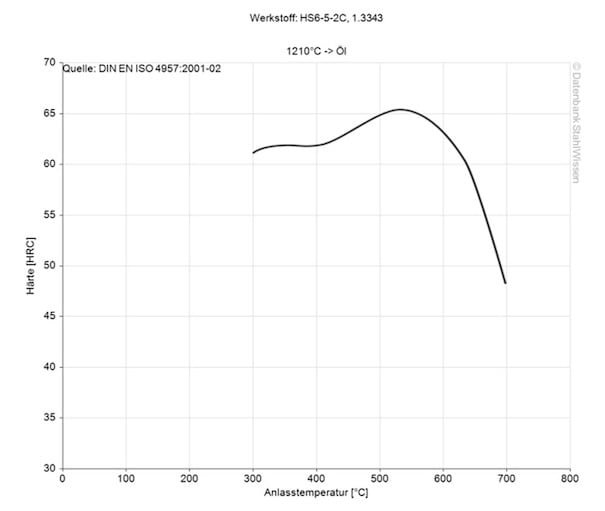
Heat the material to a tempering temperature of 530 – 560 °C and hold at least 2 hours. It is recommended to double temper this material.

To harden HSS 1.3343, the material is first preheated evenly in an air circulation furnace to a temperature of 400 °C, then raised evenly to 850 °C and increased to 1050 °C for the final preheating phase. The temperature is then quickly raised to 1190–1230 °C and held for 5–15 minutes.

  • Salt bath – quenching to a temperature of 540 – 595 °C, then further cooling to 65 °C. After quenching, the 1.3343 material must be tempered immediately.
  • Vacuum – Quench to a temperature below 540 °C at a rate of 10 °C, then allow to cool further to room temperature.
  • Air

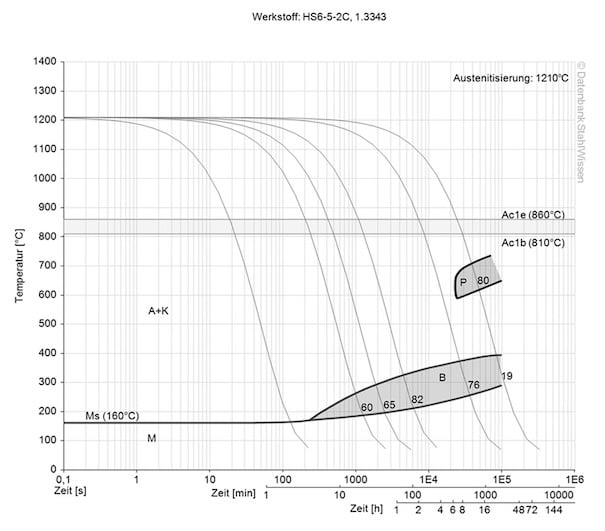
This diagram shows micro-changes over time at different temperatures. These are important in heat treatment because they provide information about the optimal conditions for processes such as hardening, annealing and normalising.

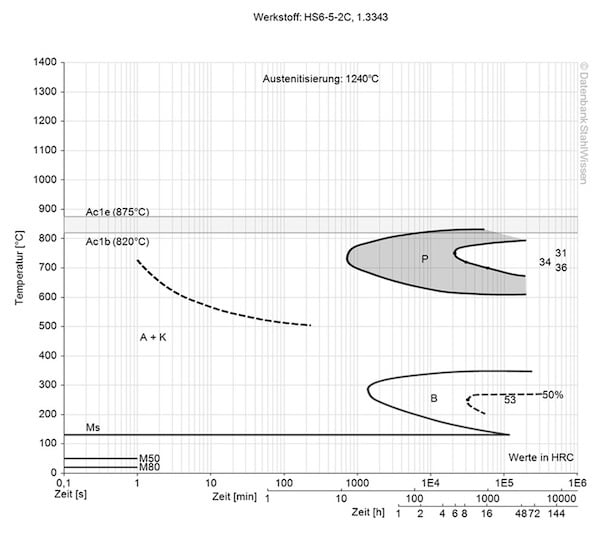
This diagram shows the structural changes at micro level over time at a constant temperatur. It shows at which temperatures after what time the different phases like perlit, martensite or bainite start to form.

1.3343 Surface treatment

When choosing a surface treatment, it is important to consider the application for which the material will be used and wether the treatment is benficial for this application. Below are some examples of surface treatments and their advantages for high speed steel 1.3343.

With this process nitrogen is diffused into the surface of this steel grade. With that the surface of the 1.3343 gets a better wear resistance and fatigue strength without affecting the existing properties.

Various coatings such as TiN (titanium nitride), TiAlN (titanium aluminium nitride), AlTiN (aluminium titanium nitride) or diamond coatings, which are applied in a thin layer to the material surface, can increase surface hardness and wear resistance, extending tool life and reducing friction.

A thin layer of chromium is applied to the surface which is mostly done for aesthetic reasons but also for a better wear resistance, strength and corrosion resistance.

1.3343 Processing

Eroding is used for parts that are manufactured from a single piece, for cutting dies or for producing complex shapes. As it is a non-contact machining process based on thermal energy, it can be used for hard materials such as HSS 1.3343. Electrodes, surface finish and heat-affected zones should be taken into account before using erosion for this type of material. The material should then be thoroughly inspected, as thermal stresses can cause microcracks in the heat-affected zones, which, if undetected, can lead to tool or component failure.

High-speed steel 1.3343 may undergo dimensional changes during heating, cooling, phase changes and stress relief. To reduce dimensional changes such as warping or deformation, it is important to control the heating and cooling rates or to use fixtures to fix the material in place. It is always important to take these changes into account and, if necessary, to add a certain amount of allowance for such changes to the material so that precise dimensions can be maintained.

Slowly preheat the material to a temperature of 850 – 900 °C and the increase it qickly to the forging temperature of 1050 – 1150 °C. The temperature should not drop below 880 – 900 °C. Larger pieces should be allowed to cool down slowly in the furnace. Smaller and uncomplicated pieces can be cooled in chalk or ash.

Please note that this is not an annealing process; when cooled down properly they should then be annealed.

A sub-zero treatment can have many advatages, for example higher wear resistance, higher hardness, better dimensional stability, a finer microstructure and stress relief. But it can also have disadvantages like brittleness and when not correctly done cracking due to the temperature difference. The process should be well though through and under strict control to receive the best result possible.

ALTERNATIVES

Are you looking for an alternative steel grade?

With the ABRAMS STEEL GUIDE®, you are able to obtain an alternative or equvelent with just a few clicks.

DATASHEET

Download the technical data sheet in PDF format here.

Messe.png

SERVICES

Do you require special dimensions?


Our services for you: water jet cutting, sawing, milling and grinding.

richtwerte-2.png

Standard values

Chemical designation: HS6-5-2C
Working hardness: 62-65 HRC
Delivery condition: maximum 270 HB
Chemical composition:
C Si Mn P S Cr Mo V W
0,86

0,94
0

0,45
0

0,4
0

0,03
0

0,03
3,8

4,5
4,7

5,2
1,7

2,1
5,9

6,7
Logo_Abrams_Ausrufezeichen.png
ABRAMS PREMIUM STEEL® – QUALITY THAT WILL IMPRESS YOU!
technical-info.png

Technical properties

This high speed steel is the most frequently used among the high speed steels. Its composition allows it to be used for a wide range of applications. High impact toughness, good compression strength, excellent wear resistance.

anwendungen.png

Applications

Machining tools, milling cutters, twist drills, screw taps, reamers, broaching tools, rotary knives, planer knives, gear shaper cutters, circular saw segments, metal saws, woodworking tools, screw dies, countersinks, chasers, cold extrusion punches, precision cutting tools, dies, punches, plastic moulds with high wear resistance.

70 STEEL GRADES IN 33.895 DIMENSIONS

EX WORKS FROM OSNABRÜCK

DELIVERY IN 3-5 WORKING DAYS (SUBJECT TO AVAILABILITY)

WITHOUT MINIMUM ORDER VALUE OR QUANTITY

FROM EUROPE'S LARGEST RANGE OF SEMI-FINISHED PRODUCTS

SPECIAL CUSTOM DIMENSIONS SAWN - MILLED - GROUND

Select Your Country / Language

Do you have any questions?

If you have any comments or questions regarding ABRAMS PREMIUM STEEL® products or this website, please do not hesitate to contact us.

Please feel free to call us at any time:

+49 541/357 39-0

or send us an E-mail to:

[email protected]

If you have any comments or questions regarding ABRAMS PREMIUM STEEL® products or this website, please do not hesitate to contact us.

Please feel free to call us at any time: