1.2067 / 1.3505 - AT A GLANCE
What kind of steel is the 1.2067 / 1.3505?
Tool steel 1.2067 / 1.3505 is an oil hardening cold work steel with good hardenability, wear resistance, impact resistance and high toughness. Even with a good hardenabilty this steel grade has a low hardening depth.
Properties
The 1.2067 1.3505 can be used in a variety of applications from bearings to knives, it offers a good balance of hardness, wear resistance and toughness lending it durability and longevity.
- Universally applicable
- Medium alloyed cold work steel (high hardenablity)
- Low hardening depth
- Good wear resistance
- Good toughness
- The 1.2067 belongs to the group of 1.3505
(roller bearing and ball bearing steel)
Applications
Steel grade 1.2067 1.3505 finds its uses in a wide range of industries and applications, like in the wood and paper industry for paper cutters and circular saw blades. As it reliably retains its dimensions it is also well suited for measuring tools, e.g., a caliper.
- Drills
- Threading tools
- Centre lathes
- Milling cutters
- Reamers
- Small die plates
- Pressure rollers
- Cold rollings
- Mearuring tools
- Cold pilger rollings
- Cold pilger jaws
- Gauges
- Mandrels
- Woodworking tools
- Cold extrusion tools
- Flanging rollers
- Shear knives
- Roller bearings
- Ball bearings (medium to large size)
1.2067 / 1.3505 Standard values
Chemical composition:
| C | Si | Mn | P | S | Cr | Mo | Ni |
|---|---|---|---|---|---|---|---|
| 0.95 - 1.1 | 0.15 - 0.35 | 0.2 - 0.4 | 0.0 - 0.025 | 0.0 - 0.025 | 1.35 - 1.6 | 0.0 - 0.1 | 0.0 - 0.4 |
Chemical designation:
102Cr6 / 100Cr6
Working hardness:
60-64 HRC
Delivery condition:
max. 223 HB
1.2067 / 1.350 Physical properties
What group of steel does the 1.2067 / 1.3505 belong to?
- Tool steel
- Cold work steel
1.2067 vs. 1.3505
Both materials are suitable for highly stressed bearing components, but also for highly stressed tools such as thread cutting tools or milling cutters.
With a slightly higher carbon content, 1.2067 achieves greater hardness compared to 1.3505, and this greater hardness also makes 1.2067 slightly more wear-resistant. However, 1.3505 is easier to machine than 1.2067.
Ultimately, the area of application and the required properties determine which of these two steel grades is used.
Is the 1.2067 / 1.3505 a stainless steel?
1.2067 / 1.3505 is not a stainless steel. To be classified as stainless steel, a steel must have a mass fraction of at least 10.5% chromium. This grade has a mass fraction of 1.35–1.6% and therefore cannot be described as stainless steel in the traditional sense.
Is the 1.2067 / 1.3505 corrosion resistant?
To be considered as a corrosion resistant steel a mass fraction of 10,5% of chromium is needed. As the 1.2067 / 1.3505 has a mass fraction of 1,35 – 1,6% it is not corrosion resistant.
When exposed to corrosive or humid environments the 1.2067 / 1.3505 will corrode. In order to protect this steel grae from corrosion it can be coated or the surface can be treated as explained in the section surface treatment.
Is the 1.2067 / 1.3505 magnetisable?
As a ferro magnetic material the 1.2067 / 1.3505 can be magnetised. The magnetic properties make it possible to use magnetic clamping plates to machine this material.
1.2067 / 1.3505 Wear resistance
Tool steel 1.2067 / 1.3505 receives a 4 for its wear resistance on a scale where 1 is low and 6 is high.
1.2067 / 1.3505 Technical Properties
Is the 1.2067 / 1.3505 a knife steel?
Tool steel 1.2067 / 1.3505 has a good balance between wear resistance, hardness and toughness. Knifes made from this material have good edge retention and are resistant to breakage and splintering under normal use. As the corrosion resistance of the 1.2067 / 1.3505 is not given use in moist and corrosive environments should be kept to a minimum to avoid rusting. Regular maintenance can prevent rusting and dulling of the blade.
1.2067 / 1.3505 Working hardness
The working hardness of the 1.2067 / 1.3505 is at 60 – 64 HRC.
1.2067 / 1.3505 Density
At room temperature the density for the tool steel 1.2067 / 1.3505 is at 7.85g/cm3.
1.2067 / 1.3505 Tensile strength
The 1.2067 / 1.3505 has a tensile strength on delivery of approx. 750 N/mm2 .
For this result the material is undergoing a tensile test which shows how much force is needed before the material starts to stretch or elongate before it breaks.
1.2067 / 1.3505 Heat conductivity
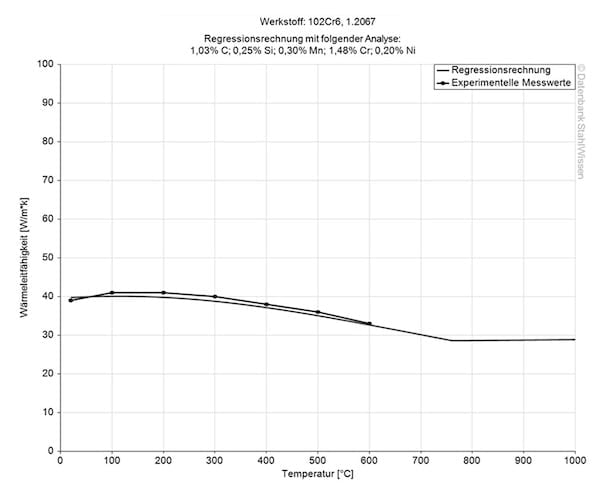
The heat conductivity for the 1.2067/1.3505 at room temperature is at 33,0 W/m*K.
Heat conductivity
Value W/(m*K)
At a temperature of
33.0
20 °C
32.2
350 °C
31.4
700 °C
1.2067 / 1.3505 Thermal expansion coefficient
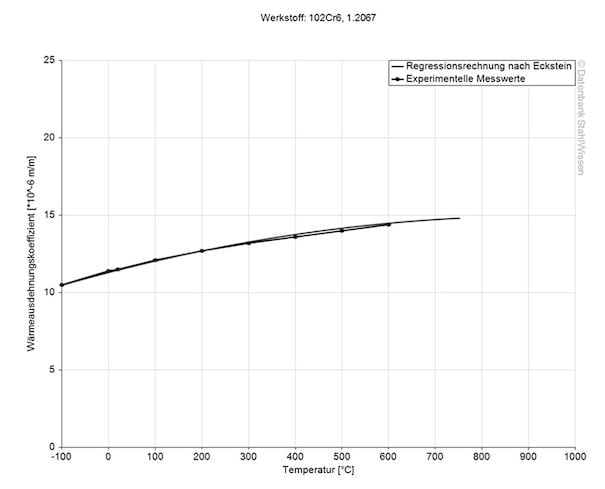
The thermal expansion coefficient shows how much a material expands or contracts at any temperature changes. This information can be relevant when when components or parts are exposed to high temperatures or for applications with ever changing temperatures.
Medium thermal expansion coefficient
Value 10-6m/(m*K)
At a temperature of
12.3
20 – 100 °C
13.4
20 – 200 °C
13.7
20 – 300 °C
14.1
20 – 400 °C
1.2067 / 1.3505 Specific heat capacity
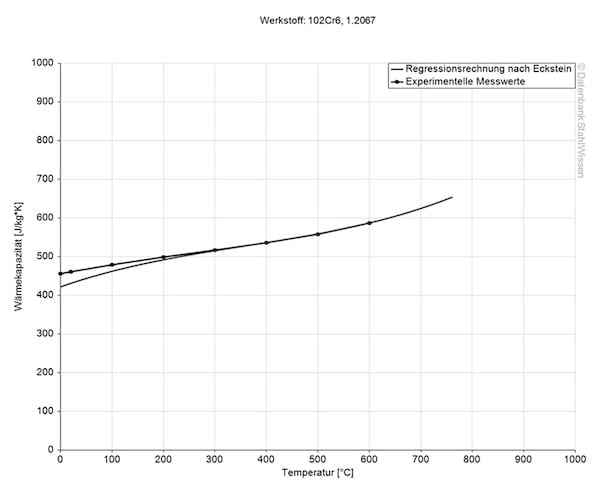
The specific heat capacity of the 1.2067 / 1.3505 is at 0,439 J/g*K at room temperature.
This value shows how much heat is needed to heat a specific amount of material by 1 Kelvin.
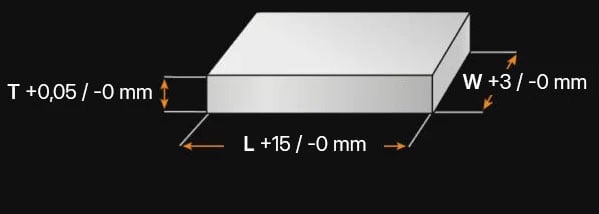
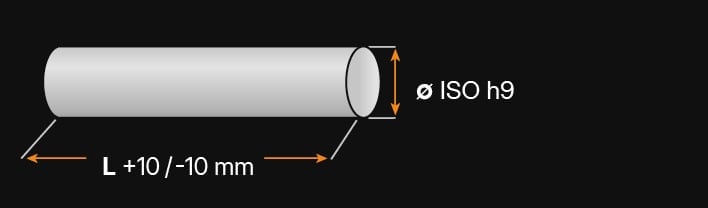
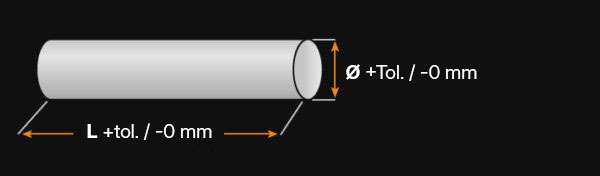
HIGHEST PRECISION!
1.2067 / 1.3505 Procedure
1.2067 / 1.3505 Annealing
Heat the material 1.2067 / 1.3505 envenly to a temperature of 710 – 750°C and hold it for at leat 2 hours or 1 hour per 25 mm thickness. To finish this process cool the material by 10°C per hour in the oven to a temperature of 540°C and then further in air.
For a better machinability let the material cool to a temperature of 675°C and hold this for further 8 hours after which it should be coold in air.
1.2067 / 1.3505 Stress relieving
To rid the material of internal stresses heat it evenly to a temperature of 600 – 650°C and hold it at that temperature for 1 – 2 hours. After that the material is coold down to 480°C in the oven. When that temperautre is reached the material can be cooled down further in air until it reache ambient temperature.
1.2067 / 1.3505 Normalising
To normalise the material 1.2067 / 1.3505 it is evenly heated to a temperature of 870 – 900°C. Afterwards it is cooled in air.
1.2067 / 1.3505 Tempering
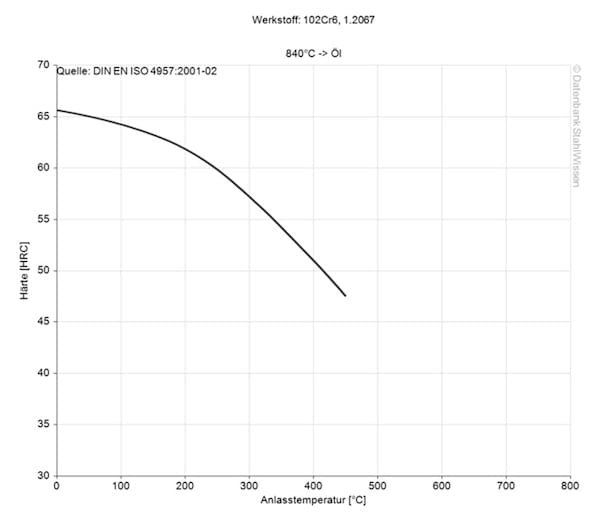
After quenching the 1.2067 / 1.3505 can be very hard and brittle. To reinstate the balance of hardness and toughness the material should tempered. To do this, the material is heated to the desired temperature and held there for 1 hour per 25 mm of thickness, then cooled to room temperature.
In a temperature range of 230–430 °C, 1.2067 / 1.3505 can be tempered without becoming brittle. To minimise internal stresses in workpieces with a cross-section of more than 150 mm or to improve the stability of tools after eroding, it is recommended to hold the material for 8 to 10 hours.
1.2067 / 1.3505 Hardening
Evenly heat the 1.2067 / 1.3505 to a temperature of 830 – 850°C and hold it for 65 minutes for each 25mm thickness. To avoid loss of hardness the material is transfered as quickly as possible to the readyly available oil.
1.2067 / 1.3505 Qenching
Choosing the right quenching medium and quenching speed can be crucial. Uneven quenching can lead to warping or cracking.
For quenching tool steel 1.2067 / 1.3505 the following media can be used.
- Water for a temperature of up to 830°C and above that:
- Oil, pre heated to 180 – 220°C
- Hot basin, pre heated to 180 – 220°C
1.2067 / 1.3505 Continuous TTT-diagram
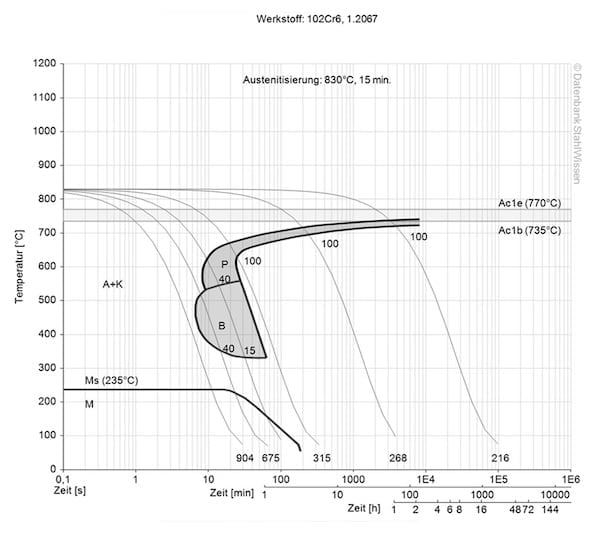
The TTT-diagram usually shows micro-changes over time at different temperature . These are important in heat treatment as they provide information on the optimal conditions for processes such as hardening, annealing and normalising.
1.2067 / 1.3505 Isothermal TTT-diagram
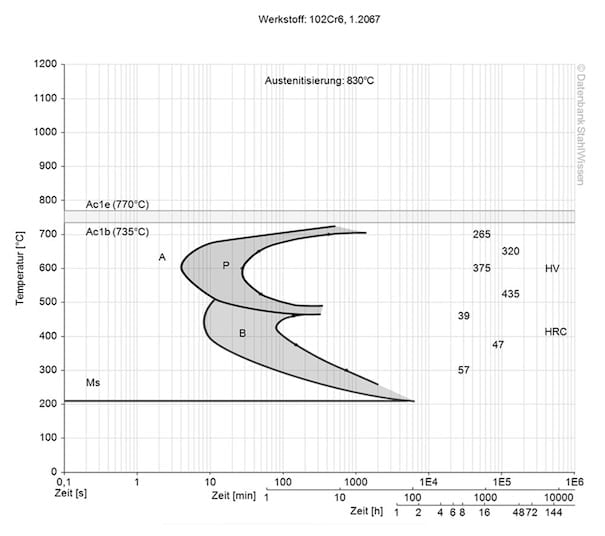
This diagram shows the structural changes at the micro level over time at a constant temperature. It shows at what temperature and after what time different phases, e.g. perlite, martensite or bainite, begin to form.
1.2067 / 1.3505 Surface treatment
The choice of surface treatment depends on where the work piece/tool is, the needed properties and what stresses it has to endure. Following are some examples for possible surface treatments.
1.2067 / 1.3505 Nitriding
During the nitriding process nitrogene is diffused into the material surface to give it a harder surface. This process can give the material a better corrosion resistance And as a low temperature treatment it reduces distortion. Care has to be taken that the material does not get brittle when applied incorrectly.
1.2067 / 1.3505 Carbonitriding
This process diffuses carbon into the material surface to give it a better wear resistance and surface hardness. Care should be taken as this is a high temperature process and the material properties can be changed and the material can distort.
1.2067 / 1.3505 Black oxide coating or blueing
This method is often chosen though because parts take on a blue-black surface colour that improves aesthetics and reduces light reflection from the surface.
1.2067 / 1.3505 Shot peening
This process involves firing multiple high-velocity shots at the surface of the material, creating small indentations to eliminate stress peaks. This makes the surface more resistant and can prevent fatigue and can optimise the shape and weight of parts.
1.2067 / 1.3505 PVD- and CVD coating
During this process, a thin coating of, for example, TiN or TiAlN is applied to the material to improve wear resistance or corrosion resistance or to reduce friction.
- PVD – physical vapour deposition
- CVD – chemical vapour deposition
1.2067 / 1.3505 Processing
1.2067 / 1.3505 Electrical Discharge Machining (EDM)
The material is eroded in order to create complex and delicate shapes or to achieve very tight tolerances. With the right parameters and electrodes, it is possible to create such shapes. The microstructure of 1.2067 / 1.3505 can be influenced and changed by the heat generated during eroding. After eroding, the recast layer, a thin white layer, should be removed by grinding and polishing, otherwise it can impair the service life and performance of the workpieces.
A heat treatment to relieve stress and to restore the wanted properties should be considred.
1.2067 / 1.3505 Machining allowance / dimensional changes
Like any other metal the 1.2067 / 1.3505 expands when heated and contracts during cooling. A controlled heating period throughout the hardening and tempering process as well as the cooling process can minimise deformation.
Dimensional changes can occur during phase changes, stress relief, grain growth or decarburisation. To prevent dimensional changes, it is important to use precise temperatures and cooling methods as well as a precise procedure for stress relief without impairing the properties and causing dimensional changes. Equipment/machinery should be serviced regularly to ensure that it operates to the highest possible standards.
1.2067 / 1.3505 Welding
Material grade 1.2067 / 1.3505 is not suitable for welding.