1.1730 - AT A GLANCE
What kind of steel is the 1.1730
The 1.1730, also known as the C45U, is an unalloyed tool steel with a medium carbon content (0.45%) that can be hardened, but only has a low depth of hardening.
As a versatile, carbon-based cold work steel the 1.1730 has good strength and impact properties, as well as good machinability and reasonable weldability. It is a case-hardening steel with a shallow depth of hardening. With a hard surface and a tough core it is used by many industry sectors for its good mechanical strength and good machinability and mainly used in its as-delivered condition. It can be hardened by quenching and tempering to receive parts with a good combination of strength and wear resistance.
Properties
Steel grade 1.1730 is a versatile cold work tool steel that is used in many industries and in an even greater number of applications. Due to its medium carbon content, this steel grade is easy to machine and weld. It can also be case-hardened, albeit to a shallow depth of hardness.
- Unalloyed tool steel
- Cold work steel
- Hardenable, due to a carbon content of 0.45 %
- Case hardener with low hardening depth
- Can be used in the naturally hard state
- Very good machinability
- Good impact strength
- Suitable for inductive and flame hardening
- Nitriding is not common for this material
Applications
As a medium carbon tool steel this steel grade has got good mechanical properties and can be used to manufacture a great variety of products. As for any other steel grade 1045 depends on the correct treatments to give it its optimum hardness, wear resistance or machinability for the many possible applications.
- Chisels
- Punch holders
- Guide plates
- Backing plates
- Simple bending dies
- Simple structural components
- Top and bottom die casting
- Tongs
- Leather knives
- Forged connecting rods
- Torsion bars
- Fixtures as well as machinery parts
- Automotive components
- Gears
- Shafts
- Rods
As with any other steel grade, the correct heat treatment is essential for the 1.1730 to achiev the optimum hardeness, wear resistance or machinability for the many applications it gets used in.
- Mechanical engineering
- Construction materials
- Jigs
- Base plates
- Moulding frames
- Small dies
- Hand tools
- Simple knives
- Sledges
- Hatches
- Axes
- Shears
- Screwdrivers
1.1730 Standard values
Chemical composition:
| C | Si | Mn | P | S |
|---|---|---|---|---|
| 0.42 - 0.5 | 0.15 - 0.4 | 0.6 - 0.8 | 0.0 - 0.03 | 0.0 - 0.03 |
Chemical designation:
C45U
Working hardness: approx. 190 HB (annealed) up to 54 HRC (surface hardness)
Delivery condition:
approx. 190 HB
1.1730 Physical Properties
What group of steel does the 1.1730 belong to?
- Tool steel
- Cold work steel
Is the 1.1730 a stainless steel?
The 1.1730 has no added chromium or nickel which make it susceptible to rust and corrosion. This means that the 1.1730 is not a stainless steel by definition.
Is the 1.730 corrosion resistant?
On a scale where 1 is low and 6 is high the 1.1730 scores a 2 for its corrosion resistance. Although is has some corrosion resistance this medium carbon steel can rust when exposed to moist environments.
Is the tool steel 1.1730 magnetisable?
Yes, the 1.1730 is magnetisable, although the heat treament can influence this property. The magnetic properties make it possible to use magnetic clamping plates to machine this material.
1.1730 Cold work
The maximum operating temperature for this medium carbon steel is 200 °C, which makes the 1.1730 a cold- work steel.
1.1730 Wear resistance
On a scale where 1 is low and 6 is high the 1.1730 reaches a 1 for its wear resistance.
1.1730 Technical properties
Is the tool steel 1.1730 a knife steel?
With a carbon content of approx. 0.45% the 1.1730 can keep an excellent edge and is easy to sharpen. Those properties make it a popular choice as a knife steel.
1.1730 Working hardness
The working hardness for the 1.1730 is at 50 – 60 HRC.
1.1730 Density
At room temperature the density for the 1.1730 is at 7,85 g/cm3.
1.1730 Tensile strength
The 1.1730 has a tensile strength on delivery of approx. 650 N/mm2 and at max. working hardness of 1.000 N/mm2.
For this result the material is undergoing a tensile test which shows how much force is needed before the material starts to stretch or elongate before it breaks.
1.1730 Yield strength
The yield strength indicates how much stress can be applied before a material undergoes plastic deformation. Beyond this point, the material no longer returns to its original shape when the stresses are removed, but remains deformed or even breaks.
The range for the 1.1730 tool steel is between 310 and 380 N/mm2.
1.1730 Machinability
The machinability for the 1.1730 is at 6 on a scale where 1 is low and 6 is high.
Tool steel 1.1730 can be used for thread cutting, drilling, milling, turning and broaching, provided that this is done with sufficient feed, speed and the necessary tools.
1.1730 Heat conductivity
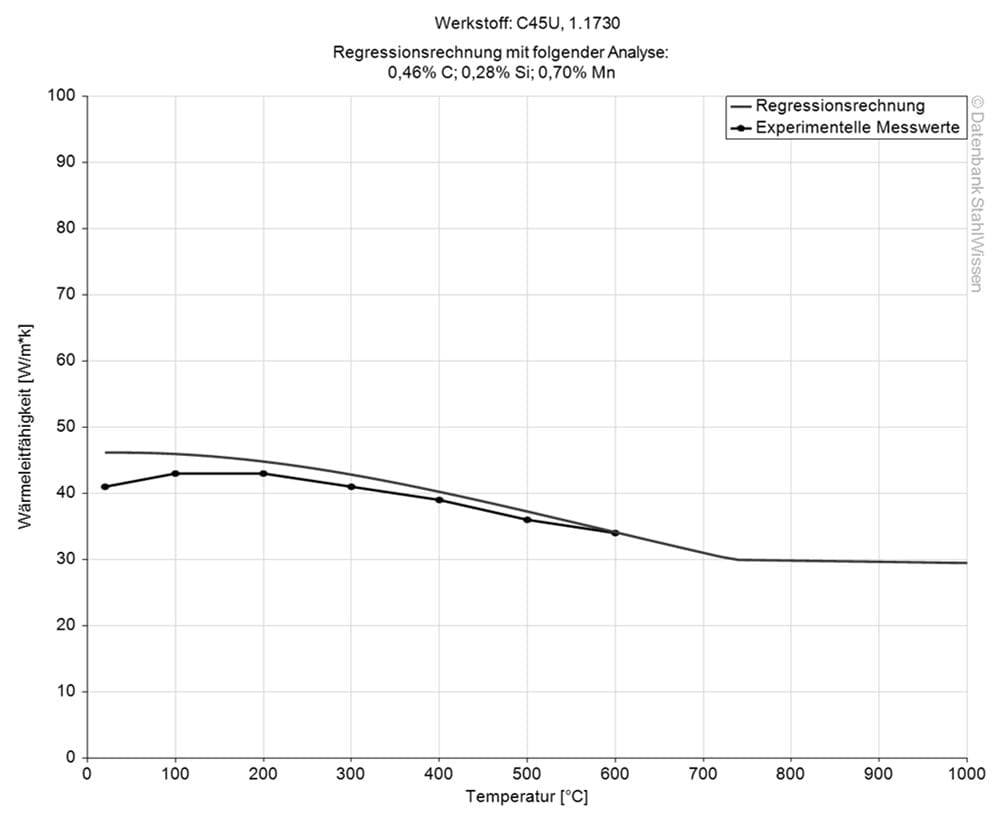
The heat conductivity for the 1.1730 at room temperature is at 44,9 W/m*K.
Heat conductivity
Value W/(m*K)
At a temperature of
44.9
20 °C
41.6
350 °C
1.1730 Thermal expansion coefficient
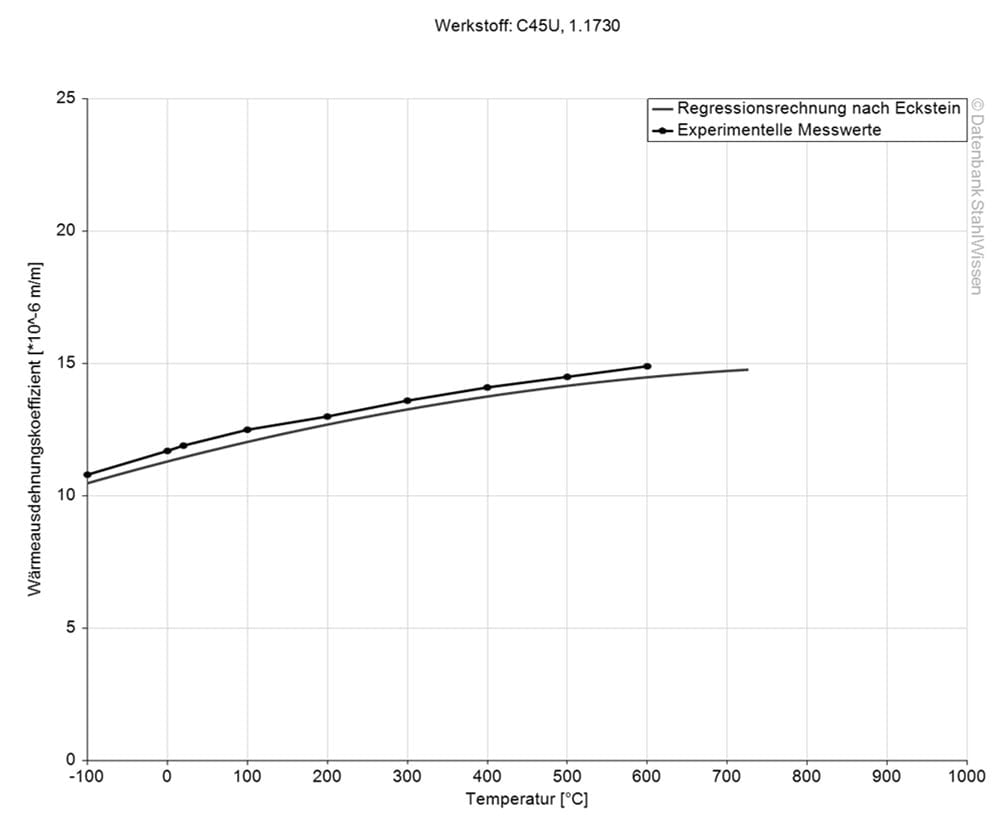
The following diagram shows how much the 1.1730 expands or contracts at changing temperatures. This information can be relevant when when components or parts are exposed to high temperatures or for applications with ever changing temperatures.
Medium thermal expansion coefficient
Value 10-6m/(m*K)
At a temeprature of
12.5
20 – 100 °C
13.0
20 – 200 °C
13.6
20 – 300 °C
14.1
20 – 400 °C
1.1730 Specific heat capacity
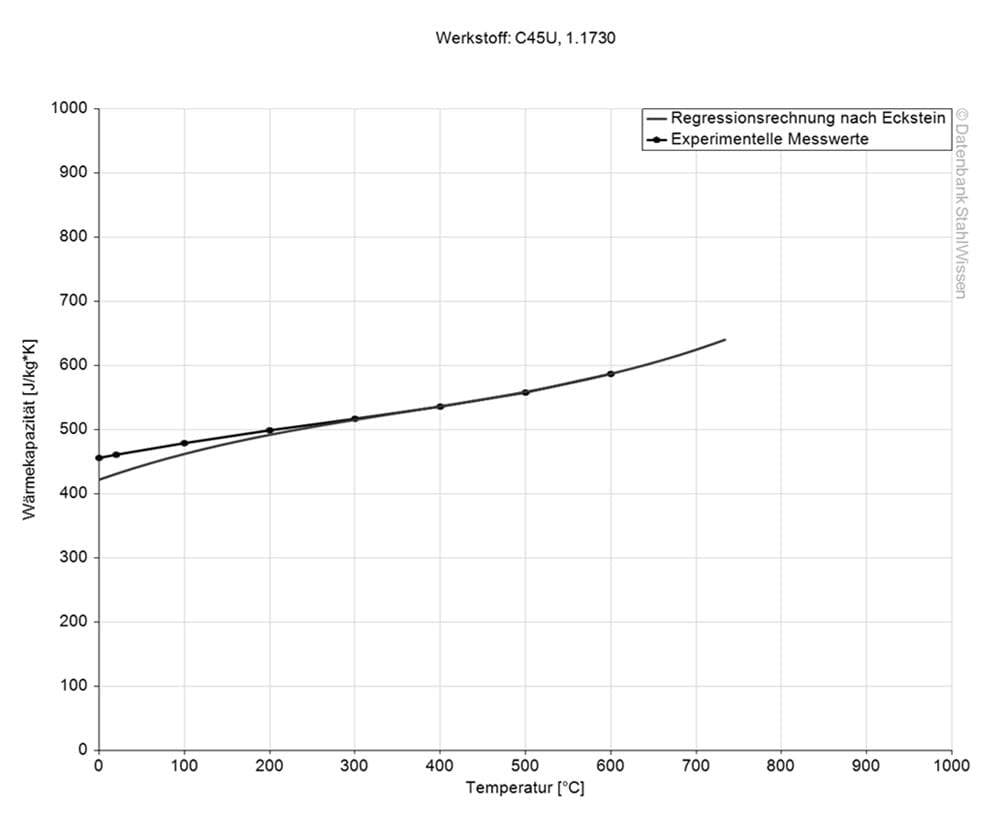
The specific heat capacity of the 1.1730 is at 0,486 J/g*K at room temperature.
This value shows how much heat is needed to heat a specific amount of material by 1 Kelvin.
1.1730 Specific electrical resistance
The following table shows the specific electrical resistance. Electrical conductivity is the reciprocal of electrical resistivity.
Table of the specific electrical resistivity
Value (Ohm*mm2)/m
At a temperature of
0.223
100 °C
FOR PREMIUM-CUSTOMERS!
1.1730 Procedure
1.1730 Heat treatment
The heat treatment determines the material properties and should be carried out with care. Properties such as strength, toughness, surface hardness and temperature resistance are determined, which in turn can extend/improve the service life of parts, tools and components.

Heat treatment includes solution heat treatment, soft annealing, normalising, stress-relief heat treatment, but also tempering, hardening and quenching.
1.1730 Annealing
This steel grade should be heated uniformly to a temperature of 700°C while being protected.
Afterwards it is cooled by 25°C per hour to a temperature of 600°C after which it can cool further in air.
1.1730 Stress relieving
The material is heated to a temperature of 650°C and held for 2 hours until it is fully and evenly heated trough. Then it is cooled in the oven to a temperature of 500°C after which it can be removed from the oven and further cool in the air.
1.1730 Normalising
The material is evenly heated to a temperature of 840 – 870°C after which it is cooled down in the air.
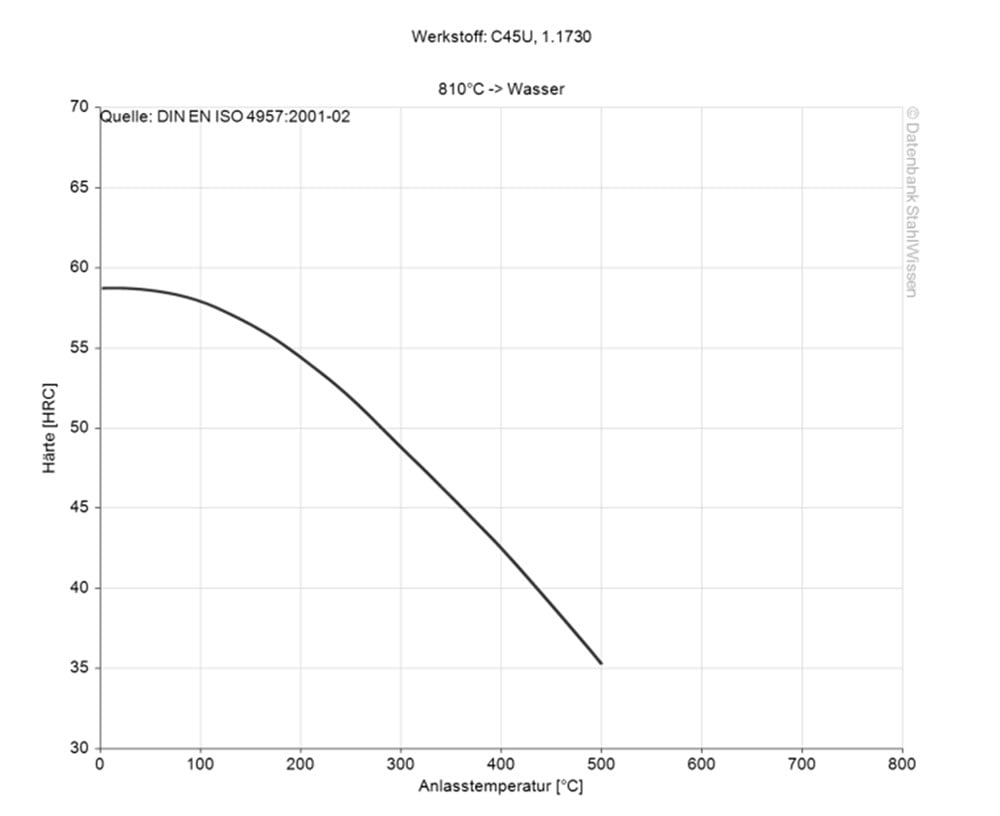
1.1730 Tempering
After hardening or quenching in oil or water, 1.1730 should be heated evenly to a temperature of 400–680 °C and held for approx. 1 hour per 25 mm thickness. To complete this process, the material is cooled in still air.


1.1730 Tempering temperature
The 1.1730 can be tempered in a temperature range of 400 – 680 °C. The temperature depends on the subsequent application for which the 1.1730 is to be used.
1.1730 Hardening
Preheat the material to a temperature of 650°C.
Austenitising temperature: The material is held at a temperature of 820-870 °C for 1 hour, or 10-15 minutes per 25 mm thickness. The material should be protected from decarburisation. Finally, the material is quenched in water or a salt solution.
Flame and induction hardening can be achieved by rapidly heating the material to the desired depth of hardening and then quenching it in oil or water. This is followed by tempering at 150–200 °C to reduce stresses without affecting the hardness.
1.1730 Quenching
The most used methodes of quenching for this cold work steel are:
- Water
- Oil
- Salt bath
1.1730 Sub-zero treatment
Although the advantages of a sub-zero treatment are greater for high-alloy steels, the 1.1730 can also benefit from it and improve its mechanical and physical properties.
After the initial heat treatment, the material is cooled to room temperature and then placed in a cooling chamber at -196 °C for approx. 24 hours. The material is then gradually reheated to room temperature.
When the 1.1730 has reached room temperature, it is recommended to subject it to a further tempering cycle at a temperature of 205 – 705 °C for at least one hour. Tempering relieves any stresses that may have arisen during deep-freezing and ensures that the new structure is stabilised.
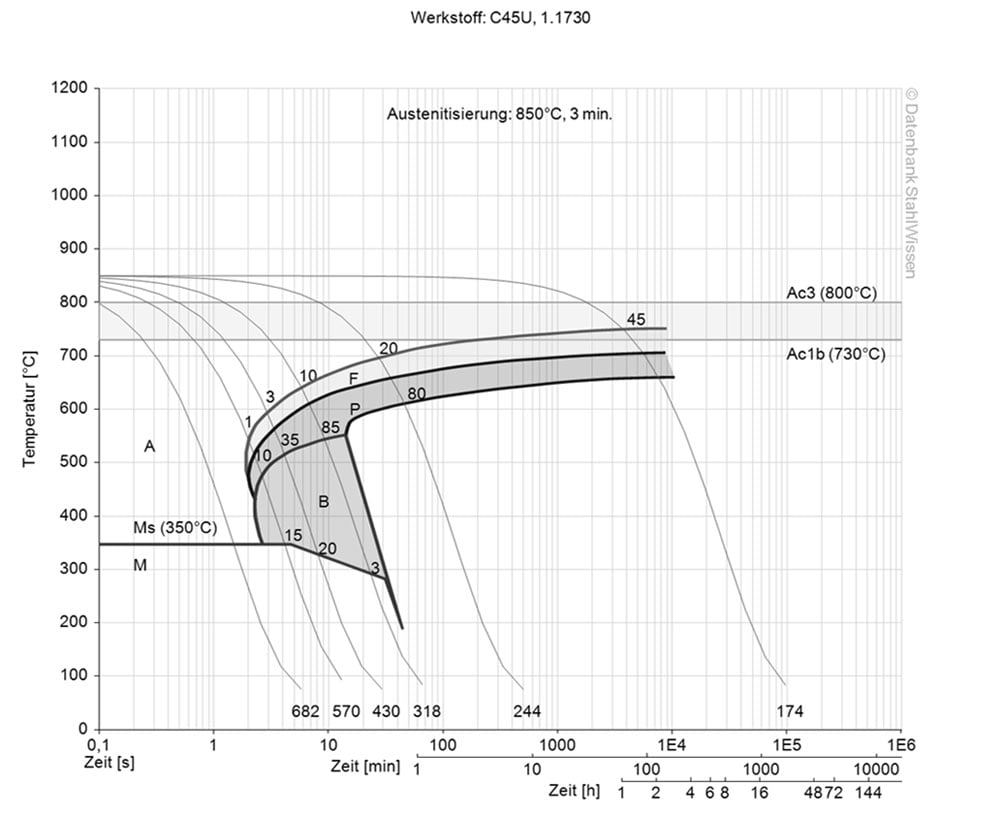
1.1730 Continuous TTT-diagram
The TTT-diagram usually shows micro-changes over time at different temperature . These are important in heat treatment as they provide information on the optimal conditions for processes such as hardening, annealing and normalising.
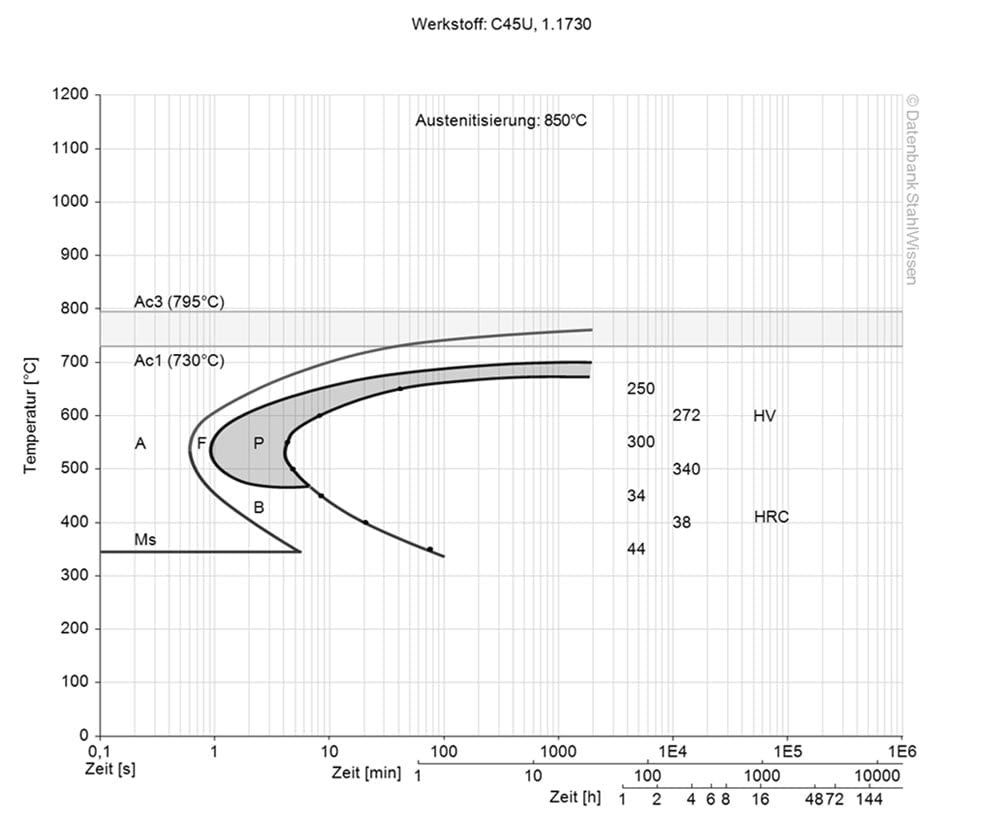
1.1730 Isothermal TTT-diagram
This diagram shows the structural changes at the micro level over time at a constant temperature. It shows at what temperature and after what time different phases, e.g. perlite, martensite or bainite, begin to form.
1.1730 Surface treatment
As this steel grade does not have the necessary alloys, 1.1730 is not suitable for nitriding.
1.1730 Processing
1.1730 Forging
1.1730 is very easy to forge and as such it is suitable for forging tool and machine parts.
Preheat the material evenly to a temperature of 750–800 °C, then increase the temperature to 1100–1200 °C and maintain it until the material is heated through evenly. The 1.1730 can then be forged and the finished pieces are cooled in the furnace. Forging at temperatures below 850 °C should be avoided.
1.1730 Welding
Welding of 1.1730 can be carried out using all conventional welding methods. Preheating and post-heating are necessary to prevent cracks.
The 1.1730 should be preheated to a temperature of 100–350 °C and this temperature should be maintained during welding. After welding, the 1.1730 should be cooled in sand or ash and then stress reliefed at a temperature of 550–660 °C.
Tool steel 1.1730 is best welded using low-hydrogen electrodes.