PREMIUM 1.2210 Steel
115CrV3

AISI / SAE L2 (Silver Steel)

PREMIUM 1.2210 Steel
115CrV3

115CrV3
PRS
-round-
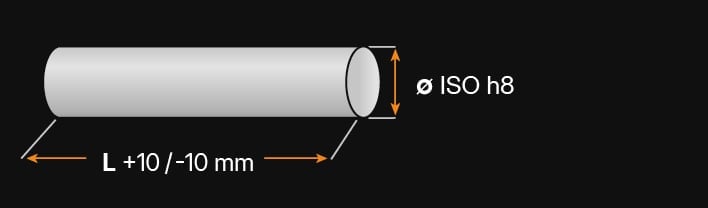
Toleranzen.png

1.2210  - AT A GLANCE

What kind of steel is the 1.2210?

The 1.2210, also kown as silver steel, is a cold work steel. As a chromium – vadium – steel this steel grade has good machinability, high hardness, edge retention, toughness and wear resistance and can be universally used.

Properties

Tool steel 1.2210 also know as silver steel or under its chemical discription 115CrV3 has a good combination of mechanical properties which finds its uses in many applications. This versatile steel grade can be used as a cold work steel across the board.

  • Tool steel
  • Cold work steel
  • Good machinability
  • High hardenability
  • High wear resistance
  • Nitriding, not usually done
  • EDM machining, not usually done
  • Generally used for round dies

Applications

Silver steel 1.2210 has a unique combination of hardness, wear resistance and toughness which make it possible to use it for tool making as well as mechanical engineering. This steel grade finds its uses in many applications, especially when precision and high mechanical stresses come into play.

  • Twist drills
  • Screw taps
  • Reamers
  • Milling custters
  • Countersinks
  • Centre drills
  • Scrapers
  • Engraving tools
  • Punches
  • Ejectors
  • Guide pins
  • Wood chisels
  • Bushes
  • Gauges
  • Jigs
  • Construction parts

PREMIUM 1.2210 Standard values

Chemical composition:

C Si Mn P S Cr V
1.1 - 1.25 0.15 - 0.3 0.2 - 0.4 0.0 - 0.03 0.0 - 0.03 0.5 - 0.8 0.07 - 0.12

Chemical designation:
115CrV3

Working hardness:
58-62 HRC

Delivery condition:
max. 220 HB

1.2210 Physical Properties

  • Tool steel
  • Cold work steel
  • Silver steel

A classic stainless steel has a mass fraction of a least 10,5 % chromium. The 1.2210 has a mass fraction of 0,5 – 0,8 % and is therfore not a classical stainless steel.

To have full corrosion resistance a steel has to have a minimum of 10,5 % chromium. The 1.2210 contains a maximum of 0,8 % which does not make it corrosion resistant.

As a ferro magnetic steel the 1.2210 is magnetisable which makes it possible to use magnetic clamping plates to machine this material.

Cold working makes this steel grade harder and more resistant, the cutting edge becomes harder, strength is increased, and dimensional accuracy and surface quality are improved. However, toughness is reduced and cold working generates internal stresses. Due to its positive properties during cold working, 1.2210 is suitable for springs and precision instruments, for example.

On a scale where 1 is low and 6 is high the 1.2210 receives a 4 for its wear resistance.

1.2210 Technical Properties

Yes, the 1.2201 can be used as a knife steel. Due to its carbon content it has a good hardness which give it the needed cutting edge and perfomance. The chromium and vanadium content give it its good wear resistance and edge stability. By regular maintenance, dry storage and oiling of the blades it is possible to keep rust at bay and expand the service life of knives made from this steel grade.

The 1.2210 can reach a working hardness of 58 – 62 HRC.

The typical density for tool steel 1.2210 at room temperature is at 7,8 g/cm3.

The 1.2210 has a tensile strength of approx. 750 N/mm2. To receive this value a tensile test is performed to show how much strength is needed in order to stretch or elongate a sample before it breaks.

On a scale where 1 is low and 6 is high the 1.2210 receives a 3 for its machinabilty.

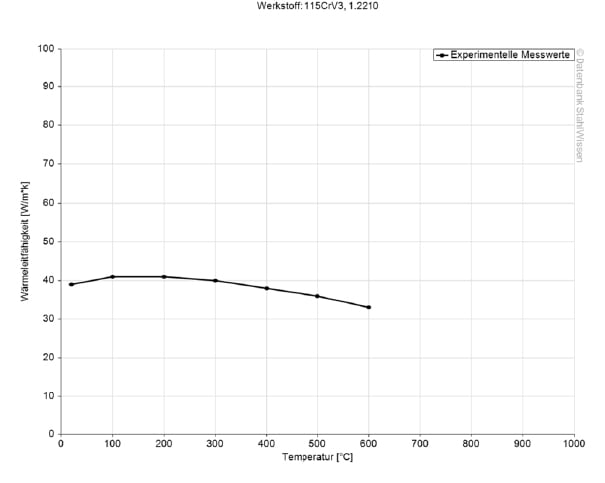
The following table shows the heat conductivity for tool steel 1.2210 at various temperatures.

Heat conductivity

Value (W/m*K)

At a temperature of

34.2

20 °C

32.6

350 °C

31.0

700 °C

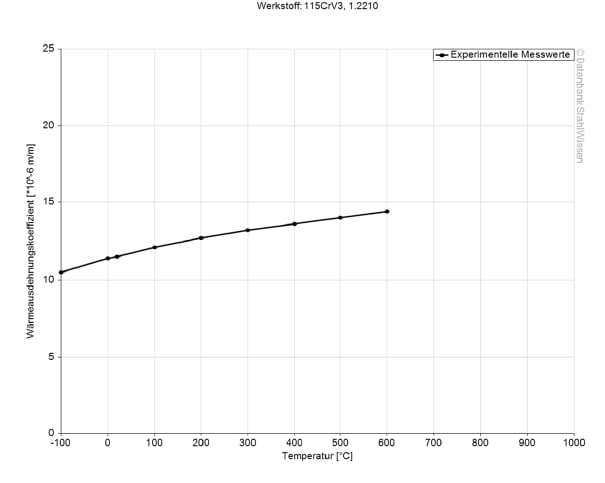
he thermal expansion coefficient shows by how much this steel expands or contracts at different tempeartures. This can be very important when working with high temperatures or rapidly changing temperatures.

Medium thermal expansion coefficient

10-6m/(m*K)

At a temperature of

10.0

20 – 100  °C

12.7

20 – 200 °C

13.7

20 – 300 °C

14.2

20 – 400 °C

14.9

20 – 500 °C

15.8

20 – 600 °C

16.8

20 – 700 °C

The specific heat capacity of tool steel 1.2210 at room temperature is 0.46 J/kg*K. This value indicates how much heat is required to heat a specific amount of material by 1 Kelvin.

The following table shows the specific electrical resistance. Electrical conductivity is the reciprocal of electrical resistivity.

Specific electrical resistance

Value (Ohm*mm²)/m

At a temperature of

0.33

20  °C

PRECISION ROUND STEEL WITHOUT MACHINING ALLOWANCE – ISO h8, h9, h11

1.2210 Procedure

The heat treatment determines the material properties and should be carried out with care. Properties such as strength, toughness, surface hardness and temperature resistance are determined, which in turn can extend/improve the service life of parts, tools and components.

Heat treatment includes solution heat treatment, soft annealing, normalising, stress-relief heat treatment, but also tempering, hardening and quenching.

To anneal the 1.2210 the material is heated evemly to a temperature of 710 – 750 °C and held. Afterwards the 1.2210 is cooled slowly in the furnace.

To release internal stresses which can be build up by machining or hardening processes the 1.2210 is heated evenly to a temperature of 650 – 680 °C and held at that temperature. To finish this process the material is cooled in the furnace.

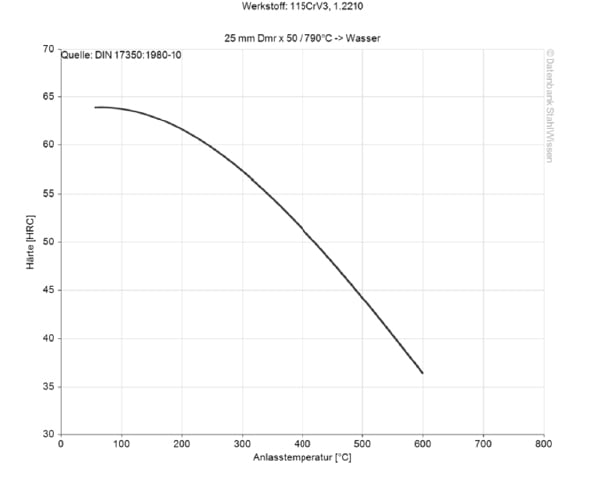
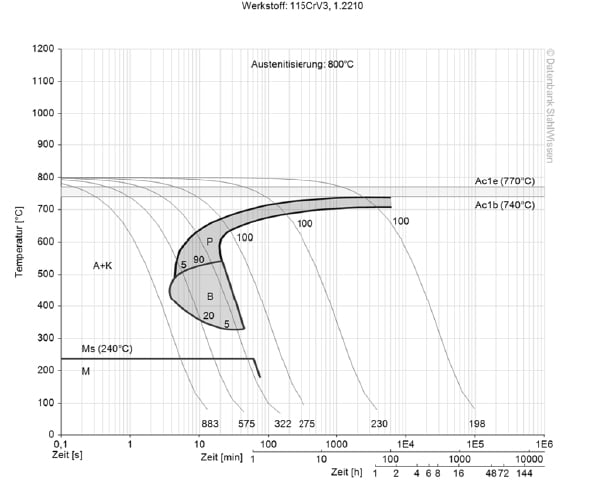
The temperature used for tempering depends on wanted hardness and properties.

Tempering releases inner stresses but also balances hardness and toughness out for this material.

More information in the following graphic:

To harden the 1.2210 it is heated evenly to a temperature of 780 – 840 °C.

Diameters up to 15 mm can be heated to a temperature of 780 – 840 °C and quenched in oil.

Diameters over 15 mm should be hardened at temperatures of 780 – 810 °C and can be quenched in water.

Silver steel 1.2210 can be quenched in the following media:

  • Oil, for ø < 15 mm
  • Water, for ø from 15 mm upwards


Diameters under 15 mm are quenched in oil to avoid dimensional changes and cracking when cooling to fast.

Water can be used for diameters from 15 mm to make sure the thicker material can cool through properly.

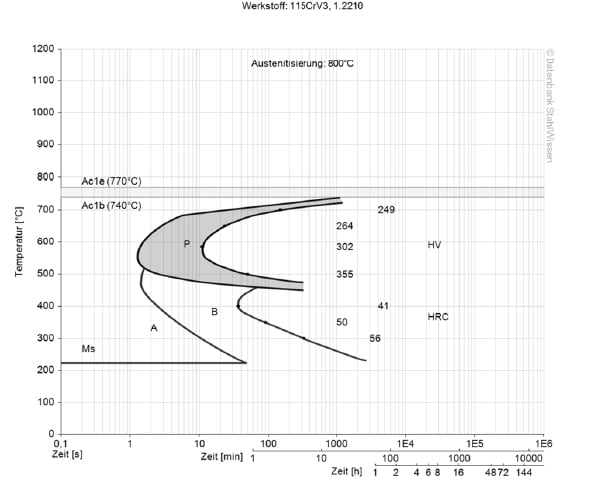
The TTT-diagram usually shows micro-changes over time at different temperature. These are important in heat treatment as they provide information on the optimal conditions for processes such as hardening, annealing and normalising.

This diagram shows the structural changes at micro level over time at a constant temperatur. It shows at which temperatures after what time the different phases like perlit, martensite or bainite start to form.

1.2210 Surface treatment

Nitriding of the 1.2210 is not usually done.

The 1.2210 is not usually hard chrome plated.

The 1.2210 is not usually polished.

1.2210 Processing

The 1.2210 is not usually EDMed.

In addition to preparing the 1.2210, precise temperature control and suitable post-treatment must be carried out to ensure that it has the required mechanical properties and quality.
The 1.2210 should be preheated evenly to a temperature of 800 – 900 °C to prevent cracks or thermal shock.

It is then heated to the forging temperature of 950 – 1050 °C. The forging temperature must not fall below 950 °C and the material should be brought back up to temperature as often as necessary. Finally, the workpieces are cooled slowly to minimise internal stresses and prevent distortion and cracking.

To remove internal stresses from the forged workpieces, create fine grain boundaries and give them the required hardness, they should be subjected to follow-up treatment.

Due to its high carbon content it is hard to weld this steel grade and should be done with proper preparation, suitable welding methods and consumables.

ALTERNATIVES

Are you looking for an alternative steel grade?

With the ABRAMS STEEL GUIDE®, you are able to obtain an alternative or equvelent with just a few clicks.

DATASHEET

Download the technical data sheet in PDF format here.

Messe.png

SERVICES

Do you require special dimensions?


Our services for you: water jet cutting, sawing, milling and grinding.

richtwerte-2.png

Standard values

Chemical designation: 115CrV3
Working hardness: 58-62 HRC
Delivery condition: maximum 220 HB
Chemical composition:
C Si Mn P S Cr V
1,1

1,25
0,15

0,3
0,2

0,4
0

0,03
0

0,03
0,5

0,8
0,07

0,12
Logo_Abrams_Ausrufezeichen.png
PRECISION ROUND STEEL WITHOUT MACHINING ALLOWANCE – ISO h8, h9, h11
technical-info.png

Technical properties

Cold work steel that can be used for a wide range of applications. Good machinability, high hardenability and wear resistance. Generally used for round dies.

anwendungen.png

Applications

Twist drills, screw taps, reamers, milling cutters, countersinks, centre drills, scrapers, engraving tools, punches, ejectors, guide pins, wood chisels, bushes, gauges, jigs, construction parts.

70 STEEL GRADES IN 33.895 DIMENSIONS

EX WORKS FROM OSNABRÜCK

DELIVERY IN 3-5 WORKING DAYS (SUBJECT TO AVAILABILITY)

WITHOUT MINIMUM ORDER VALUE OR QUANTITY

FROM EUROPE'S LARGEST RANGE OF SEMI-FINISHED PRODUCTS

SPECIAL CUSTOM DIMENSIONS SAWN - MILLED - GROUND

Select Your Country / Language

Do you have any questions?

If you have any comments or questions regarding ABRAMS PREMIUM STEEL® products or this website, please do not hesitate to contact us.

Please feel free to call us at any time:

+49 541/357 39-0

or send us an E-mail to:

[email protected]

If you have any comments or questions regarding ABRAMS PREMIUM STEEL® products or this website, please do not hesitate to contact us.

Please feel free to call us at any time: