1.2367 - AT A GLANCE
What kind of steel is the 1.2367?
1.2367 is a tool steel suitable for hot work. It has a high level of strength at high temperatures, and with good toughness, it is ideal for applications with mechanical stresses and impacts. 1.2367 has good resistance to wear, is resistant to thermal cracking and maintains its hardness even at high temperatures. All these properties make it suitable for applications with high stresses and ensure that it has a long service life.
Properties
With a good combination of mechanical properties and its ability to withstand high temperatures as well as its wear resistance the 1.2367 is a good choice for many applications.
- Tool steel
- Hot-working steel
- Good toughness
- Very good high-temperature strength
- High tempering resistance
- Good hardenability
- Low warping tendency
- Resistant to heat checking
- Can be water cooled
Applications
Tool steel 1.2367 has many good properties that make it suitable for use in a wide range of industries and for numerous applications.
- Forging dies
- Hot extrusion tools
- Pressure casting tools
- Press punches
- Press mandrels
- Intermediate sleeves
- Die holders
- Profile dies
- Profile mandrels
- Ingot holders
- Hot shearing blades
- Light metal processing
- Plastic moulds
1.2379 STANDARD VALUES
Chemical composition:
| C | Si | Mn | P | S | Cr | Mo | V |
|---|---|---|---|---|---|---|---|
| 0.35 - 0.4 | 0.3 - 0.5 | 0.3 - 0.5 | 0.0 - 0.03 | 0.0 - 0.02 | 4.8 - 5.2 | 2.7 - 3.2 | 0.4 - 0.6 |
Chemical designation:
X38CrMoV5-3
Working hardness:
50-54 HRC
Delivery condition:
max. 229 HB
1.2367 Physical Properties
What group of steel does the 1.2367 belong to?
- Tool steel
- Plastic mould steel
- Hot work steel
Is the 1.2367 a stainless steel?
In the classical sence the 1.2367 is not a stainless steel. To be classified as stainless steel a steel has to have a chromium content of at least 10.5 %. The 1.2367 has a chromium content of 4.8 – 5.2 %.
1.2367 Corrosion resistance
Although 1.2367 exhibits a certain degree of corrosion resistance, it is not corrosion-resistant. To be corrosion-resistant, the chromium content in a steel grade must be at least 10.5 %.
Is the 1.2367 magnetisable?
As a ferrous metal, 1.2367 can be magnetised. For example grinding, milling and eroding can be carried out on machines with magnetic adhesion.
1.2367 Hot work
The 1.2367 can withstand thermal and mechanical stresses. Thanks to its good heat resistance and high tempering resistance, it retains its mechanical properties even at high operating temperatures. As a hot-work steel, the 1.2367 can also withstand rapid temperature changes without cracking, for example, and can dissipate heat well thanks to its good thermal conductivity.
1.2367 Wear resistance
Material grade 1.2367 is rated 5 for its wear resistance on a scale of 1 (low) to 6 (high).
1.2367 Technical Properties
Is the 1.2367 a knife steel?
A knife steel is characterised by a good combination of hardness, toughness, corrosion resistance and the ability to be easily reground.
1.2367 was developed for the use as a hot-work steel and has some properties that a knife steel should also have, such as high hardness and good toughness. However, these properties have been optimised for the hot work in this grade, which means that 1.2367 is not a suitable knife steel.
1.2367 Working hardness
The 1.2367 achieves a working hardness of 50 – 54 HRC.
1.2367 Density
The typical density for the tool steel 1.2367 is 7,9 g/cm3 at room temperature.
1.2367 Tensile strength
The tensile strength for the 1.2367 ia approx. 770 N/mm2. To reach this value, a tensile test is performed which shows how much force is needed to elongate or stretch this material before it breaks.
1.2367 Machinability
On a scale where 1 is low and 6 is high, 1.2367 receives a 4 for its machinability.
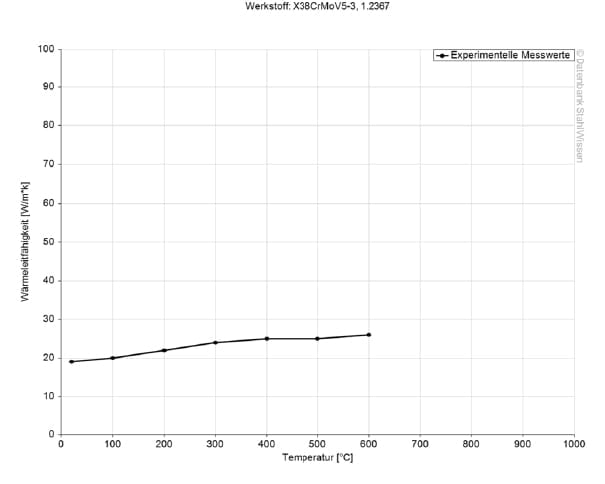
1.2367 Heat conductivity
The following table shows the thermal conductivity of tool steel 1.2367 at different temperatures.
Heat conductivity
Value anneled W/(m*K)
Value tempered W/(m*K)
At a temperature of
30.8
29.8
20 °C
33.5
33.9
350 °C
35.1
35.3
700 °C
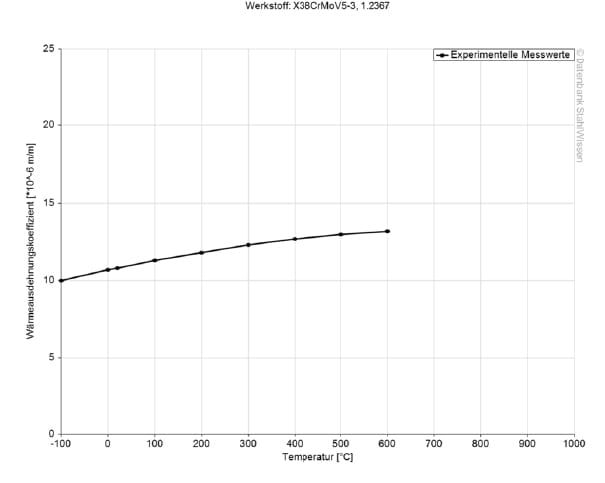
1.2367 Thermal expansion coefficient
The thermal expansion coefficient shows how much a material expands or contracts at temperature changes. This information can very important when working with high temperatures or during applications with stark temperature changes during an application.
Medium thermal expansion coefficient
Value 10-6m/(m*K)
At a temperautre of
11.9
20 – 100 °C
12.5
20 – 200 °C
12.6
20 – 300 °C
12.8
20 – 400 °C
13.1
20 – 500 °C
13.3
20 – 600 °C
13.5
20 – 700 °C
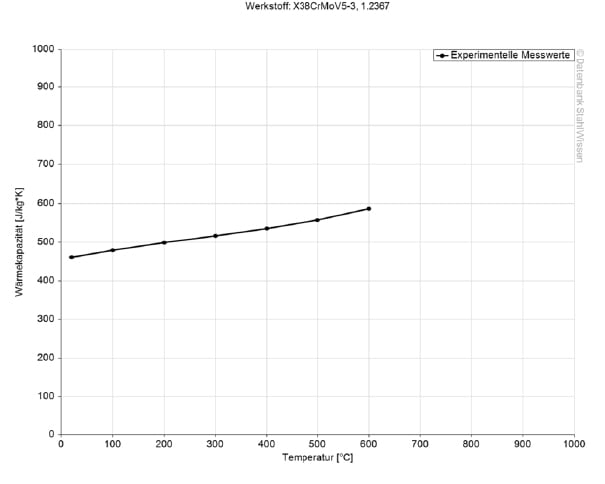
1.2367 Specific heat capacity
The specific heat capacity of tool steel 1.2367 at room temperature is 0.46 J/g*K. This value indicates how much heat is required to heat a specific amount of material by 1 Kelvin.
1.2367 Specific electrical resistance
The specific electrical resistance can be found in the following table. Electrical conductivity is the reciprocal of specific electrical resistance.
Specific electrical resistance
Value (Ohm*mm2)/m
At a temperature of
0.5
20 °C
STEEL MADE WITH ”STYLE“ !
1.2367 Procedure
1.2367 Heat treatment
The heat treatment is used to determine material properties. It should therefore always be carried out with care. Properties such as strength, toughness, surface hardness and temperature resistance are determined, which in turn can extend/improve the service life of parts, tools and components.Heat treatment includes solution annealing, soft annealing, normalising, stress relief annealing, but also tempering, hardening and quenching or tempering.
Heat treatment includes solution heat treatment, soft annealing, normalising, stress-relief heat treatment, but also tempering, hardening and quenching.
1.2367 Annealing
To anneal the material 1.2367 it is heated evenly to a temperature of 730–780 °C. It is kept at this temperature for 6–8 hours and then cooled in the furnace by approx. 20 °C to 600 °C. The material can then be left to cool further in the air.
1.2367 Stress relieving
After the initial processing of the workpiece it is heated evenly to a temperature of 600 – 650°C and held in a nutural atmosphere 2 – 6 hours. Afterwards they are left to cool down in the oven.
1.2367 Tempering
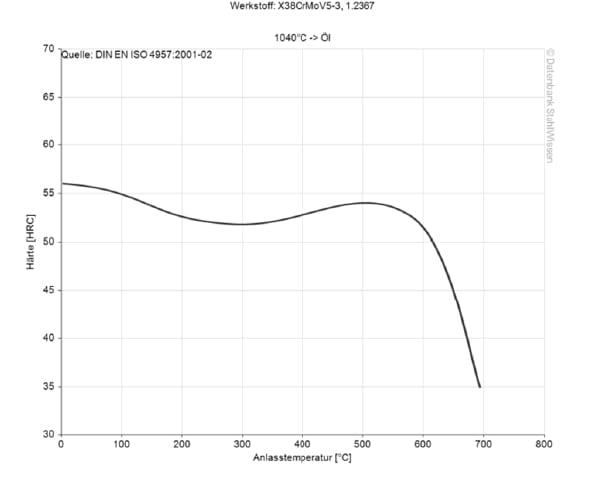
For tempering, the workpieces are heated evenly to the desired tempering temperature and held there for 1 hour per 25 mm, but for at least 2 hours. It is recommended to carry out at least 2 tempering processes, with a third to relax the workpiece at approx. 50 °C below the highest tempering temperature. For more information, please refer to our tempering diagram.
1.2367 Hardening
For hardening, the 1.2367 material is heated evenly to a temperature of 1020 – 1050 °C and held for approx. 15 – 30 minutes. The material is then quenched as follows.
1.2367 Quenching
The 1.2367 can be quenched in the following media. The mechanical properties and microstructure that the material should achieve must be taken into account, and the quenching medium should be selected accordingly.
- Air
- Oil
- Hot bath (500 – 550 °C)
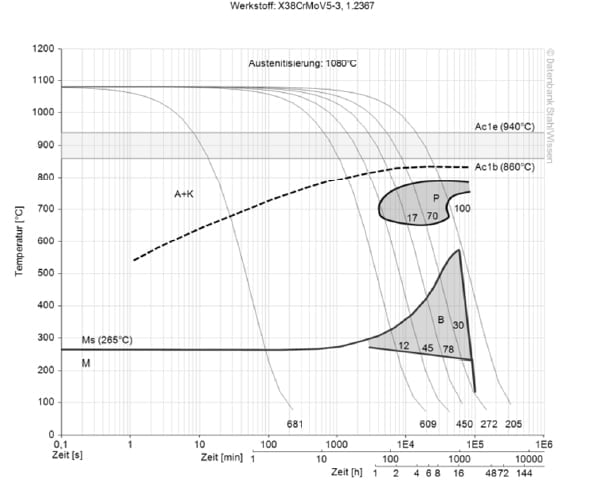
1.2367 Continuous TTT-diagram
This diagram shows the micro changes at different temperatures which are important during heat treatment. They show the optimum condition for the hardening, annealing and normalizing process.
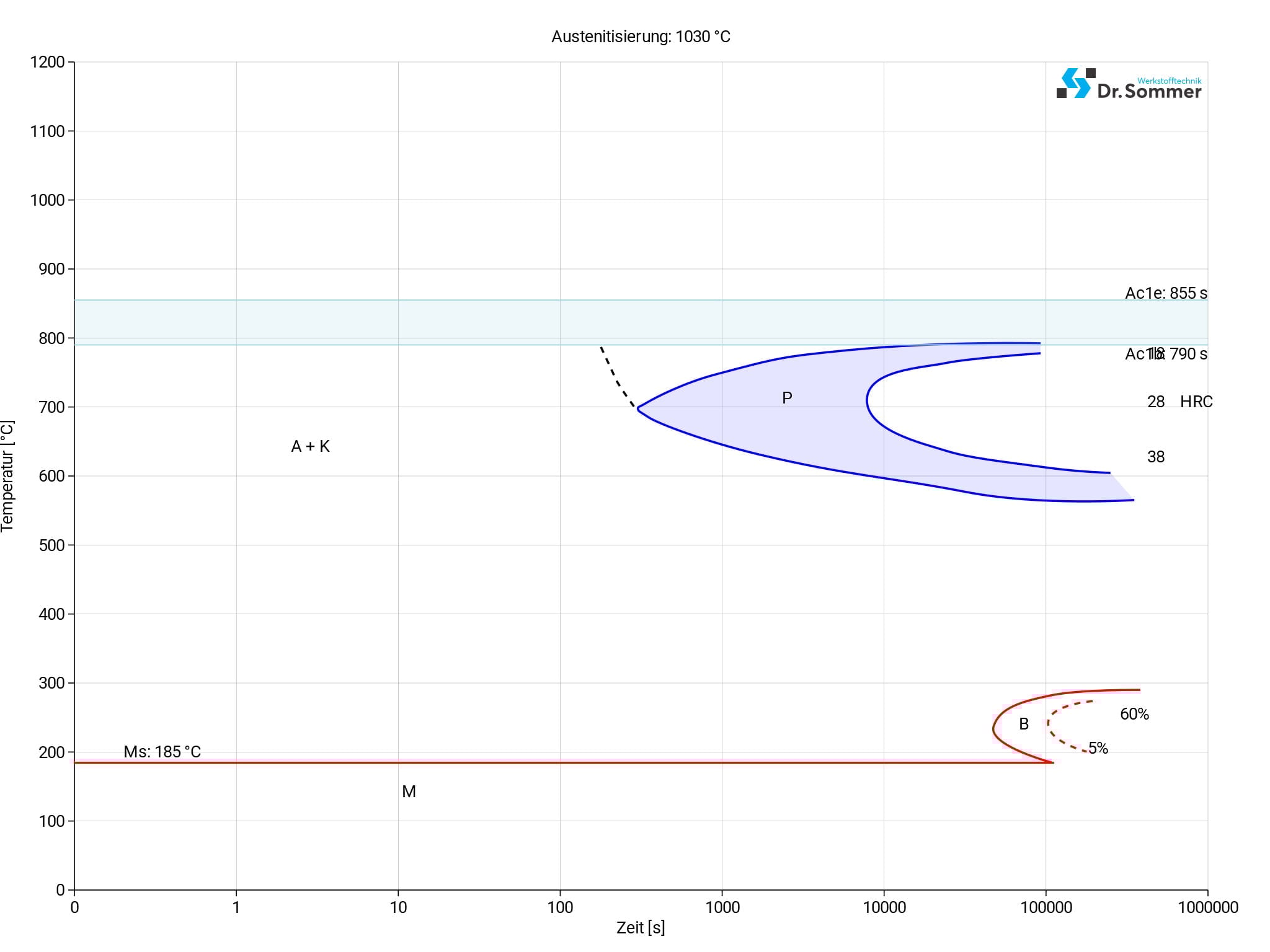
1.2367 Isothermal TTT-diagram
This diagram shows the structural changes at micro level over time at a constant temperature. It shows at what temperature and after what time different phases, e.g., perlite, martensite or bainite start to build.
1.2367 Surface Treatment
The choice of surface treatment depends on the requirements, the environment in which the workpieces/tools are used, the required properties and the expected loads. Below are a few examples of possible surface treatments.

1.2367 Nitriding
The introduction of nitrogen into the material surface creates a hard and wear-resistant layer that increases wear resistance and service life. The thickness of the nitriding layer should be carefully considered to suit the respective application.
1.2367 Carbonitriding
In this process, both nitrogen and carbon are introduced into the surface layer to improve surface hardness, wear resistance and resistance to softening at high temperatures.

1.2367 PVD
With PVD (Physical Vapor Deposition), a thin layer is applied to the material surface to provide additional protection and improve wear resistance and lubricity.

1.2367 Hard chrome plating
During this process, a thin layers of chrome is applied to the base material. Depending on the level of stress, the chrome layer can be applied thicker or thinner. The applied layer serves as extra protection against wear.
1.2367 Processing
1.2367 Electrical Discharge Machining (EDM)
Eroding can be used to achieve various surface finishes, but it is mainly used to produce complicated shapes, small details and complex geometries in hard materials. The material 1.2367 can also be used successfully for eroding. When selecting the electrodes, the dielectric fluid and the cutting speed, the surface quality and the subsequent application should be taken into account.
1.2367 Machining allowance / dimensional changes
As with all metals, 1.2367 expands when heated and contracts when cooled. Controlled heating during the hardening and tempering process, as well as during the cooling phase, can minimise deformation and other dimensional changes. In addition, the reduction of stresses and/or dimensional changes by incorporating tolerances into the dimensions should be considered.
1.2367 Forging
The 1.2367 is heated evenly to a temperature of approx. 1100 °C. The temperature should not fall below 900 °C to prevent damages such as cracks.
Following forging, a heat treatment should be considered to reduce residual stresses.
1.2367 Welding
1.2367 can be welded using the correct procedures, preparation and post-treatment.
Before welding this material, ensure that the surface is free of contaminants such as grease, oil or rust.
To minimise stresses, the material should be preheated, the welding consumables should be similar to the base material and post-weld heat treatment should be carried out. After welding, the material should be checked for cracks and other defects to ensure that components can continue to be used safely after welding.