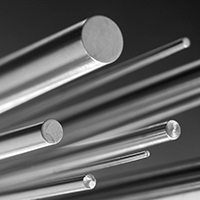
PREMIUM 1.2436 Steel
X210CrW12

AISI / SAE D6

PREMIUM 1.2436 Steel
X210CrW12

X210CrW12
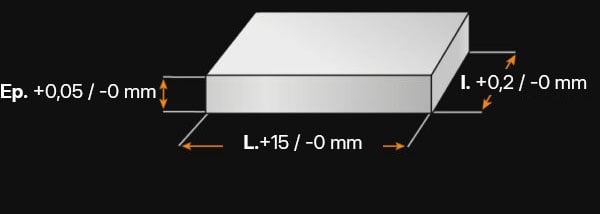
PFS
-flat-
Toleranzen.png
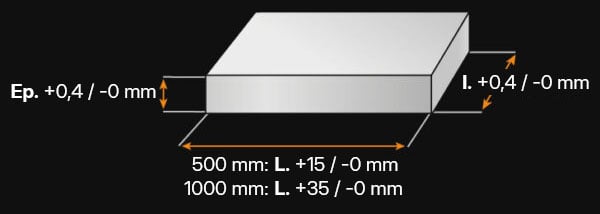
PFS/BA
-flat-
Toleranzen.png
Hart-Präz®
-flat-
Toleranzen.png
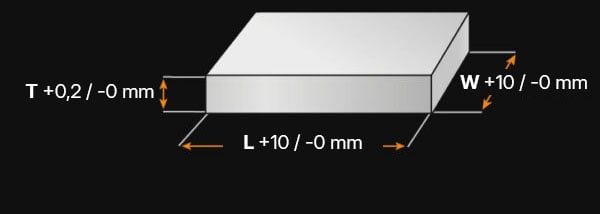
PRS/BA
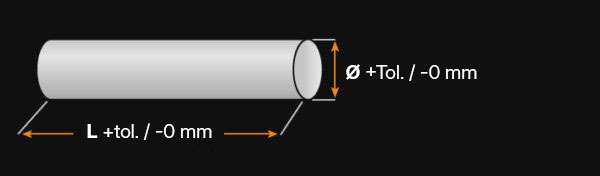
-round-
Toleranzen.png

1.2436  - AT A GLANCE

What kind of steel is the 1.2436?

The material 1.2436 is a ledeburitic, 12% chromium steel with 0.7% tungsten. Its exceptional properties include high cutting durability, dimensional accuracy, tempering and wear resistance, as well as high hardness. These properties make it possible to use 1.2436 in many different industries.

Properties

This cold-work steel features high cutting durability for sheet metal cuts up to 4 mm thick and very low dimensional change despite its high hardness.

  • Cold work tool steel
  • Ledeburit
  • High hardness
  • Good dimensional accuracy
  • High tempering resistance compared to 1.2080 mod.
  • High wear resistance compared to 1.2080 mod.
  • High tempering resistance due to its tungsten content
  • Nitriding is not common

Applications

The corrosion-resistant tool steel 1.2436 is used in many industries. Thanks to its high wear resistance, edge retention and high hardness, it can be used in numerous applications.

  • Cutting tools
  • Punching tools
  • Stamping tools
  • Scraping tools
  • Rework tools
  • Deburring tools
  • Woodworking tools
  • Drawing tools
  • Pressing tools
  • Stone pressing moulds
  • Sintering tools
  • Machine knives
  • Knife jaws
  • Hammer cores
  • Ring rolling dies
  • Thread rolling rollers
  • Plastic mould

1.2436 Standard values

Chemical composition:

C Si Mn P S Cr W
2.0 - 2.3 0.1 - 0.4 0.3 - 0.6 0.0 - 0.03 0.0 - 0.03 11.0 - 13.0 0.6 - 0.8

Chemical designation:
X210CrW12

Working hardness:
59-63 HRC

Delivery condition:
max. 255 HB

1.2436 Physical properties

  • Tool steel
  • Cold work steel

With a mass fraction of 11 – 13 % chromium the 1.2436 can be classified as a stainless steel. To be classified as classic stainless steel, a steel grade must contain a minimum of 10.5% chromium.

Steel is corrosion-resistant when it contains at least 10.5% chromium by mass. With a chromium content of 11–13%, 1.2436 is therefore corrosion-resistant.

Yes, 1.2436 is ferromagnetic and can be clamped to a magnetic plate for machining.

Its high carbon and chromium content gives 1.2436 high hardness after heat treatment. This property gives it wear resistance during cold forming. To counteract sudden loads during cold working, this material also has toughness and compressive strength that are useful for tools exposed to such loads, for example.

The 1.2436 tool steel’s wear resistance comes in at 6 on a scale where 1 is low and 6 is high.

1.2436 Technical Properties

As a steel with a high hardness, edge retention and wear resistance the 1.2436 can be used as a knife steel for example for industrial, punching and forming knives.

This steel grade has a good corrosion resistance which can be enhanced even further with a good and regular maintenance.

Due to its hardness and to guarantee a lasting cutting edge the right abrasive materials should to be used.

The 1.2436 can reach a working hardness of 59 -63 HRC.

The typical density at room temperature for the 1.2436 is at 7,7 g/cm3.

The tensile strength for the 1.2436 ia approx. 860 N/mm2. To reach this value, a tensile test is performed which shows how much force is needed to elongate or stretch this material before it breaks.

On a scale where 1 is low and six is high the 1.2436 gets a 1 for its machinability.

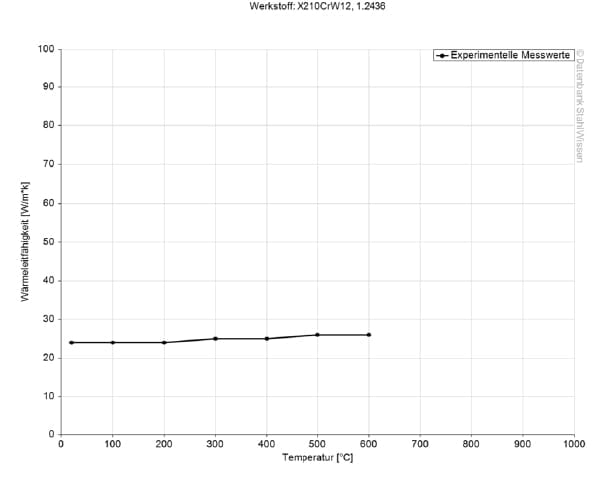
The following table shows the heat conductivity of 1.2436 at various temperatures.

Heat conductivity

Value (W/m*K)

At a temeprature of

16.7

20 °C

20.5

350 °C

24.2

700 °C

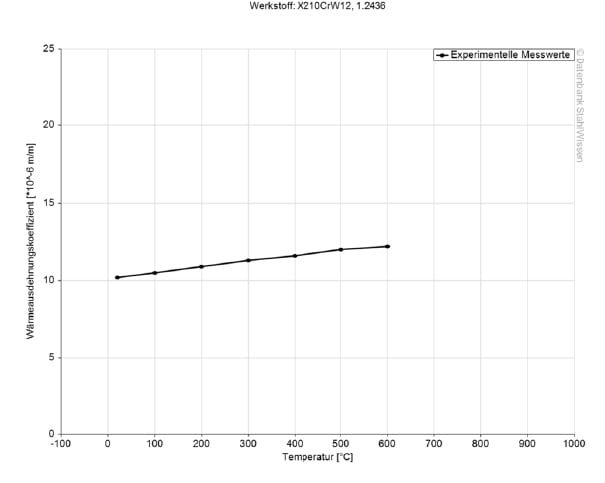
The thermal expansion coefficient shows how much a material expands or contracts at any temperature changes. This information can be relevant when when components or parts are exposed to high temperatures or for applications with ever changing temperatures.

Medium thermal expansion coefficient

10-6m/(m*K)

 At a temeprature of

10.9

20 – 100  °C

11.9

20 – 200 °C

12.3

20 – 300 °C

12.6

20 – 400 °C

12.9

20 – 500 °C

13.0

20 – 600 °C

13.2

20 – 700 °C

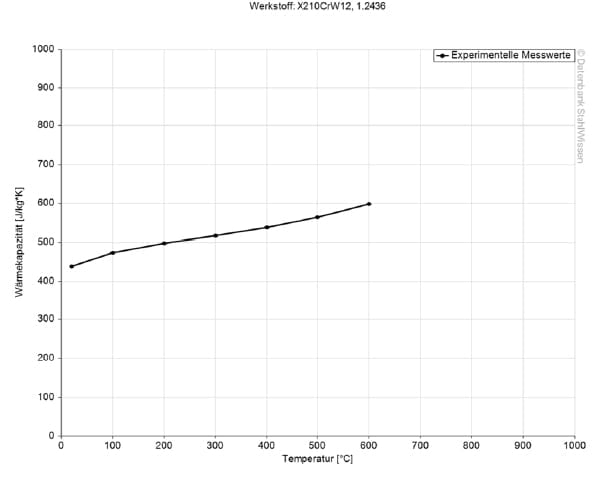
The specific heat capacity of 1.2436 at room temperature is 0.46 J/g • K. This value indicates how much heat is required to heat a specific amount of material by 1 Kelvin

The specific electrical resistance can be found in the following table. Electrical conductivity is the reciprocal of specific electrical resistance.

Table of the specific electrical resistivity

Value (Ohm*mm²)/m

At a temperature of

0.65

20  °C

ON REQUEST – SAWN – MILLED – GROUND!

1.2436 Procedure

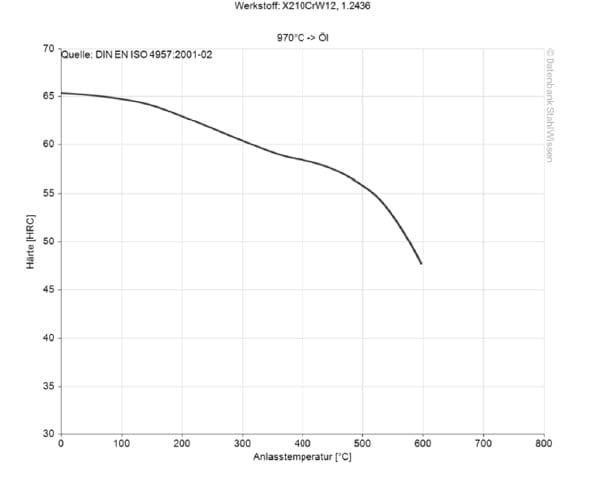
The heat treatment determines the material properties and should be carried out with care. Properties such as strength, toughness, surface hardness and temperature resistance are determined, which in turn can extend/improve the service life of parts, tools and components.
Heat treatment includes solution heat treatment, soft annealing, normalising, stress-relief heat treatment, but also tempering, hardening and quenching.

Evenly heat the workpieces to a temperature range of 800 – 840°C and soak at that temperature. To finish this process of cool the pieces by 20°C per hour down to 600°C. Further cooling them in the air.

Heat the work pieces evenly to a temperature of 650 – 700 °C after machining to stress relive them. Then cool them in the furnace.

To achieve a wide range of hardness values and mechanical properties, heat the workpieces to a temperature range of 160–300 °C and then cool them in still air.

To harden heat the 1.2436 evenly to a temperature of 950 – 980 °C and soak for approx. 15 – 30 min. and quench after.

The 1.2436 can be quenched in the following media:

  • Air
  • Oil
  • Hot basin at a temperature of 500 – 550°C

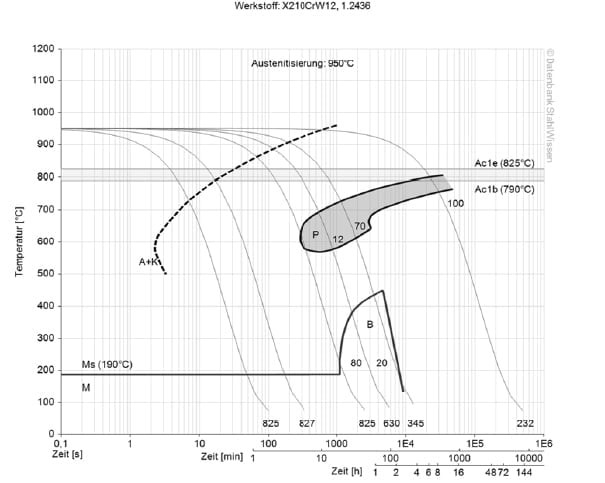
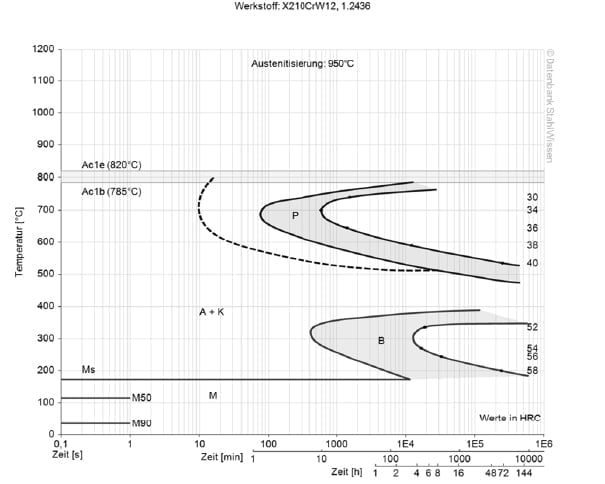
The TTT-diagram usually shows micro-changes over time at different temperature . These are important in heat treatment as they provide information on the optimal conditions for processes such as hardening, annealing and normalising.

This diagram shows the structural changes at micro level over time at a constant temperatur. It shows at which temperatures after what time the different phases like perlit, martensite or bainite start to form.

1.2436 Surface treatment

In general, polishing is a type of surface treatment that can increase corrosion resistance, for example, but also creates an attractive appearance.

Another type of surface treatment is coating or hardening the surface. To name just a few, the surface can be nitrided, carburised, hard chrome-plated or treated with CVP or PVD processes to give it greater hardness.

1.2436 Processing

In general, a material is eroded to produce workpieces from a single piece. Erosion can be used to produce dies or more complex shapes. There are various methods of eroding different materials, such as wire erosion, spark erosion or sink erosion.

As with all metals, 1.2436 expands when heated and contracts when cooled. Controlled heating during the hardening and tempering process, as well as during the cooling phase, can minimise deformation and other dimensional changes. Furthermore, the reduction of stresses and/or dimensional changes by adding tolerances to the dimensions should be considered.

The 1.2436 is heated evenly to a temperature of approx. 1050 to 1150 °C and then forged. To prevent embrittlement and cracks, the temperature of the workpieces should not fall below 850 °C. When necessary, the workpieces are reheated to the forging temperature.

Finally, the parts are slowly cooled to avoid stresses and associated cracks. Slow cooling can take place in the furnace or in a medium that guarantees slow cooling.

To relieve any internal stresses, the material can be treated as described in the section ‘Stress relieving’.
A heat treatment to achieve the desired mechanical properties is the final step in the forging process.

ALTERNATIVES

Are you looking for an alternative steel grade?

With the ABRAMS STEEL GUIDE®, you are able to obtain an alternative or equvelent with just a few clicks.

DATASHEET

Download the technical data sheet in PDF format here.

Messe.png

SERVICES

Do you require special dimensions?


Our services for you: water jet cutting, sawing, milling and grinding.

richtwerte-2.png

Standard values

Chemical designation: X210CrW12
Working hardness: 59-63 HRC
Delivery condition: maximum 255 HB
Chemical composition:
C Si Mn P S Cr W
2,0

2,3
0,1

0,4
0,3

0,6
0

0,03
0

0,03
11,0

13,0
0,6

0,8
Logo_Abrams_Ausrufezeichen.png
ON REQUEST – SAWN – MILLED – GROUND!
technical-info.png

Technical properties

Cold work steel with maximum wear resistance and cutting power (for plates: thickness up to 4 mm). Full hardenability, good dimensional stability, but medium toughness. Due to its tungsten content this steel grade has a higher tempering resistance and higher wear permanence compared to AISI / SAE 3 mod.

anwendungen.png

Applications

Blanking tools, stamping tools, embossing tools, scraping tools, trimming tools, woodworking tools, drawing tools, press tools, stone moulds, sintered tools, machine knives, hammer cores, ring rollers, thread rolling dies, plastic moulds.

70 STEEL GRADES IN 33.895 DIMENSIONS

EX WORKS FROM OSNABRÜCK

DELIVERY IN 3-5 WORKING DAYS (SUBJECT TO AVAILABILITY)

WITHOUT MINIMUM ORDER VALUE OR QUANTITY

FROM EUROPE'S LARGEST RANGE OF SEMI-FINISHED PRODUCTS

SPECIAL CUSTOM DIMENSIONS SAWN - MILLED - GROUND

Select Your Country / Language

Do you have any questions?

If you have any comments or questions regarding ABRAMS PREMIUM STEEL® products or this website, please do not hesitate to contact us.

Please feel free to call us at any time:

+49 541/357 39-0

or send us an E-mail to:

[email protected]

If you have any comments or questions regarding ABRAMS PREMIUM STEEL® products or this website, please do not hesitate to contact us.

Please feel free to call us at any time: