PREMIUM 1.2550 Steel
60WCrV8

AISI / SAE S1

PREMIUM 1.2550 Steel
60WCrV8

60WCrV8
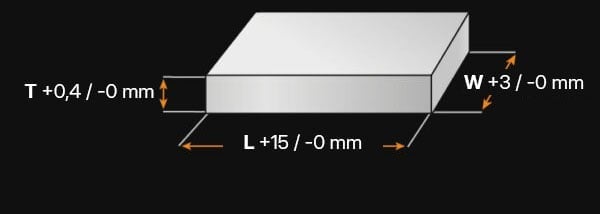
€co-Präz® [€co/BA]
-flat-
Toleranzen-1.png
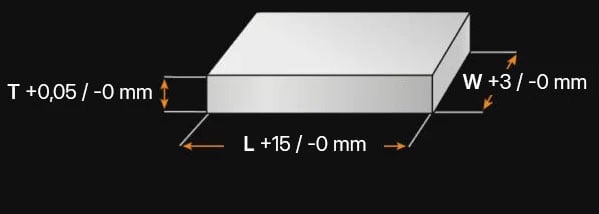
€co-Präz® [€co]
-flat-
Toleranzen-1.png
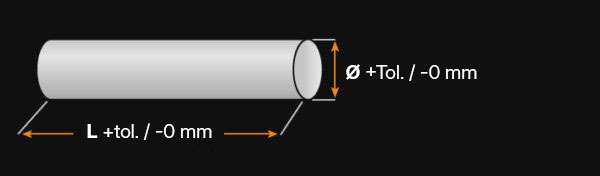
PRS/BA
-round-
Toleranzen.png

1.2550  - AT A GLANCE

What kind of steel is the 1.2550?

1.2550 steel is a tool steel with good dimensional stability, toughness and wear resistance. It has a microstructure that resists deformation when in a tempered state, making it a reliable choice for tools that have to withstand high loads. The steel grade (with a focus on cold work) has a high hardness and impact strength.

Properties

The 1.2550 has advantages and disadvantages that should be taken into account when selecting a steel for certain applications and its specific properties.

Practically, this means:

  • Impact resistant
  • Robust
  • Good wear resistance
  • Good heat resistance
  • Can be nitrided
  • Not corrosion resistant
  • Difficult to machine in hardened condition
  • Certain properties can only be achieved with a precise heat treatment process
  • Working hardness is 56 – 60 HRC

Applications

1.2550 is used for high-impact tools such as punching dies or extrusion dies. This involves applying a great deal of pressure to push the material through a die to create complex shapes. 1.2550 can be used for woodworking tools such as carving tools; particularly for hardwood tools.

  • Cutting tools
  • Dies
  • Punches
  • Cold punching tools
  • Forming tools
  • Stamping tools
  • Coining tools
  • Tabletting punches
  • Insert tools
  • Deburring tools
  • Cold shear blades
  • Riveting pins
  • Hand chisels
  • Pneumatic chisels
  • Centre punches
  • Ejectors
  • Woodworking tools
  • Cold forming tools
  • Forging dies

1.2550 Standard values

Chemical composition:

C Si Mn P S Cr V W
0.55 - 0.65 0.7 - 1.0 0.15 - 0.45 0.0 - 0.03 0.0 - 0.03 0.9 - 1.2 0.1 - 0.2 1.7 - 2.2

Chemical designation:
60WCrV8

Working hardness:
56-60 HRC

Delivery condition:
max. 229 HB

1.2550 Physical Properties

  • Tool steel
  • Cold work steel

To be classified as stainless steel, the steel must have a mass fraction of at least 10.5% chromium. 1.2550 has a chromium content of 0.9–1.2% and is therefore not stainless steel.

Although 1.2550 has a certain degree of corrosion resistance, it is not corrosion-resistant in the classic sense like stainless steel. 1.2550 can corrode when exposed to moisture, chemicals and corrosive environments.

Regular maintenance and dry storage of the tools help to extend their service life. Oiling or otherwise coating the material with a protective layer can protect it from moisture or corrosive environments.

Yes, as a ferromagnetic metal, 1.2550 is magnetisable. Grinding, milling and eroding can be carried out on machines with magnetic adhesion, for example.

The 1.2550 can be shaped, cut and formed at temperatures close to room temperature, for example for use as punching tools, stamps, cold forming tools or shear blades.

The wear resistance of 1.2550 is rated at 3 on a scale, where 1 is low and 6 is high.

1.2550 Technical Properties

The working hardness for 1.2550 tool steel is 56–60 HRC.

At room temperature the density for tool steel 1.2550 is typically at 7,89 g/cm3.

The 1.2550 has a tensile strength of approx. 770 N/mm2. This value is the result of a tensile test that shows how much force is required before the material begins to stretch or deform before it breaks.

On a scale of 1 being low and 6 being high, material 1.2550 is given a 4 for its machinability.

The yield strength indicates how much stress must be applied in order for the material to deform plastically and when the point is reached at which it no longer returns to its original state after the stress is removed. It then either remains deformed or even breaks.

The range for tool steel 1.2550 is between 827 and 862 N/mm2.

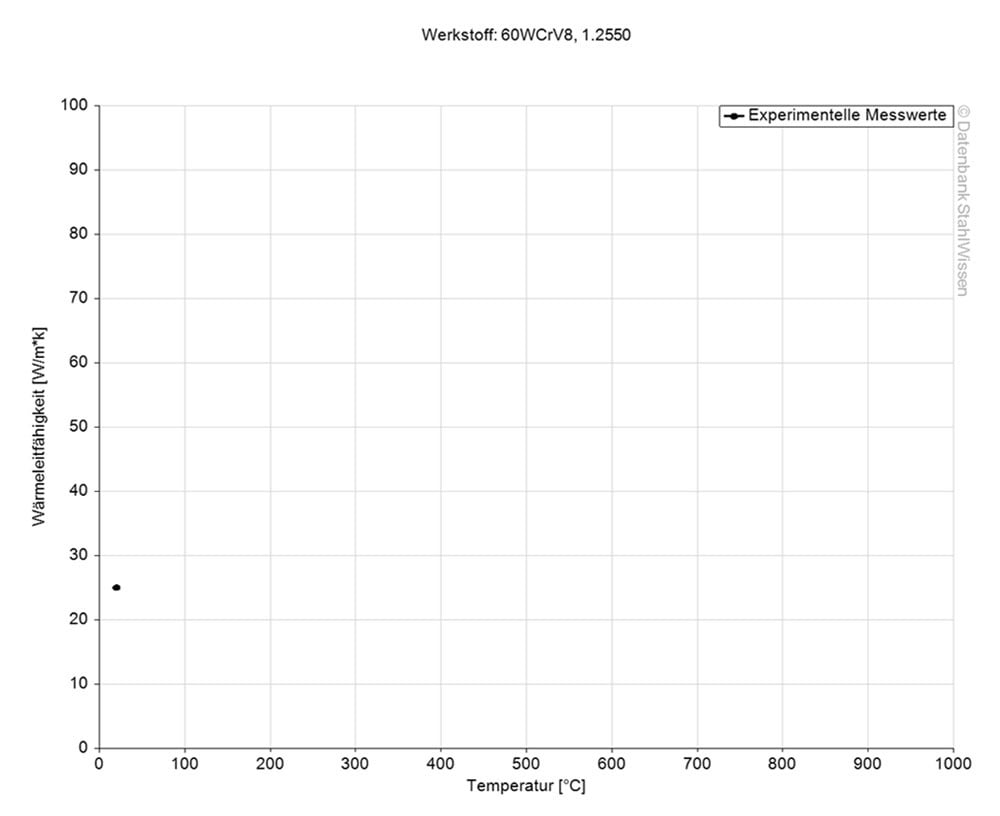
The following table shows the heat conductivity for tool steel 1.2550 at various temperatures.

Heat conductivity

Value (W/m*K)

At a temeprature of

34.2

20 °C

32.6

350 °C

30.9

700 °C

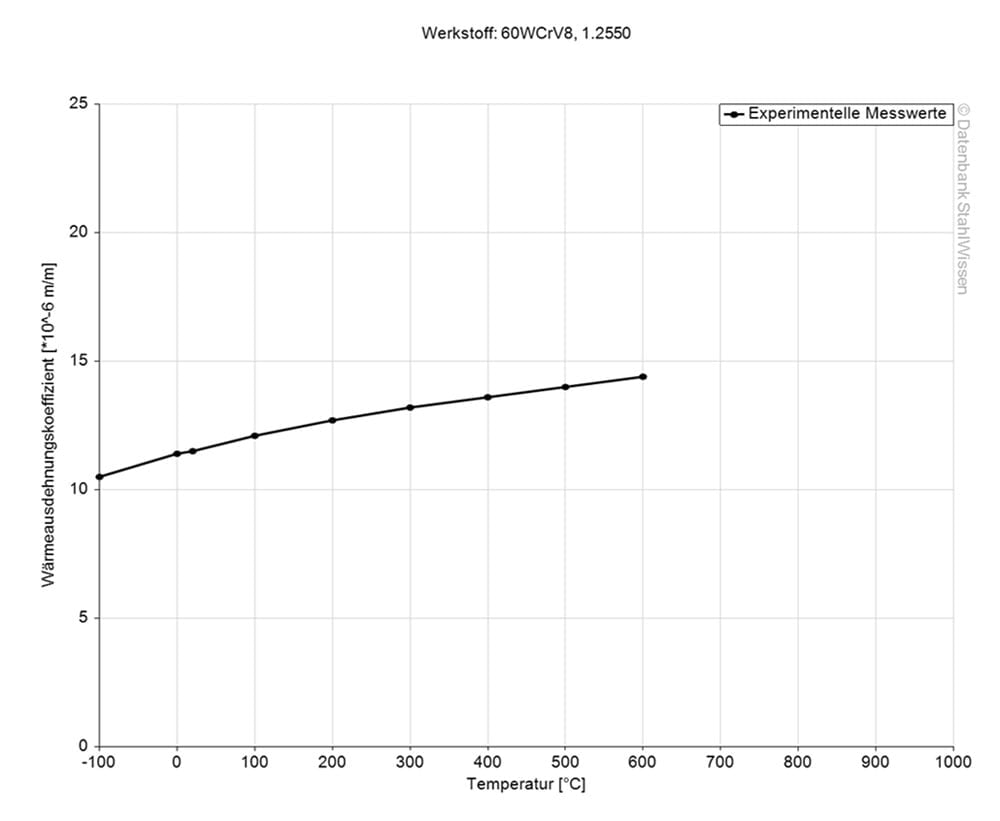
The following table shows the expansion or contraction at different temperatures, which can be very important for work at high temperatures or with significant temperature fluctuations.

Medium thermal expansion coefficient

Value 10-6m/(m*K)

 At a temeprature of

11.8

20 – 100 °C

12.7

20 – 200 °C

13.1

20 – 300 °C

13.5

20 – 400 °C

14.0

20 – 500 °C

14.3

20 – 600 °C

14.5

20 – 700 °C

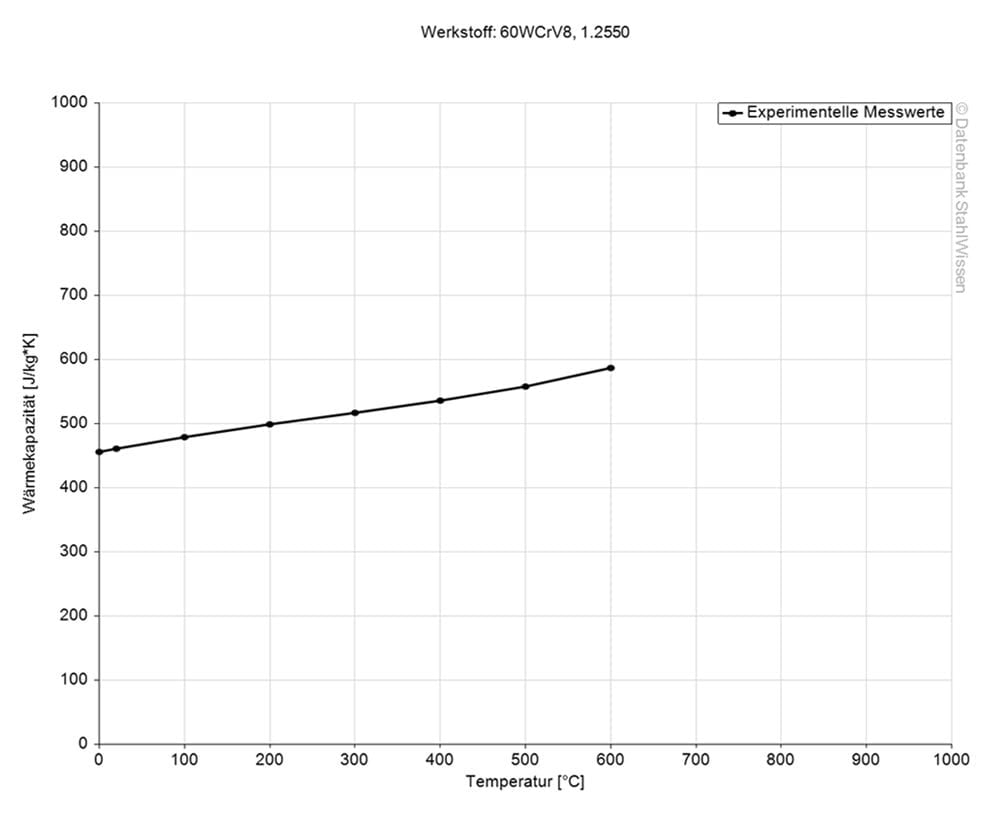
The specific heat capacity of 1.2550 at room temperature is 0.46 J/kg*K. This value indicates how much heat is required to heat a certain amount of material by 1 Kelvin.

The specific electrical resistance can be found in the following table. Electrical conductivity is the reciprocal of specific electrical resistance.

Table of the specific electrical resistivity

Value (Ohm*mm²)/m

Bei einer Temperatur von

0.3

20 °C

PREMIUM QUALITY
OUR HIGHEST STANDARD!

1.2550 Procedure

Heat treatment is used to determine material properties. It should therefore always be carried out with care. Properties such as strength, toughness, surface hardness and temperature resistance are determined, which in turn can extend/improve the service life of parts, tools and components.
Heat treatment includes solution annealing, soft annealing, normalising, stress relief annealing, but also tempering, hardening and quenching or tempering.

In order to anneal tool steel 1.2550, heat the workpieces evenly to a temperature of 710–750 °C and cool them slowly in the furnace at a rate of 10–20 °C per hour to 600 °C. Complete this process by allowing the pieces to cool further in the air.

Stress relieving can reduce internal stresses that may arise during machining, welding or forging. This process can help to improve mechanical properties and dimensional stability. Heat the workpieces evenly and slowly to 650 °C, for example after rough machining. Hold and then allow to cool slowly in still air. The workpieces can then be further machined.

Slowly heat the workpieces to the required tempering temperature, then hold the material at this temperature for 1 hour per 25 mm of thickness and allow to cool in the air.

Heat the workpieces evenly to a temperature of 650 °C and then increase the temperature to a range of 870 to 900 °C. Complete the process by quenching the material.

Common quenching media for 1.2550 tool steel are:

  • Oil
  • Salt bath 180 – 220 °C

After quenching, 1.2550 is extremely hard and brittle. To reduce this and improve toughness, the steel should be tempered.

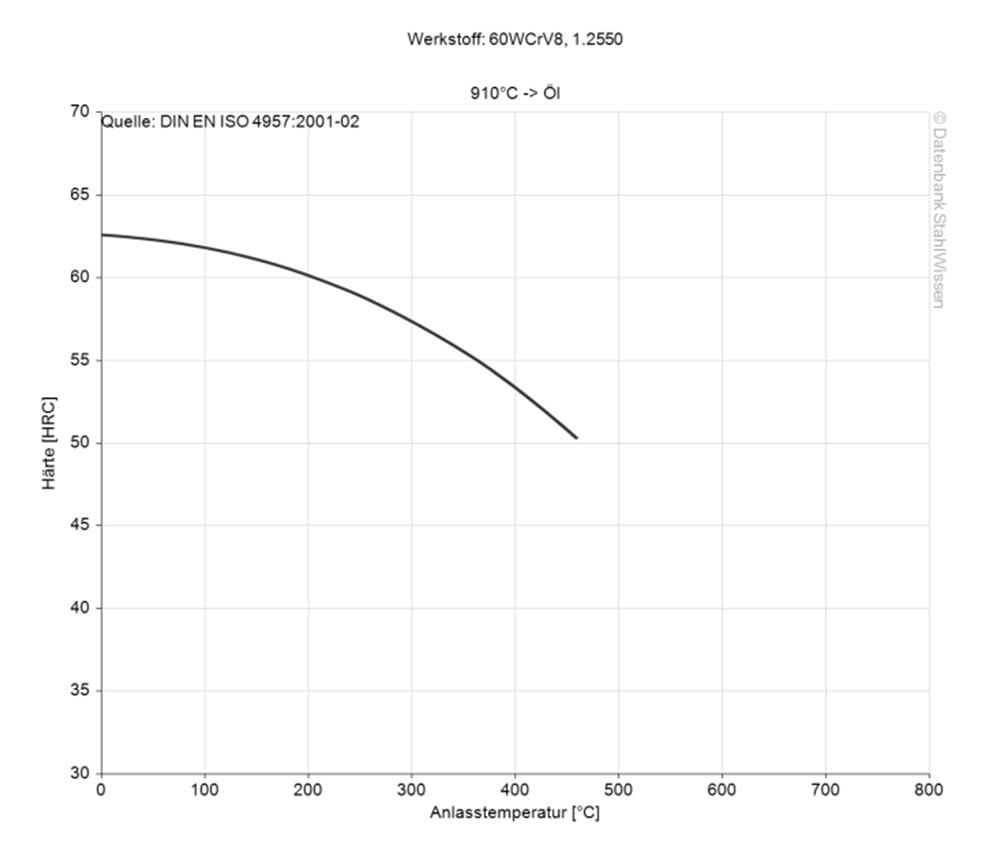
This diagram shows the micro changes at different temperatures which are important during heat treatment. They show the optimum condition for the hardening, annealing and normalizing process.

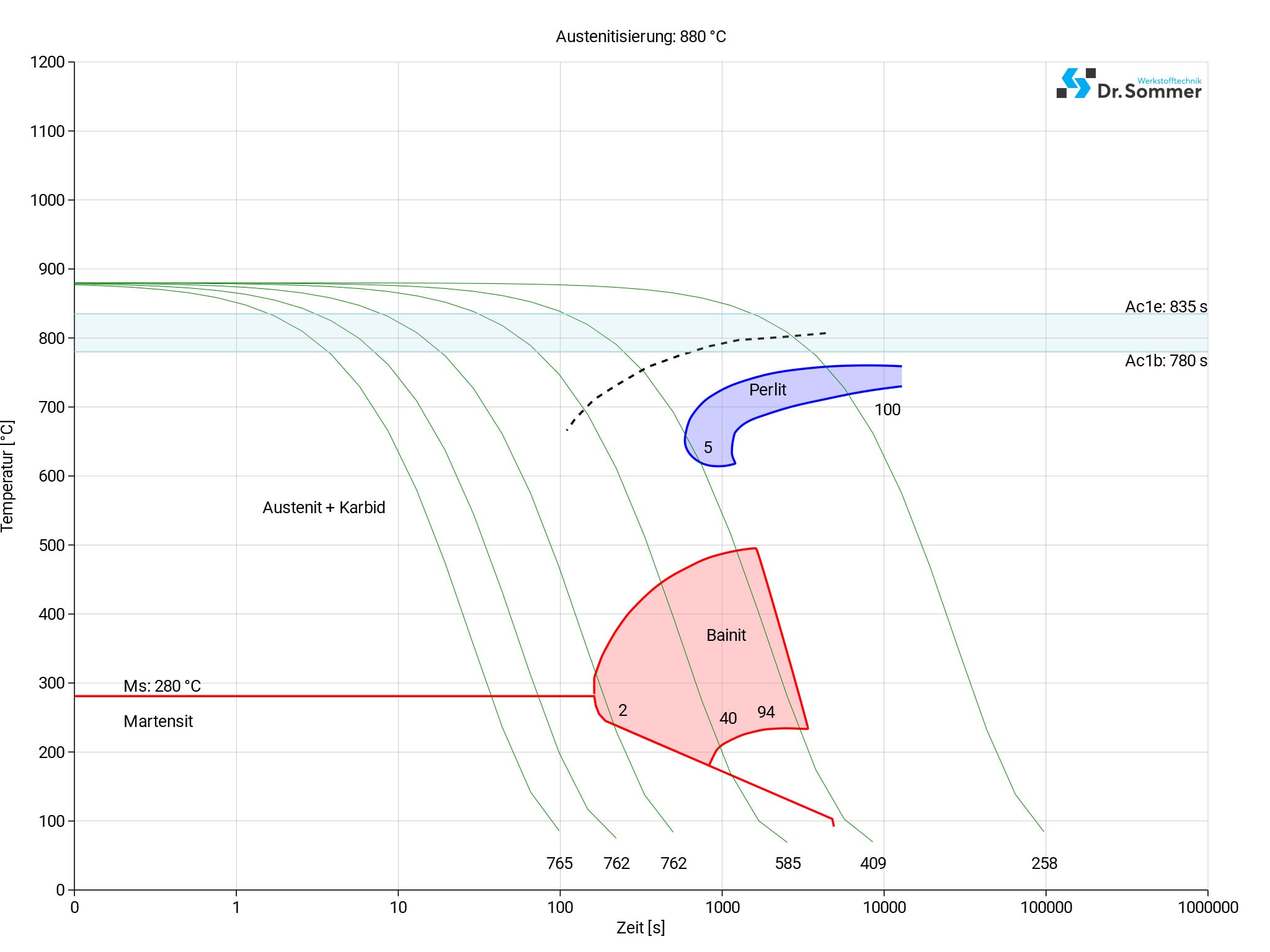
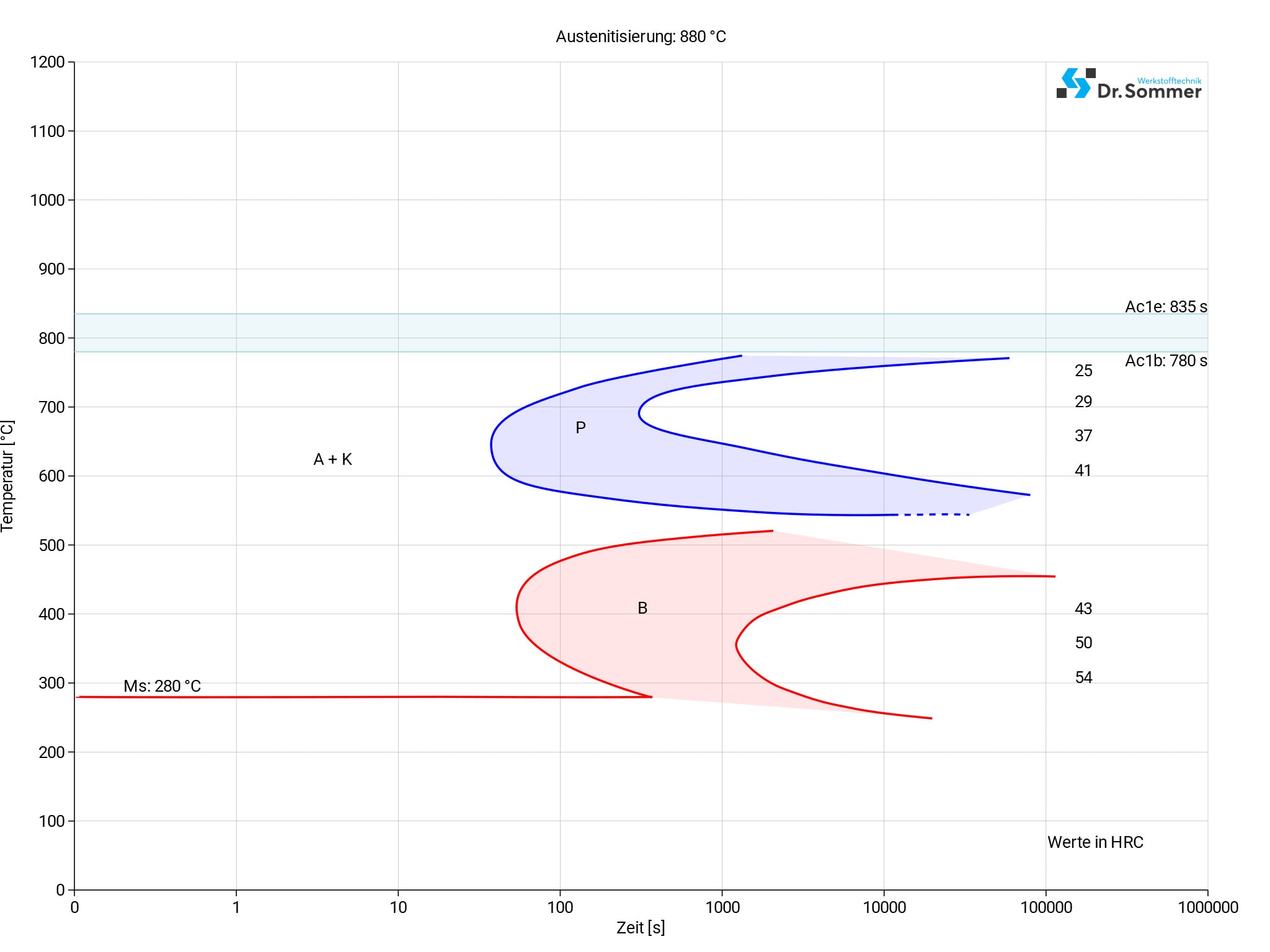
This diagram shows the structural changes at micro level over time at a constant temperature. It shows at what temperature and after what time different phases, e.g., perlite, martensite or bainite start to build.

1.2550 Surface treatment

The introduction of nitrogen into the material surface creates a hard and wear-resistant layer, thereby increasing wear resistance and service life.

Carburising increases hardness and wear resistance by introducing carbon into the surface of the material.

By coating the 1.2550 with physical vapour deposition (PVD), chemical vapour deposition (CVD), the wear resistance and corrosion resistance are improved and friction is reduced.

Passivation removes free iron and impurities from the surface and creates a passive oxide layer that can prevent rust and other corrosion when the material is exposed to corrosive environments. Since material 1.2550 is not a stainless steel, passivation offers several advantages for certain applications.

1.2550 Processing

Depending on hardness, cutting speed, feed rate, lubricants, heat treatment, choice of cutting tools and service life, 1.2550 is fairly easy to machine.

As with all other steels, material 1.2550 expands when heated and contracts again when cooled. Local heating and cooling during welding can lead to dimensional changes or deformation. Stress reliefing of 1.2550 can lead to dimensional changes, as can high mechanical stresses on the material. Heavy loads can lead to elastic or plastic deformation to failures or changes in shape and dimensions.

To forge the 1.2550, heat the workpieces evenly to a temperature of 1000 °C. The temperature range for forging is between 800 and 1000 °C. Heat the material as often as necessary and avoid forging below 800 °C. To prevent internal stresses, cool the 1.2550 slowly in the furnace after forging.

Ensure that the 1.2550 is free of contaminants such as grease, rust, oil and moisture, remove sharp edges and check the surface for cracks before welding.
When selecting filler materials, tensile strength and yield strength should be taken into account and either matched to the base metal or be even better than the base metal.

ALTERNATIVES

Are you looking for an alternative steel grade?

With the ABRAMS STEEL GUIDE®, you are able to obtain an alternative or equvelent with just a few clicks.

DATASHEET

Download the technical data sheet in PDF format here.

Messe.png

SERVICES

Do you require special dimensions?


Our services for you: water jet cutting, sawing, milling and grinding.

richtwerte-2.png

Standard values

Chemical designation: 60WCrV8
Working hardness: 56-60 HRC
Delivery condition: maximum 229 HB
Chemical composition:
C Si Mn P S Cr V W
0,55

0,65
0,7

1,0
0,15

0,45
0

0,03
0

0,03
0,9

1,2
0,1

0,2
1,7

2,2
Logo_Abrams_Ausrufezeichen.png
PREMIUM QUALITY – OUR HIGHEST STANDARD!
technical-info.png

Technical properties

Steel grade with focus on cold work, with full hardenability, excellent toughness, dimensional stability and impact strength.

anwendungen.png

Applications

Blanking tools, dies, punches, forming dies, embossing tools, coining tools, tableting punches, plug-in tools, trimming tools, cold shear knives, riveting pins, hand chisels, pneumatic chisels, centre punches, ejectors, woodworking tools.

70 STEEL GRADES IN 33.895 DIMENSIONS

EX WORKS FROM OSNABRÜCK

DELIVERY IN 3-5 WORKING DAYS (SUBJECT TO AVAILABILITY)

WITHOUT MINIMUM ORDER VALUE OR QUANTITY

FROM EUROPE'S LARGEST RANGE OF SEMI-FINISHED PRODUCTS

SPECIAL CUSTOM DIMENSIONS SAWN - MILLED - GROUND

Select Your Country / Language

Do you have any questions?

If you have any comments or questions regarding ABRAMS PREMIUM STEEL® products or this website, please do not hesitate to contact us.

Please feel free to call us at any time:

+49 541/357 39-0

or send us an E-mail to:

[email protected]

If you have any comments or questions regarding ABRAMS PREMIUM STEEL® products or this website, please do not hesitate to contact us.

Please feel free to call us at any time: