1.2714+QT - AT A GLANCE
What kind of steel is the 1.2714+QT?
As an oil hardening chrome nickel tool steel, 1.2714+QT is often used for applications needing a greater toughness. This steel grade has a better toughness due to the nickel content, at the same time retaining good hardness and wear resistance. With its lower carbon content, it has a slightly better shock resistance in comparison to higher alloyed steels and can be used if wear resistance is secondary to increased toughness.
Properties
1.2714+QT tool steel has a unique blend of properties, its high carbon content makes it a good choice for applications needing a high wear resistance. Its exceptional toughness gives the 1.2714+QT a resistance to impacts and makes it less prone to chipping and breaking.
Possible corrosion should be managed and should be considered when choosing the 1.2714+QT as well as the correct heat treatment needs to be chosen as many of the properties of the 1.2714+QT may be affected when not heat treated correctly.
Practically, this means:
- High carbon content
- For applications that require high wear resistance
- Exceptional toughness makes it impact resistant
- Less susceptible to chipping and cracking
- High tempering resistance
- Good through hardenability
- Can be nitrided and eroded
- Working hardness is in the range of 40 – 54 HRC
- High compressive strength
- Water coolable
- High impact strengt
Applications
1.2714+QT tool steel can withstand sudden stresses and impacts, has a good toughness and wear resistance as well as a reasonable hardness. These properties lend themselves to applications like knives and blades, cold work tools, bearings, bushings, woodwork tools, spindles, cams, and springs.
- Forging dies
- Slides
- Punch heads
- Extruding stamps
- Press tools
- Hot shear knives
- Extrusion press tools
- Support tools
- Pressure plates
- Stamping heads
- Extrusion punches
- Moulding presses
- Hot shearing blades
- Hot punches
- Extrusion tools
- Forging saddles
- Die holders
- Support tools
- Press mandrel holders
- Tool holders
- Pressure plates
- Armoured cutting plates
- Lugs
- Springs
- Spindles
- Cold-forming tools
- Ball bearings
- Bushings
- woodworking tools
1.2714+QT STANDARD VALUES
Chemical composition:
| C | Si | Mn | P | S | Cr | Mo | Ni | V |
|---|---|---|---|---|---|---|---|---|
| 0.5 - 0.6 | 0.1 - 0.4 | 0.6 - 0.9 | 0.0 - 0.03 | 0.0 - 0.03 | 0.8 - 1.2 | 0.35 - 0.55 | 1.5 - 1.8 | 0.05 - 0.15 |
Chemical designation:
55NiCrMoV7+QT
Working hardness:
ca. 40 HRC (delivery condition) up to 54 HRC
Delivery condition:
max. 400 HB
1.2714+QT PHYSICAL PROPERTIES
What group of steel does the 1.2714+QT belong to?
- Tool steel
- Hot work steel
Is the 1.2714+QT a stainless steel?
No, the 1.2714+QT is not stainless steel. 1.2714+QT is a tool steel. Stainless steel has a mass fraction of 10.5% chromium, while 1.2714 has a mass fraction of 0.8 to 1.2% chromium.
Is the 1.2714+QT corrosion resistant?
1.2714+QT is not a corrosion-resistant steel. To be corrosion-resistant, steel must have a chromium content of at least 10.5% to be corrosion-resistant like stainless steel.
Although 1.2714+QT has a certain degree of corrosion resistance, it will corrode when exposed to corrosive environments or moisture. To protect this steel grade, it can be coated or the surface can be additionally treated against corrosion.
Is the 1.2714+QT magnetisable?
As an iron-containing material, 1.2714+QT can be magnetised; that is especially true for materials in a martensitic state.
1.2714+QT Hot work
Unlike cold working, hot working, hot rolling, forging and extruding does not harden 1.2714+QT tool steel. This reduces porosity, improves the overall structure and allows the material to be formed over large areas.
Care must be taken during hot forming to avoid a scale layer, possible deformation and excessive grain growth.
1.2714+QT Cold work
Cold working, cold drawing, rolling and cold forging can cause work hardening, achieving tighter tolerances and a smooth surface without further processing.
The increased hardness can in turn promote crack formation, but also lead to increased tool wear. The internal stresses arising during this process should ideally be compensated by stress relief annealing.
1.2714+QT Wear resistance
The wear resistance of the 1.2714+QT is at 2 on a scale where 1 is low and 6 is high.
1.2714+QT TECHNICAL PROPERTIES
Is the 1.2714+QT a knife steel?
The combination of high carbon content, toughness, adequate wear resistance and the fact that 1.2714+QT is easy to sharpen and has fairly good edge retention make this steel grade suitable for knife manufacturing.
As 1.2714+QT is not stainless steel, knives should be stored in a dry and clean place to prevent corrosion.
1.2714+QT Working hardness
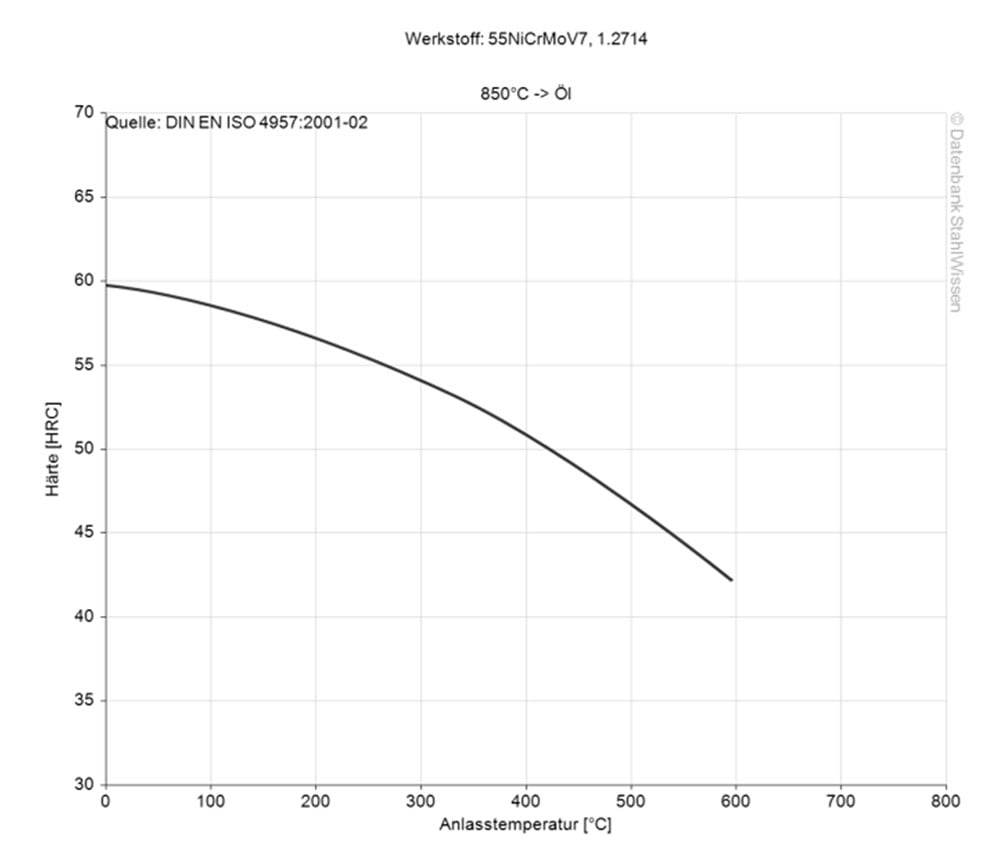
The working hardness for tool steel 1.2714+QT is in the range of 40–54 HRC.
1.2714+QT Steel density
At room temperature, the density of 1.2714+QT tool steel is typically 7.8 g/cm3.
1.2714+QT Tensile strength
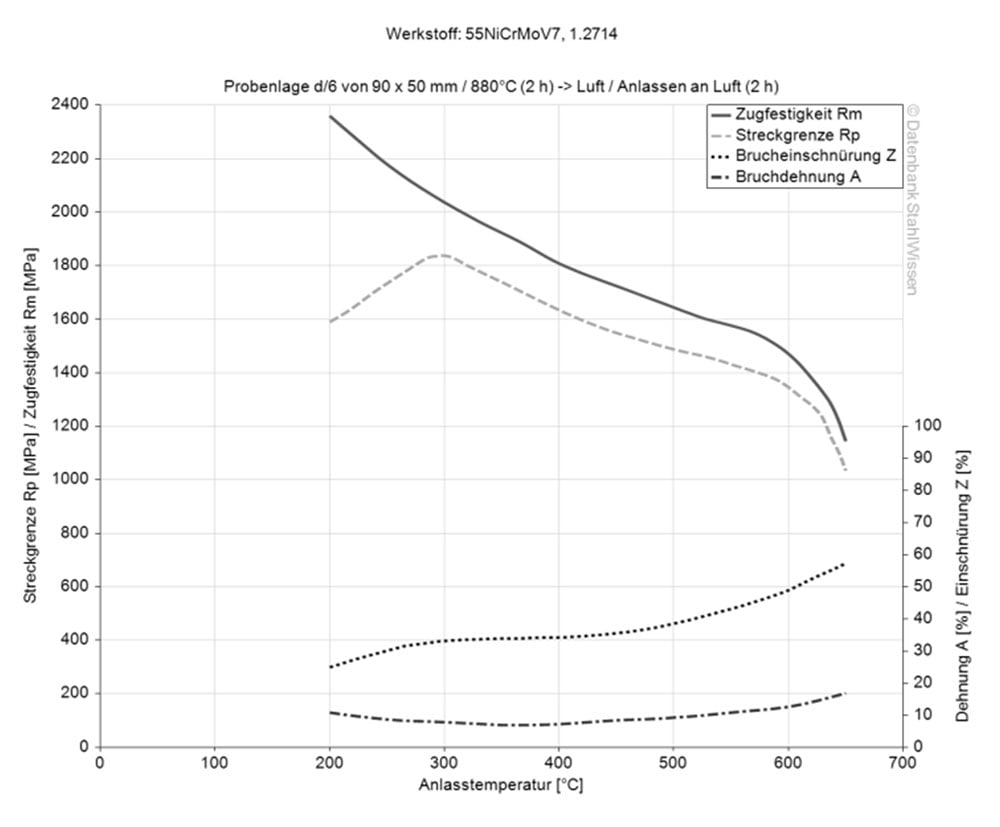
1.2714+QT tool steel has a tensile strength of approx. 850 N/mm2. The tensile strength indicates the maximum load capacity. To obtain this information, a tensile test is carried out to show how much force is required to stretch or elongate a sample before it breaks.
1.2714+QT Machinability
On a scale where 1 is low and 6 is high, the material grade 1.2714+QT receives a 4 for its machinability.
1.2714+QT Heat conductivity
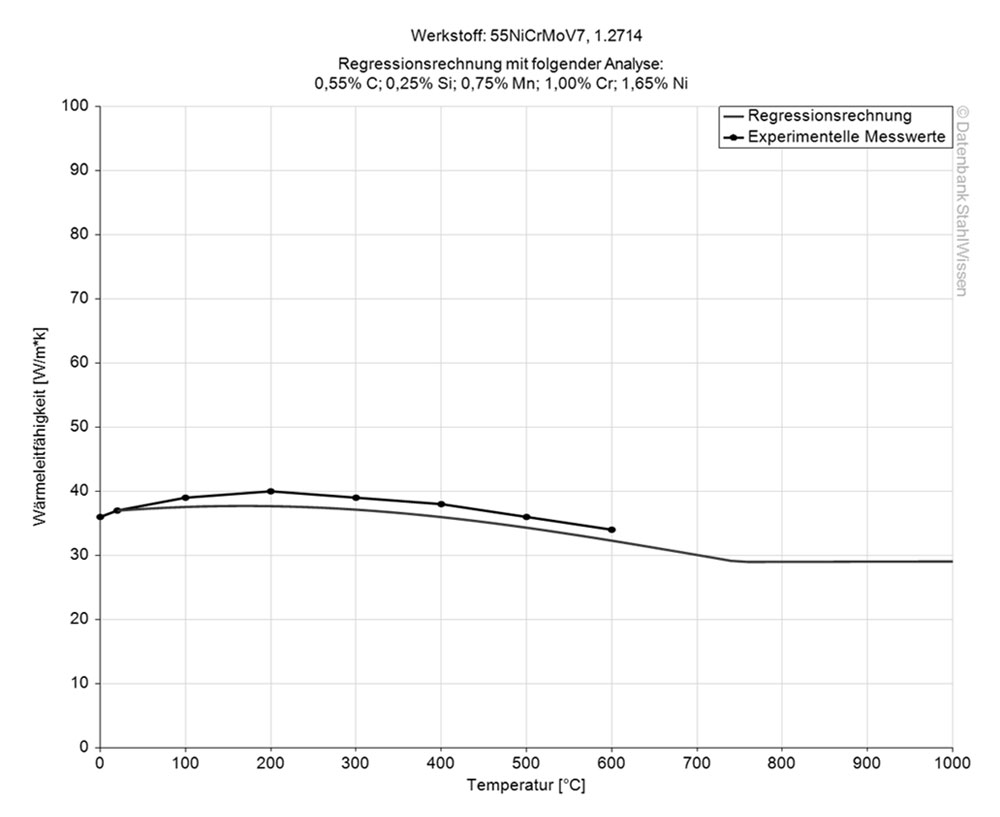
The following table shows the thermal conductivity of tool steel 1.2714+QT at different temperatures.
Heat conductivity
Value (W/m*K)
At a temeprature of
36.0
20 °C
38.0
350 °C
35.0
700 °C
1.2714+QT Thermal expansion coefficient
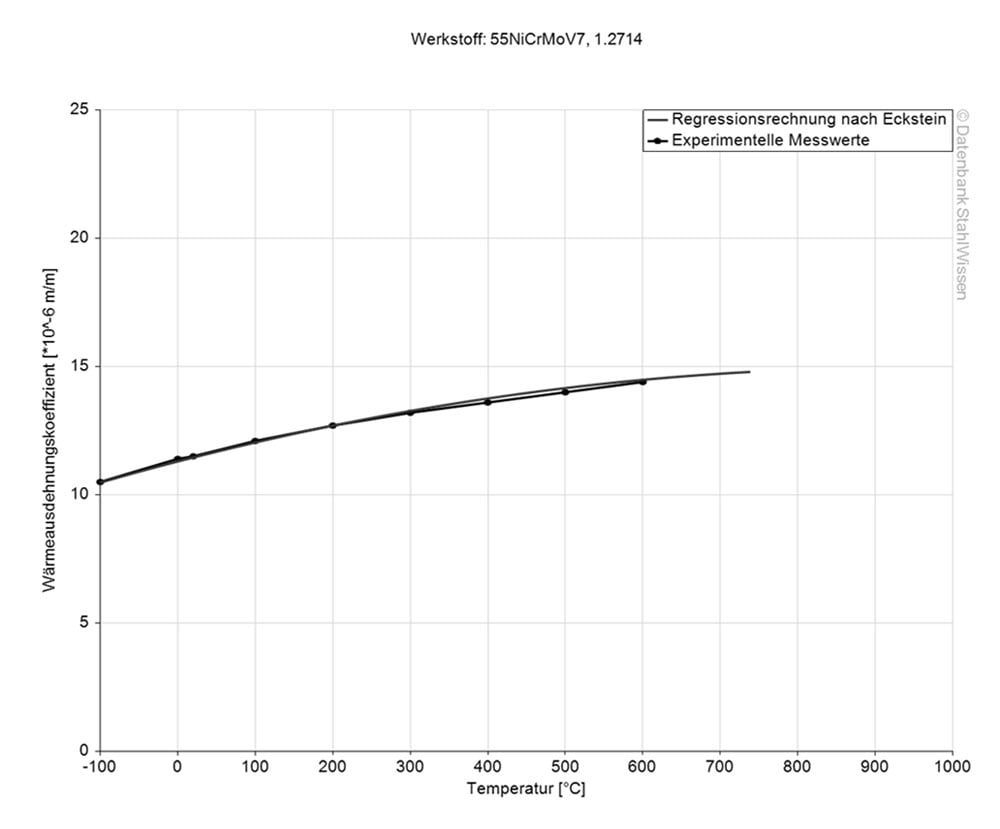
The thermal expansion coefficient indicates how much the material can expand or contract when the temperature changes. This is very important information, especially when working with high temperatures or when there are significant temperature fluctuations during use.
Medium thermal expansion coefficient
At a temeprature of
12.2
20 – 100 °C
13.0
20 – 200 °C
13.3
20 – 300 °C
13.7
20 – 400 °C
14.2
20 – 500 °C
14.4
20 – 600 °C
1.2714+QT Specific heat capacity
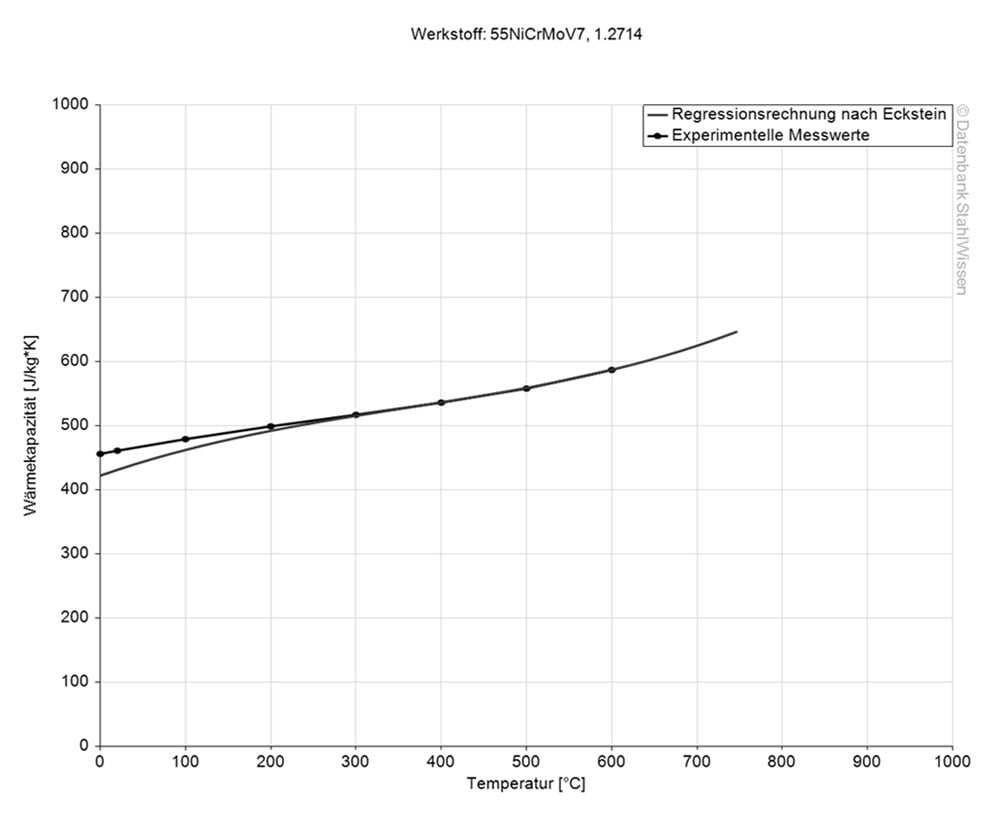
The specific heat capacity of 1.2714+QT at room temperature is 0.46 J/g*K. This value indicates how much heat is required to heat a specific amount of 1.2714+QT material by 1 Kelvin.
1.2714 Specific electrical resistance
The specific electrical resistance can be found in the following table. Electrical conductivity is the reciprocal of specific electrical resistance.
Table of the specific electrical resistivity
Value (Ohm*mm²)/m
At a temperature of
0.3
20 °C
1.2714+QT Elastizitätsmodul (e-Modul)
Das Spannungs- und Dehnungsmodul oder das Elastizitätsmodul (Youngscher Modul) für Werkzeugstahl 1.2714+QT liegt bei 190–210 kN/mm2.
ROUND STEEL – IN BLACK!
1.2714+QT PROCEDURE
2714+QT Heat treatment
Material properties are determined during heat treatment. Therefore, this process should always be carried out with care. Properties such as strength, toughness, surface hardness and temperature resistance are determined, which in turn can extend/improve the service life of parts, tools and components.
Heat treatment includes solution annealing, soft annealing, normalising, stress relief annealing, but also tempering, hardening and quenching or tempering.
1.2714+QT Annealing
Heat material 1.2714+QT slowly and evenly to a temperature of 650–700 °C and maintain this temperature for 1 hour per 25 mm thickness, but for at least 2 hours. Then cool slowly in the furnace at 10 °C per hour to 538 °C, then allow to cool in air.
To improve machinability, cool the workpiece slowly in the furnace to a temperature of 677 °C, hold it at this temperature for 8 hours and then cool it in air to room temperature.
1.2714+QT Stress relieving
Heat the workpieces evenly to a temperature range of 566–677 °C and maintain this temperature for two hours. Complete this process by allowing the parts to cool in the furnace to 482 °C and then to ambient temperature in the air.
1.2714+QT Normalising
Normalising 1.2714+QT can improve machinability and mechanical properties, as well as reduce internal stresses, as normalising gives it a finer and more uniform pearlitic grain structure.
1.2714+QT Tempering
To avoid cracks, start tempering 1.2714+QT immediately after quenching. Maintain the selected tempering temperature for 1 hour per 25 mm thickness, but for at least 4 hours, and then cool the material to room temperature. 1.2714+QT can be tempered in a temperature range of 232 – 427 °C without becoming brittle. To minimise internal stresses in workpieces with a cross-section greater than 150 mm and/or to improve the stability of tools that are machined after heat treatment, it is recommended to hold the material for 8 to 10 hours.
1.2714+QT Hardening
Heat the parts evenly to a temperature of 677–732 °C, then continue with the austenitising temperature of 816–843 °C and maintain this temperature for 10–30 minutes. To protect the material from excessive scale or decarburisation, either heat the workpieces in neutral salt, pack them in cast iron chips or spent coke, or heat them in a protective atmosphere or vacuum furnace.
1.2714+QT Sub-zero treatment
Sub-zero treatment can be carried out as an extension of quenching after austenitisation and before tempering.
Cryogenic treatment can improve the hardness and toughness of 1.2714+QT, increasing its wear resistance and stability – all advantages that can extend the service life of tools and components. However, the duration of treatment and the cooling rate must be taken into account when deciding whether treatment below freezing is beneficial for this type of material.
1.2714+QT Quenching
- Oil, heated – the pieces should be cooled to 50–65°C or until they can be held in the hand without difficulty, and then the material should be tempered immediately.
- Air – this quenching method is used for workpieces smaller than 25 mm. Air quenching is a safer option for small and delicate workpieces, as they are less deformed by air quenching than by quenching with oil.
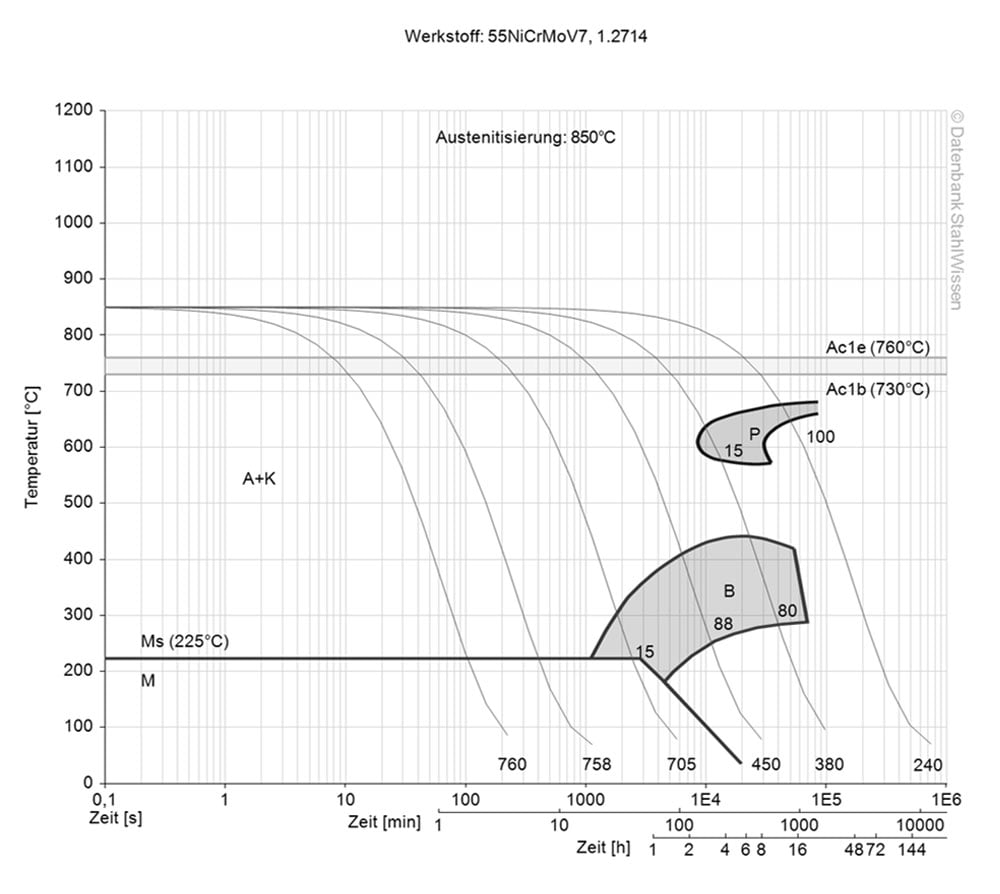
1.2714+QT Continuous TTT-diagram
This diagram shows micro-changes over time at different temperatures. These are important in heat treatment because they provide information about the optimal conditions for processes such as hardening, annealing and normalising.
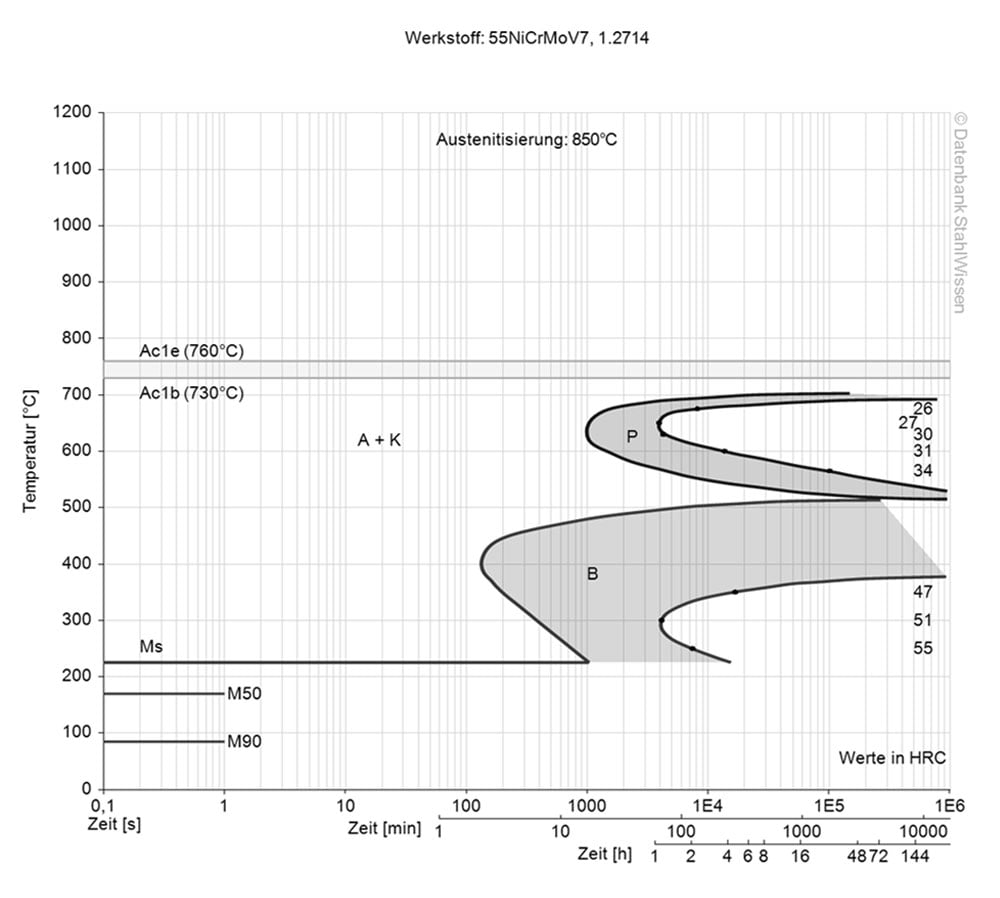
1.2714+QT Isothermal TTT-diagram
This diagram shows the structural changes at the micro level over time at a constant temperature. It shows at what temperature and after what time different phases, e.g. perlite, martensite or bainite, begin to form.
1.2714+QT SURFACE TREATMENT
The choice of surface treatment depends on the requirements, the environment in which the workpieces/tools are used, the required properties and the expected loads. To improve its performance and service life, the following surface treatments can be applied to 1.2714+QT.
1.2714+QT Nitriding
During nitriding, nitrogen is diffused into the surface to increase surface hardness and improve corrosion resistance. Since low temperatures are used in this process, the likelihood of deformation is low. If nitriding is not carried out properly, the material can become brittle.
1.2714+QT Carburising
During this process, carbon is introduced into the surface to improve wear resistance and surface hardness. As this is a high-temperature process, caution is required as it can alter the material properties and cause the material to warp.
1.2714+QT Black oxide coating (blueing)
Blueing is often used for aesthetic reasons, as it provides a black-blue finish that is frequently used for tools or firearms because it reduces light reflection from the surface.
1.2714+QT PVD- und CVD
Both PVD (Physical Vapor Deposition) and CVD (Chemical Vapor Deposition) coatings apply a thin layer to the material surface that can increase wear resistance or reduce friction.
1.2714+QT Shot peening
Shot peening involves blasting small spherical particles made of glass, ceramic or steel at high speed onto the surface of the material, leaving behind tiny indentations that replace the tensile stress on the surface with a residual compressive layer. Shot peening strengthens the material and makes the surface more resistant, preventing fatigue and stress corrosion.
1.2714+QT PROCESSING
1.2714+QT Electrical Discharge Machining (EDM)
With its good electrical conductivity and hardness, 1.2714+QT can be eroded. Erosion is often used to achieve tight tolerances or to machine intricate details from hardened material.
1.2714+QT Machining allowance / dimensional changes
Like most metals, 1.2714+QT can contract and expand when heated or cooled. Phase changes, internal stresses and decarburisation can also cause dimensional changes which can affect the properties of this steel grade. To prevent this, it may be advantageous to preheat the workpieces.
Controlled heating and cooling, stress relief and the avoidance of overheating, as well as the use of the correct quenching medium, can reduce the risk of thermal shock and undesirable dimensional changes, such as warping or deformation, as well as crack formation, which may result in a project having to be started all over again.
1.2714+QT Forging
Heat the workpiece slowly and evenly to a temperature of 982–1038 °C. Do not allow the temperature to fall below 871 °C and reheat the material as often as necessary. Once the forging process is complete, cool the workpieces slowly in lime, dry ash or in the furnace.
1.2714+QT Welding
1.2714+QT is generally weldable. The surfaces should be free of grease and dirt, as well as rust and paint. To avoid cracking, excessive hardening and loss of properties, the material should be preheated slowly. Similar fillers can be added to the base material and the welding process should be selected according to the specific requirements.
Overheating can lead to grain growth, which in turn weakens the weld seam and can be avoided with the right combination of current, voltage and travel speed. To relieve stresses that occur during welding, the material can be tempered after welding.