PREMIUM 1.2842 / 1.2510 Steel
90MnCrV8 / 100MnCrW4

AISI / SAE O2 / O1

PREMIUM 1.2842 / 1.2510 Steel
90MnCrV8 / 100MnCrW4

90MnCrV8 / 100MnCrW4
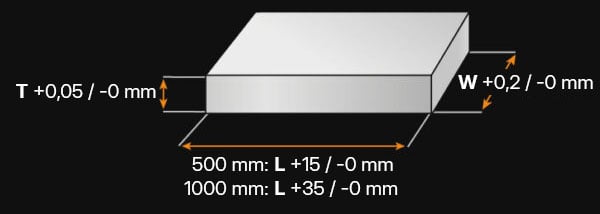
Hart-Präz®
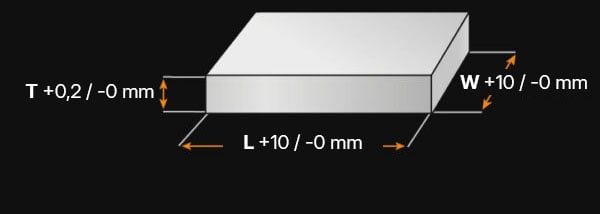
-flat-
Toleranzen.png

Would you like to find out more about the 1.2842 / 1.2510 and its benefits?

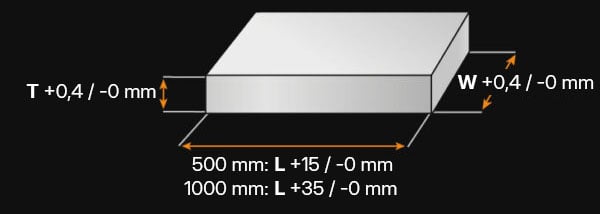
PRS
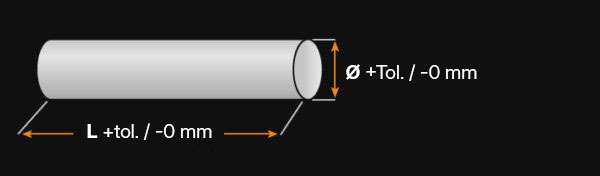
-round-
Toleranzen.png
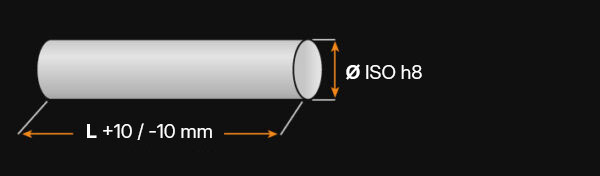
PRS/BA
-round-
Toleranzen.png

1.2842 / 1.2510 - AT A GLANCE

What kind of steel is the 1.2842 / 1.2510?

The 1.2842 / 1.2510 (O2 / O1) tool steel meets a wide range of characteristics including good machinability, good dimensional stability when hardened, good cutting edge retention as well as a good combination of high surface hardness and toughness after hardening and tempering.

Properties

Tool steel 1.2842 1.2510 has many advantages like high hardness, high degree of dimensional stability, good cutting power and good toughness. As an oil hardening steel with a focus on cold work it can be used for a wide range of applications.


The combination of the formentioned properties make this tool steel a great choice for manufacturing tools, which need to have a good tool life and production economy. The high manganese content provides good dimensional stability when quenched from the proper hardening temperature.

  • Universally applicable
  • Medium alloyed oil hardener
  • High hardness acceptance
  • High dimensional stability
  • Good edge retention
  • Good toughness
  • Forgeable
  • Weldable
  • Magnetizable
  • Also popular as a knife steel due to its combination of good properties

Applications

The applications for this steel grade include:

  • Blanking and stamping tools up to 6 mm thickness
  • Shear knives
  • Threading tools
  • Thread dies
  • Reamers
  • Chasers
  • Measuring tools
  • Plastic molds
  • Rubber molds
  • Calibres
  • Guide rails
  • Dies
  • Punches
  • Woodworking tools
  • Machine knives
  • Punches
  • Shear blades
  • Threading tools
  • Tap-cutting dies
  • Chasers
  • Reamers
  • Measuring tools
  • Gauges
  • Guide bars
  • Dies

1.2842 / 1.2510 Standard values

Chemical composition:

C Si Mn P S Cr V
0.85 - 0.95 0.1 - 0.4 1.8 - 2.2 0.0 - 0.03 0.0 - 0.03 .2 - 0.5 0.05 - 0.2

Chemical designation:
90MnCrV8 / 100MnCrW4

Working hardness:
57-62 HRC

Delivery condition:
max. 229 HB

1.2842 / 1.2510 PHYSICAL PROPERTIES

  • Tool steel
  • Cold work steel
  • Plastic mould steel
  • Oil hardening steel

The 1.2842 and the 1.2510 have a similar microstructure and are similar in terms of their processing and properties.

The hardenability of the 1.2842 is increased by the added manganese and compensated for in the 1.2510 material with an increased amount of chromium. In addition, tungsten has been added to 1.2510 to form carbides; this addition achieves the wear resistance and tempering resistance.

There are no differences in processing or dimensional changes after hardening for either one of these steel grades.

As a tool steel with a chromium content of 0,5 – 0,7% the 1.2842 / 1.2510 is not a stainless steel. To be classified as a stainless steelthe chromium content has to be at least at 10,5%.

Yes, as an iron-based metal, 1.2842 / 1.2510 is a ferromagnetic material and can be magnetised, which makes it suitable for magnetic clamping. However, heat treatment may affect its magnetic properties.

It is important when hot working the 1.2842 / 1.2510 to stay within the recommended temperature range to avoid grain growth. Reheating might be necessary if more time is required.

As for other steels when cold working the 1.2842 / 1.2510 it work hardens. This means that it can deform and gets harder and less ductile and that in turn can lead to a risk of cracking.

To avoid internal stresses in the material it should be stress relieved after cold work is done.

On a scale where 1 is low and 6 is high the 1.2842 / 1.2510 get a 4 for its wear resistance.

1.2842 / 1.2510 TECHNICAL PROPERTIES

With a good combination of hardness, toughness and simple heat treatment the 1.2842 / 1.2510 is popular as a knife steel. The heat treatment gives this material grade the ability to reach a high hardness. Its hardness makes it possible to maintain a good edge retention and in turn makes it harder to be sharpened.

To prevent rusting the 1.2842 / 1.2510, as a non stainless steel, should be regularly maintained.

The working hardness for the tool steel 1.2842 / 1.2510 is at max. 62 HRC.

Typically the density of tool steel 1.2842 / 1.2510 is at 7,83 g/cm3 at room temperature.

The tensile strength for the tool steel grade 1.2842 / 1.2510 is at approx. 770 N/mm2. For this result the material is undergoing a tensile test which shows how much force is needed before the material starts to stretch or elongate before it breaks.

The yield strength indicates how much stress can be applied before a material undergoes plastic deformation. Beyond this point, the material no longer returns to its original shape when the stresses are removed, but remains deformed or even breaks.

The range for the 1.2842 / 1.2510 tool steel is between 390 and 510 N/mm2.

The 1.2842 / 1.2510 gets a 4 on a scale were 1 is low and 6 is high for its machinability.

Wärmeleitfähigkeitstabelle

Wert

Nach Temperatur

33,0

20 °C

32,0

350 °C

31,3

700 °C

The following table shows the heat conductivity for the tool steel 1.2842 / 1.2510 at various temperatures.

Heat conductivity

Value (W/m*K)

By temperature

33.0

20 °C

32.0

350 °C

31.0

700 °C

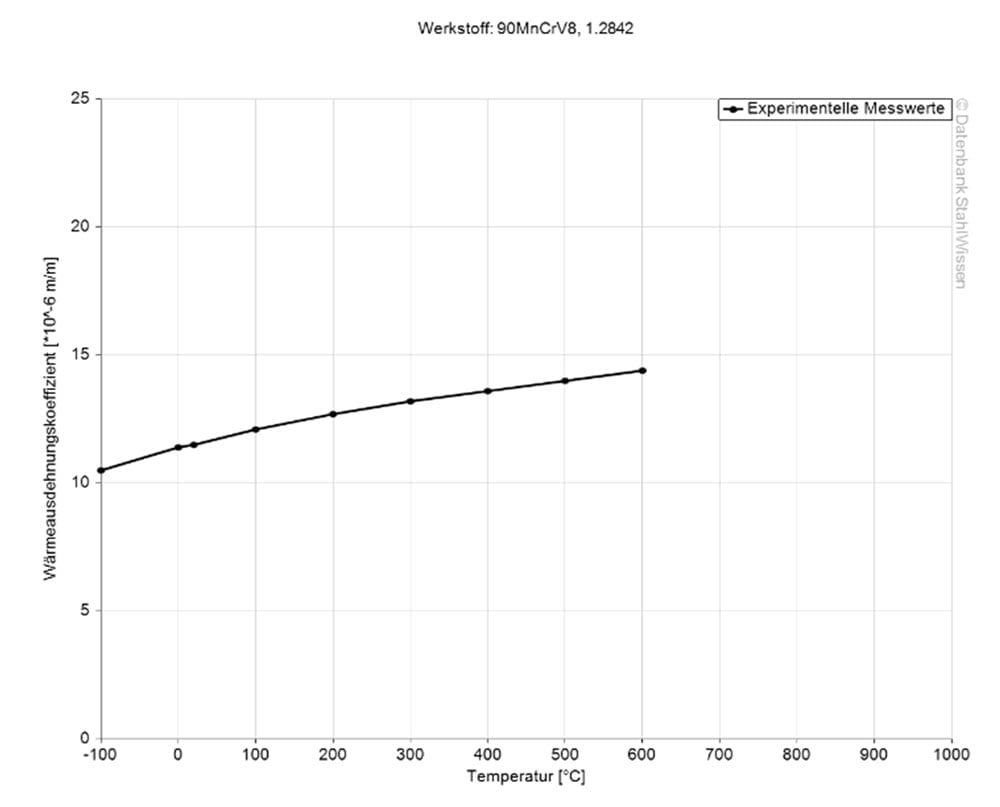
The thermal expansion coefficient shows how much a material expands or contracts at any temperature changes. This information can be relevant when when components or parts are exposed to high temperatures or for applications with ever changing temperatures.

Wert 10-6m/(m*K)

At a temperature of

12.2

20 – 100 °C

13.2

20 – 200 °C

13.8

20 – 300 °C

14.3

20 – 400 °C

14.7

20 – 500 °C

15.0

20 – 600 °C

15.3

20 – 700 °C

Medium thermal expansion coefficient

The specific heat capacity of tool steel 1.2842 / 1.2510 at room temperature is 0,46 J/kg*K. This value shows how much heat is needed to heat a specific amount of material by 1 Kelvin.

The following table shows the specific electrical resistance. Electrical conductivity is the reciprocal of electrical resistivity.

Table of the specific electrical resistivity

Value (Ohm*mm2)/m

At a temperature of

0,35

20 °C

The modulus of electricity or the stress and strain modulus for the 1.2842 / 1.2510 is at 214 kN/mm2.

HART-PRÄZ® – ALREADY HARDENED DIMENSIONS IN LENGTH OF 250 mm AND 500 mm!

1.2842 / 1.2510 Procedure

The heat treatment determines the material properties and should be carried out with care. Properties such as strength, toughness, surface hardness and temperature resistance are determined, which in turn can extend/improve the service life of parts, tools and components.

Heat treatment includes solution heat treatment, soft annealing, normalising, stress-relief heat treatment, but also tempering, hardening and quenching.

Heat the protected steel uniformly to a temperature of 780°C and then cool it in the oven with 15°C per hour down to 650°C after that the 1.2842 / 1.2510 can be cooled down to room temperature. To prevent excessive carburisation or decarburisation the 1.2842 / 1.2510 the appropriate precaution have to taken.

Heat the 1.2842 / 1.2510 to a temperature of 650°C after work pieces have been prepared and hold them at that temperaure for 2 hours. Slowly cool the material down to a temperature of 500°C and then finish cooling to room temperature in the air.

Stress relieving can be done after intensive machining as well as after grinding, welding, forging or cold working the 1.2842 / 1.2510 to relive internal stresses that might have build up during the processes.

Then either machining can commence or the material can be hardened and tempered if stress relieving is used as a preparation.

Stress relieving can improve stability and performance but can result in dimensional changes. Further information can be obtained in our section “Dimensional Changes”.

For a more uniform microstructure, refined grain structure, stress relieve after machining the 1.2842 / 1.2510 can be normalised. This can improve mechanical properties and can be used as a preparation for further heat treatments.

To normalise the 1.2842 / 1.2510 heat it uniformly over the critical temperature and hold it for a short time. Afterwards cool it down naturally in still air.

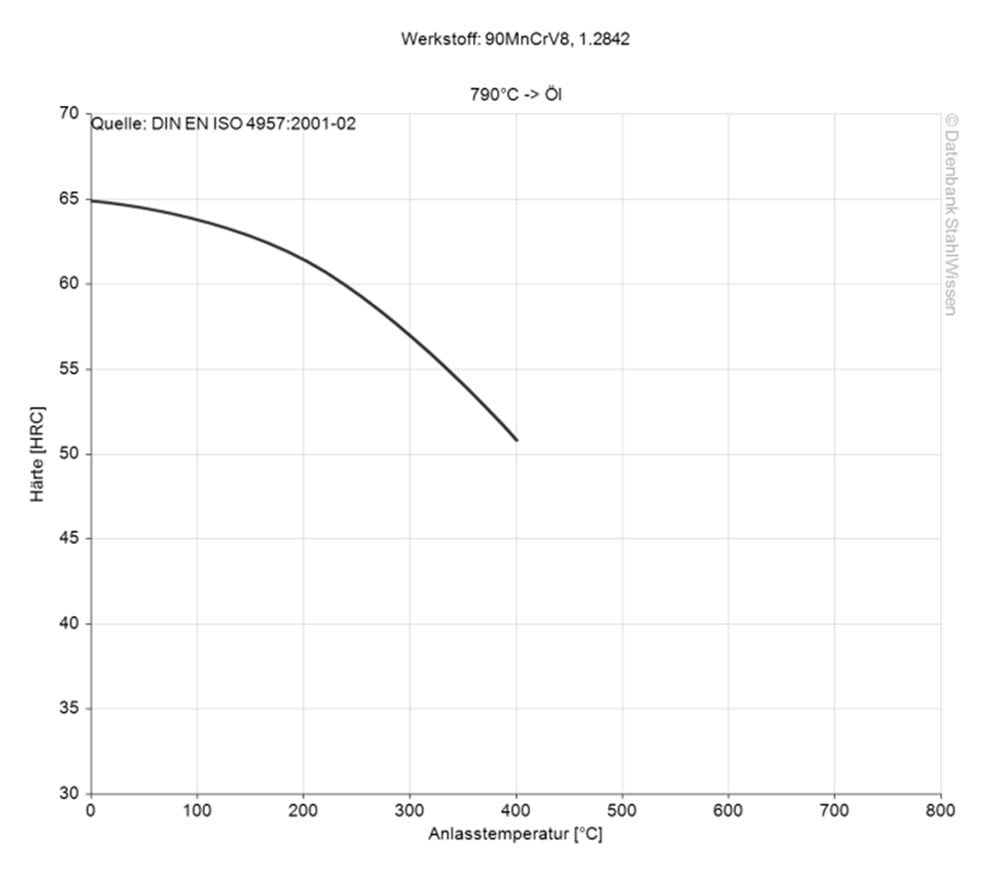
Choose the tempering temperature according to the hardness that is needed. Work pieces should be temped twice with a cooling down to room temperature between the first and the second tempering process. The tempering temperature should not drop below 182°C and should be held at this temperature for a minimum of 2 hours.

Sub-zero treatment for the 1.2842 / 1.2510 should be done straight away after quenching. Work pieces are cooled to a temperature of -70 to -80°C and held for 3 – 4 hours.

The hardness can be elevated by 1 – 3 HRC with this treatment. Due to cracking it is not advised to treat intricate shapes at sub-zero temperatures.

Generally, the cryogenic treatment converts residual austenite to martensite to refine the carbide structure and the dimensionally stable structure.
Rapid heating or cooling can cause stresses to reappear, which can lead to cracks.

Although cold treatment has many advantages, it can reach a point where the advantages are reversed and the 1.2842 / 1.2510 loses its stability or can even become too hard.

The 1.2842 / 1.2510 should be protected against decarburization and oxidation during hardening.

Preheating temperature: 600 – 700°C

Austenitizing temperature: 790 – 850°C

Soak the material for approx. 20 – 30 mins. per 25 mm thickness and the quench it.

Tools with an austenitisation temperature are immersed in the heat bath and then cooled in the air to not less than 100°C. Then temper immediately.

  • Oil
  • Martempering bath at 80 – 225°C


1.2842 / 1.2510 should be quenched in warm oil to a temperature of 50–65 °C and tempered immediately. Even cooling at a sufficient rate can prevent deformation of the workpieces. However, it should be noted that excessive distortion and/or hardening cracks may still occur.

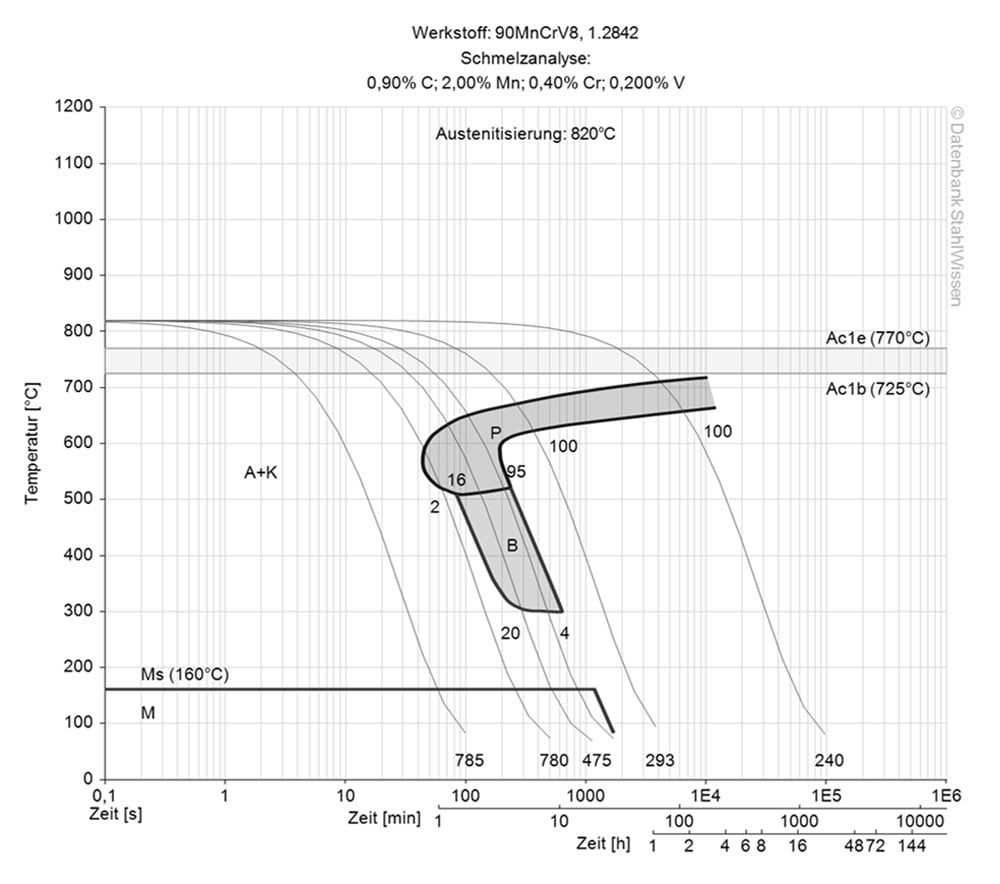
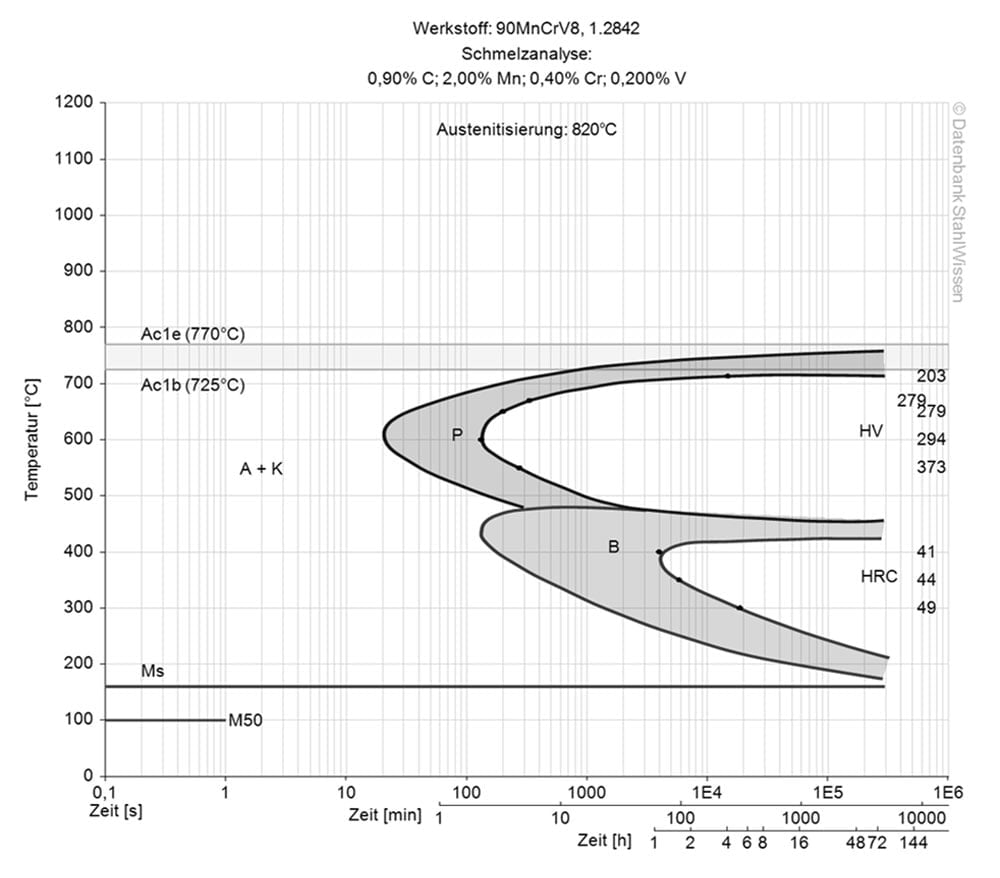
The TTT-diagram usually shows micro-changes over time at different temperature . These are important in heat treatment as they provide information on the optimal conditions for processes such as hardening, annealing and normalising.

This diagram shows the structural changes at micro level over time at a constant temperatur. It shows at which temperatures after what time the different phases like perlit, martensite or bainite start to form.

1.2842 / 1.2510 SURFACE TREATMENT

To give the 1.2842 / 1.2510 a better wear resistance, corrosion resistance or improved aestethic it can undergo a variety of surface treatments.

Following are a few examples for possible surface treatments for this steel grade.

Nitrogen is diffused into the material surface during nitriding the 1.2842 / 1.2510. This gives it a harder surface wich in turn improves the wear resistance and tool life.

This process diffuses carbon as well as nitrogen into the surface of the 1.2842 / 1.2510 to create a harder surface, better wear resistance as well as the resistance to soften at high temperatures.

This process diffuses carbon into the material surface building a hard carbide layer. This increases the surface hardness and wear resistance of the 1.2842 / 1.2510.

A black oxide coating can provide additional corrosion resistance. This method is often chosen though because parts take on a blue-black surface colour that improves aesthetics and reduces light reflection from the surface.

Both processes, Physical Vapor Deposition (PVD) and Chemical Vapor Deposition (CVD), bring a thin coating on the surface of the material. This thin hard layer gives the material a wear resistant coat.

1.2842 / 1.2510 PROCESSING

The 1.2842 / 1.2510 tool steel has a fine grained structure and balanced composition which makes it relatively easy to machine.

This material gets machined preferable in its annealed condition as it is more challenging in its hardened condition when a considerable amount of material needs to be removed. To machine this high carbon steel in its hardened conditon more wear resistant tools like carbide tools should be used as well as coolant or lubricants can help to reduce heat and prolong tool life.

Regular monitoring of tool wear can ensure prolonged tool life as well as ensuring precise machining processes. Coolants and lubricants can as mentioned before reduce heat as this material can work harden during machining.

Tool steel 1.2842 / 1.2510 can be EDMed in its annealed condition but also in its hardened condition. EDM can introduce some heat affected zones which in turn can alter properties in those zones. As those properties are not the same as in the rest of the work piece and to reduce introduced stresses or refine the microstructure of the 1.2842 / 1.2510 can be tempered.

The by-product of this process is a recast layere which can be removed by stoning and polishing for example.

Dimensional changes during hardening and tempering should not exeed 0,25% per side if the recommended stress relieving has been done. Any potential changes should be considred when the finished product has to have tight toleranzes.

For a refined grain structure tool steel 1.2842 / 1.2510 can be forged. A finer grain structure can improve mechanical properties like toughness and fatigue strength as well as producing a more uniform and homogeneous material.

Heat the material to a temperature range of 980 – 1000°C to forge it and do not let the temperature drop below 800°C. To keep the material at the needed temperature it can be reheated into the needed range and when finished the material is slowly cooled ata controlled rate. Cooling down is done preferably in a furnace or in lime or dry ash.

Tool steel can achieve good results during welding if some precautions are taken during the process like for example using an increased working temperature, preparing joints properly, choosing the appropriate filler metals and welding methodes. When polishing or photo-etching is done it is necessary to work with suitable electrode types with a matching composistion to get the best results possible.

ALTERNATIVES

Are you looking for an alternative steel grade?

With the ABRAMS STEEL GUIDE®, you are able to obtain an alternative or equvelent with just a few clicks.

DATASHEET

Download the technical data sheet in PDF format here.

Messe.png

SERVICES

Do you require special dimensions?


Our services for you: water jet cutting, sawing, milling and grinding.

richtwerte-2.png

Standard values

(1.2842)
Chemical designation: 90MnCrV8 / 100MnCrW4
Working hardness: 57-62 HRC
Delivery condition: maximum 229 HB
Chemical composition:
C Si Mn P S Cr V
0,85

0,95
0,1

0,4
1,8

2,2
0

0,03
0

0,03
0,2

0,5
0,05

0,2
Logo_Abrams_Ausrufezeichen.png
HART-PRÄZ® – ALREADY HARDENED DIMENSIONS IN LENGTH OF 250 mm AND 500 mm!
technical-info.png

Technical properties

Alloyed oil hardener with focus on cold work; can be used for a wide range of applications: full hardenability, high degree of dimensional stability, good cutting power and good toughness. Its technical properties and its applications are similar to those of AISI / SAE O1.

anwendungen.png

Applications

Blanking and stamping tools (up to 6 mm thickness), shear knives, threading tools, thread dies, reamers, chasers, measuring tools, plastic moulds, rubber moulds, calibres, guide rails, dies, punches, woodworking tools, machine knives.

70 STEEL GRADES IN 33.895 DIMENSIONS

EX WORKS FROM OSNABRÜCK

DELIVERY IN 3-5 WORKING DAYS (SUBJECT TO AVAILABILITY)

WITHOUT MINIMUM ORDER VALUE OR QUANTITY

FROM EUROPE'S LARGEST RANGE OF SEMI-FINISHED PRODUCTS

SPECIAL CUSTOM DIMENSIONS SAWN - MILLED - GROUND

Select Your Country / Language

Do you have any questions?

If you have any comments or questions regarding ABRAMS PREMIUM STEEL® products or this website, please do not hesitate to contact us.

Please feel free to call us at any time:

+49 541/357 39-0

or send us an E-mail to:

[email protected]

If you have any comments or questions regarding ABRAMS PREMIUM STEEL® products or this website, please do not hesitate to contact us.

Please feel free to call us at any time: