1.4122 - AT A GLANCE
What kind of steel is the 1.4122?
The 1.4122 (X39CrMo17-1) 420RM shows outstanding mechanical properties with good corrosion resistance that can be polished to a high gloss finish. Due to the added chromium, up to 17%, it has a higher corrosion resistance compared to stainless steels with for example 13% of chromium.
Though it has a good corrosion resistance, this stainless steel should not be used in seawater but can be used in freshwater for valves or pump shafts for marine- or mechanical engineering for instance.
Properties
With a good balance between corrosion resistance, performance, mechanical properties and durability, 1.4122 stainless steel is a good choice when high hardness, toughness and wear resistance are required for knives or machine parts, for example. Environmental conditions should be considered as the corrosion resistance of 1.4122 may be limited in chlorides and extreme pH values.
- Quenched and tempered chromium steel
- Good polishability
- Good heat resistance
- Good wear resistance
- Very good mechanical properties
- Acid resistant
- Corrosion resistant
- Magnetizable
- Nitridable
- Polishable
- Poor weldability
Applications
Stainless steel 1.4122 has a good combination of mechanical properties and corrosion resistance which lends itself for applications like cutting tools, mechanical components, pump and valve parts, surgical and dental instruments, the food industry as well as for machine parts.
As a martensitic steel it can be hardened to a high level to provide good wear resistance and a long lasting cutting edge. Care should be taken when exposing the material to environments with chlorides and extreme pH levels.
- Mechanical engineering
- Marine engineering
- Apparatus engineering
- Plastic processing
- Plastic molds
- Extrusion tools
- Press molds
- Fitting tools
- Shafts
- Spindles
- Bolts
- Pistons
- Valves
- Steam valves
- Water valves
- Beater bars
- Fittings parts
- Pump construction
- Pump rods
- Compressor construction
- Compressor parts
- Surgical Instruments
1.4122 Standard values
Chemical composition:
| C | Si | Mn | P | S | Cr | Mo | Ni |
|---|---|---|---|---|---|---|---|
| 0.33 - 0.45 | 0.0 - 1.0 | 0.0 - 1.5 | 0.0 - 0.045 | 0.0 - 0.03 | 15.5 - 17.5 | 0.8 - 1.3 | 0.0 - 1.0 |
Chemical designation:
X39CrMo17-1
Working hardness: approx. 30 HRC (delivery condition) up to 48 HRC
Delivery condition:
max. 325 HB
1.4122 Physical properties
What group of steel does the 1.4122 belong to?
- Martensitic stainless steel
- Plastic mould steel
- Stainless steel, corrosion resistant
- Stainless steel, acid resistant
Is the 1.4122 a stainless steel?
Yes, with a mass fraction of 15,5 – 17,5 % of chromium the 1.4122 is a stainless steel.
Is the 1.4122 corrosion resistant?
To be classified as corrosion-resistant, the material must contain at least 10.5% chromium. With a chromium content of 15.5–17.5%, this means that 1.4122 is a corrosion resistant steel.
1.4122 General corrosion resistance
In moderately corrosive environments with low chlorine ion concentrations, 1.4122 exhibits good corrosion resistance. The 1.4122 can be used with cathodic corrosion protection in extremely corrosive environments such as in seawater or soil. Without this extra protection, this steel is not suitable for use in seawater. Due to its high chromium content, this stainless steel grade offers corrosion resistance to organic acids and citric acid. Corrosion resistance can be further increased by finely grinding or polishing the surface.
Is the 1.4122 magnetisable?
As a martensitic stainless steel, 1.4122 can be magnetised, which can be advantageous for some applications. Machining operations such as grinding, milling or eroding can be carried out on machines with magnetic adhesion.
1.4122 Wear resistance
This tempered stainless steel is rated 3 for wear resistance on a scale where 1 is low and 6 is high.
1.4122 Technical properties
Is the 1.4122 a knife steel?
1.4122 has good corrosion resistance, high hardness after heat treatment, and good wear resistance and toughness. These properties give a knife a sharp cutting edge with good edge retention and resistance to chipping and breaking. Due to its balanced properties, 1.4122 can be used for knife manufacturing.
1.4122 Working hardness
The achievable hardness for 1.4122 is in the range of 30 HRC – 48 HRC (as supplied).
1.4122 Density
Typically, the density of 1.4122 stainless steel is 7.7 g/cm3 at room temperature.
1.4122 Tensile strength
1.4122 has a tensile strength of approx. 1100 N/mm2. This value is the result of a tensile test that shows how much force is required before the material begins to stretch or deform before it breaks.
1.4122 Yield strength
The yield strength indicates how much stress can be exerted on a material before it undergoes plastic deformation. Beyond this point, it will not return to its original shape, even if the stress is removed. The material will deform permanently or break beyond this point.
The range for 1.4122 stainless steel is at 500 N/mm2.
1.4122 Machinability
On a scale where 1 is low and 6 is high the 1.4122 receives a 2 for its machinability.
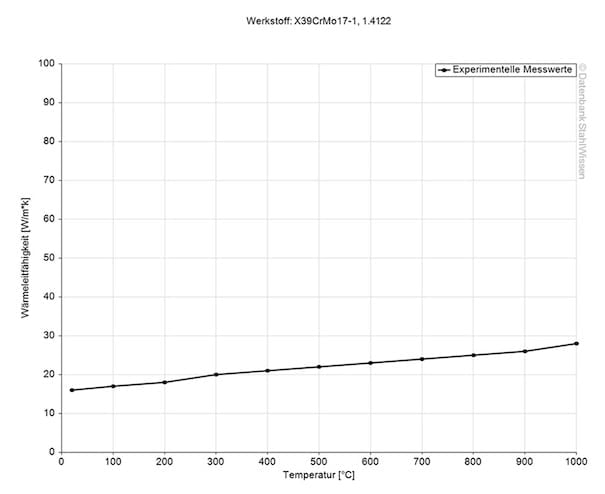
1.4122 Heat conductivity
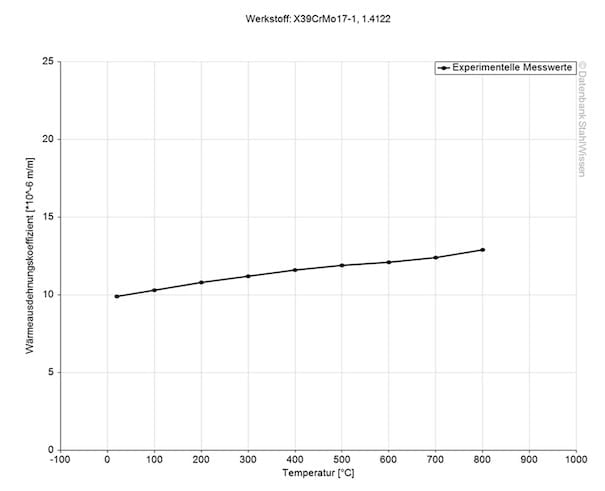
1.4122 Thermal expansion coefficient
The following table shows the expansion or contraction at different temperatures, which can be very important for work at high temperatures or with significant temperature fluctuations.
Medium thermal expansion coefficient
Value 10-6m/(m*K)
At a temperature of
10.4
20 – 100 °C
10.8
20 – 200 °C
11.2
20 – 300 °C
11.6
20 – 400 °C
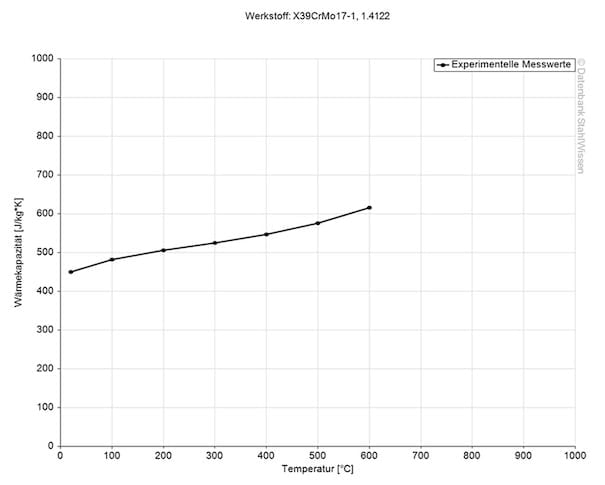
1.4122 Specific heat capacity
The specific heat capacity for stainless steel 1.4122 at room temperature is 0,43 J/kg*K. This value indicates how much heat is required to heat a certain amount of material by 1 Kelvin.
1.4122 Specific electrical resistance
The specific electrical resistance can be found in the following table. Electrical conductivity is the reciprocal of specific resistance.
Specific electrical resistance
Value (Ohm*mm²)/m
At a temperature of
0.65
20 °C
QUENCHED AND TEMPERED AND CORROSION RESISTANT – BS 1.4122!
1.4122 Procedure
1.4122 Heat treatment
For the 1.4122 the heat treatment is essencial as to receive needed mechanical properties for specific applications.
1.4122 Annealing
Heat the material evenly to a temperature of 750 – 820 °C and hold it for 2 to 4 hours. The process is finished by cooling the material down slowly in the furnace or in air.
1.4122 Stress relieving
Heat workpieces evenly to a temperature of 600 – 650 °C and finish it off by cooling them in the furnace.
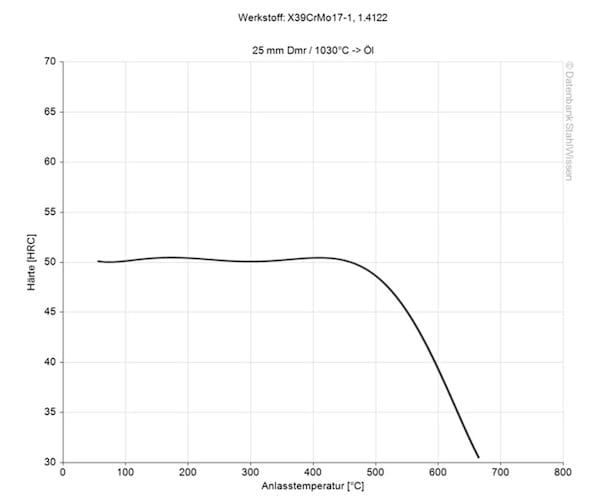
1.4122 Tempering
Evenly heat the material to a tempering temperature of 650 – 750 °C and cool it back down in air. To avoid cracking the matrial should be tempered shortly after hardening.
1.4122 Hardening
Heat the material slowly to a temperature of 980 – 1060 °C, hold it there and then quench it to finish the process.
1.4122 Quenching
To avoid deformation and/or cracking the chosen quenching medium depends on the size and complexity of the workpiece.
- Air
- Oil
- Hot basin
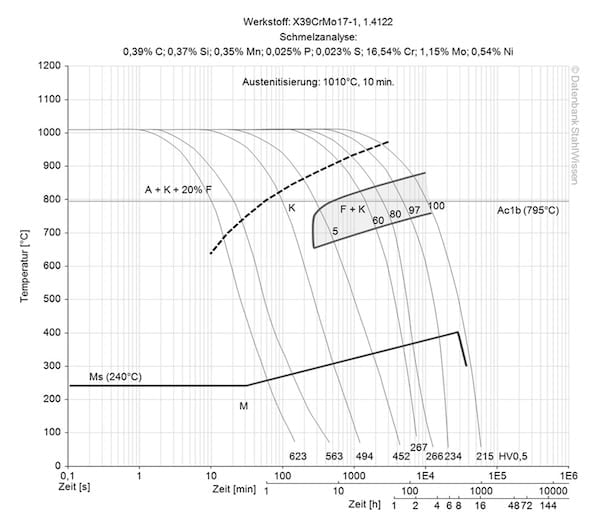
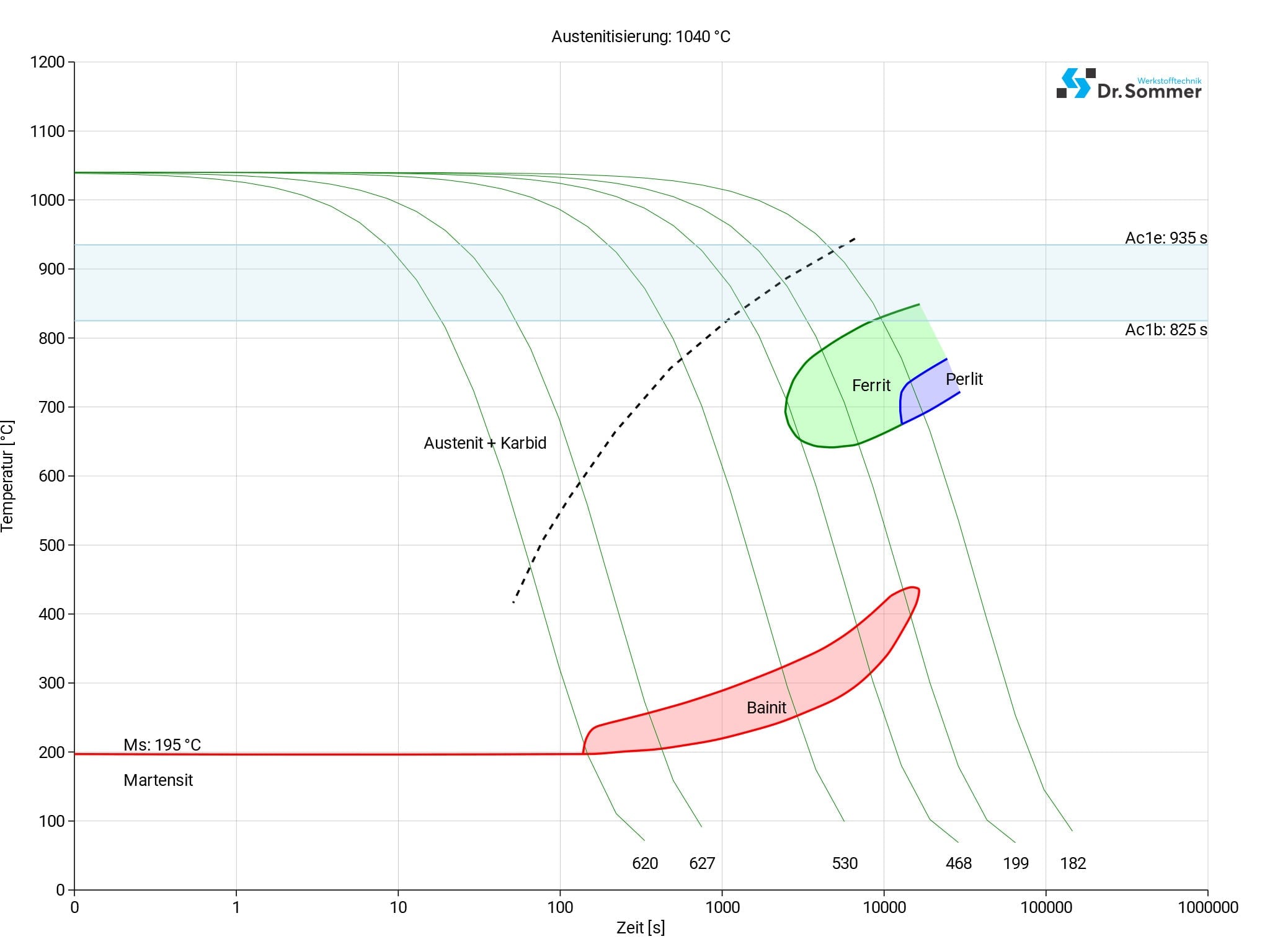
1.4122 Continuous TTT-Diagram
This diagram shows micro-changes over time at different temperatures. These are important in heat treatment because they provide information about the optimal conditions for processes such as hardening, annealing and normalising.
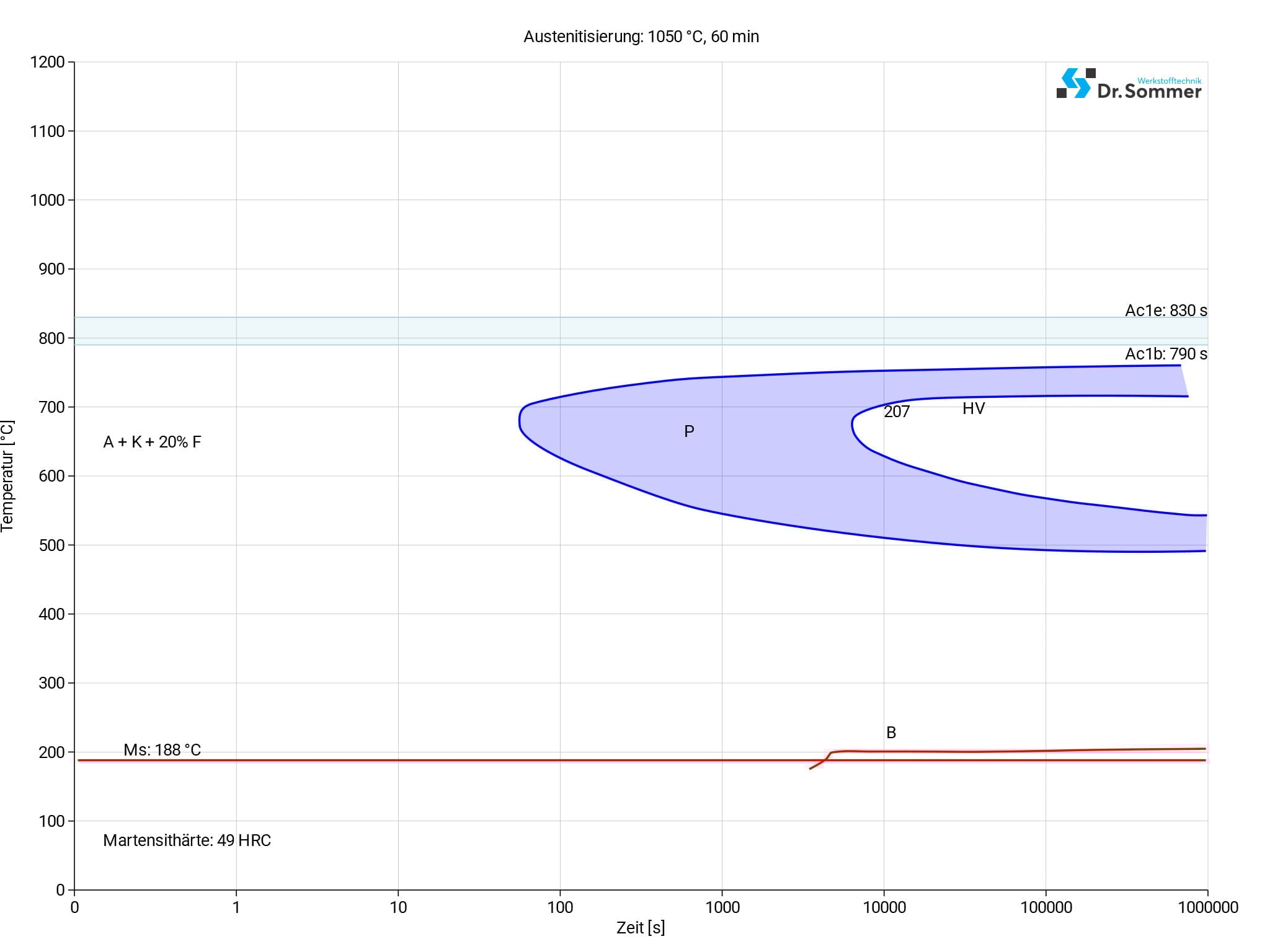
1.4122 Isothermal TTT-diagram
This diagram shows the structural changes at micro level over time at a constant temperatur. It shows at which temperatures after what time the different phases like perlit, martensite or bainite start to form.
1.4122 Surface treatment
Although the 1.4122 is already corrosion resistant, it can be surface treated to further improve corrosion resistance or increase wear resistance for a longer tool life, as well as for an aesthetic appearance. Below are some examples of surface treatments for 1.4122 stainless steel.
1.4122 Nitriding
During this process nitrogen is diffused into the material surface. This gives it a harder surface which improves the wear resistance and service life of tools or components.

1.4122 Carburisation
To receive a harder and more wear resistant surface carbon is diffused into the surface of the 1.4122.
1.4122 Black oxide coating, brushing and polishing
The black oxide coating (bluing) gives the material a non-reflective, matt black surface that can provide light corrosion resistance.
Brushing and polishing create a satin finish that is aesthetically appealing, like a black oxide coating, but can also reduce product adhesion to the surface. Polishing smooths out tiny grooves, giving contaminants less space to adhere and thus can preventing corrosion from starting.
1.4122 PVD- und CVD Verfahren
Both PVD (Physical Vapor Deposition) and CVD (Chemical Vapor Deposition) coatings apply a thin layer to the material surface that can increase wear resistance or reduce friction.
- PVD – physical vapor deposition
- CVD – chemical vapor deposition
1.4122 Passivation
This process removes free iron from the surface using nitric or citric acid and applies a protective oxide layer to the material that can prevent rust and other forms of corrosion when this material is exposed to a corrosive environment.
1.4122 Process
1.4122 Machining allowance / dimensional changes
As other metals the 1.4122 expand and contract when heating or cooling, due to internal stresses or phase changes. Care has to be taken that the material does not deform during the fore meationed processes.


1.4122 Forging
Slowly heat the material to a temperature of 800 °C and the fast to a temperaature of 1150 °C. Forging temperatures are between 1180 – 950 °C and forging should not be continued under 950 °C. To finish this process cool workpieces down in the furnace, dry ash or materials which allow slow cooling.
1.4122 Welding
It is not usual to weld the material grade 1.4122. Should welding be unavoidable preheat the 1.4122 to a temperaure of 300 – 400 °C.
Since a large proportion of non-tempered martensite forms in the heat-affected zones, it is necessary to temper the material afterwards. During the tempering treatment, the martensite in the rest of the workpiece is overhardened, so it is advisable to carry out a hardening and tempering process as described above.
As with tempering, it is important to start the heat treatment as soon as possible after completion of the welding process in order to reduce the possibility of cracking.