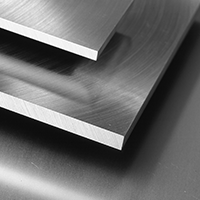

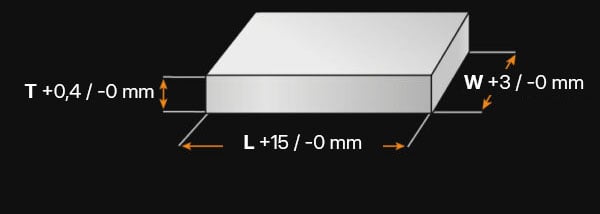
1.4841 - AT A GLANCE

What kind of steel is the 1.4841?
The 1.4841, also know under its chemical discription X15CrNiSi25-21, is an austenitic, heat resistant stainless steel. The addition of sililcon, among other alloys, in the stainless steel 1.4841 makes this steel grade more resistant to oxidation and prevents carburization at elevated temperatures.
On the other hand, continuous use at a temperature range of 650 – 900°C makes this stainless steel more susceptible to phase changes and embrittlement. This material grade is suitable for cold forming and cold heading, hammer- and die forging and is not magnetizable.

Properties
The 1.4841 stainless steel is a good choice for high-temperature environments due to its high temperature resistance. It has good corrosion resistance in mild atmospheres and is relatively easy to form. As with all materials, the applications and desired properties should be considered when choosing the material.
- Heat resistant
- Chromium-nickel-molybdenum steel
- Resistant to oxidation at high temperatures
- Good strength properties
- Excellent chemical resistance at high temperatures up to 1100 °C
- Very good corrosion resistance
- Creep resistant at high temperatures
- Non-magnetizable

Applications
Stainless steel 1.4841 can be used at high temperatures up to 1100°C and is resistant to oxidation which makes it ideal for furnace components, ore processing and kiln components as well as heat treatment equipment like heat retorts and heat conductors.
In high temperatures the material does not go soft or brittle which is beneficial when using the 1.4841 in heat exchangers with aggressive atmospheres, high temperature oxidation and carburization.
The 1.4841 can resist creep (a deformation over an extended time at elevated temperatures and high, constant stress) in high temperatures and for extended periods.
Apparatus engineering for high temperature application
- Automotive industry
- Chemical industry
- Oil industry
- Chains for the cement and concrete industry
- Mechanical engineering
- Furnace construction
- Annealing muffles
- Enamel grates
- Fire baskets
- Heat conductors

1.4841 STANDARD VALUES
Chemical composition:
| C | Si | Mn | P | S | Cr | Ni | N |
|---|---|---|---|---|---|---|---|
| 0.0 - 0.2 | 1.5 - 2.5 | 0.0 - 2.0 | 0.0 - 0.045 | 0.0 - 0.015 | 24.0 - 26.0 | 19.0 - 22.0 | 0.0 - 0.11 |
Chemical designation:
X15CrNiSi25-21
Working hardness:
ca. 223 HB (Lieferzustand)
Delivery condition:
max. 223 HB
1.4841 Physical properties
What group of steel does the 1.4841 belong to?
- Aistenitic stainless steel
- Stainless steel, corrosion resistant
- Stainless steel, acid resistant
- Stainless steel
- Chromium-Nickel steel
- V4A steel
Is the 1.4841 a stainless steel?
Yes, the 1.4841 is a stainless steel. To be classified as a stainless steel the material has to have a mass fraction of at least 10,5 % of chromium. The 1.4841 has a mass fraction of 24 – 26 % of chromium.
Is the 1.4841 corrosion resistant?
Yes, due to its chromium content of 24 – 26 % the 1.4841 is corrosion resistant.
1.4841 General corrosion resistance
In general, 1.4841 is resistant to scaling at high temperatures and can maintain its good mechanical properties at such high temperatures. It shows limitations in more aggressive environments, e.g. with chloride ions. Stainless steels with added molybdenum are more suitable for these environments.
1.4841 Oxidation resistance
This steel grade is suitable for use in higher temperatures up to 1100 °C as it has a resistance to oxidation.
1.4841 Intergranular corrosion
Due to the added carbon, this alloy is susceptible to intergranular corrosion after sensitisation.
1.4841 Corrosion resistance in various environments
Due to its chromium content, the 1.4841 offers good corrosion resistance in mild environments. Chromium forms a protective passive oxide layer that can prevent corrosion or further erosion.
In aggressive environments, such as those containing chloride, the 1.4841 is not as resistant and may be susceptible to stress corrosion cracking.
1.4841 Atmospheric corrosion
Above 650 °C, there already exists limited corrosion resistance to reducing or oxidising gases with a sulphur content.
Above 900 °C, 1.4841 exhibits only limited corrosion resistance to carburising gases or low-oxygen gases with a nitrogen content.
Is stainless steel 1.4841 magnetisable?
As an austenitic stainless steel the 1.4841 is in its annealed condition not magnetic. Cold forming, welding and, under certain conditions, such as prolonged exposure to high temperatures the material can become slightly magnetic. This material grade is not suitable for magnetic clamping.
1.4841 Hot work
Work pieces are heated slowly and evenly to a temeprature range of 1200 – 950 °C to carry out hot forming. Do not let the temperature drop below 1000 °C for this process and finish the hot forming of with anannealing. This is very important if temperatures should have dropped below the 1000 °C.
1.4841 Cold work
With its austenitic structure which makes this material grade more ductile stainless steel 1.4841 is easy to cold form. Work pieces which have been exposed over a longer time to higher temperatures (650 – 900 °C) should not be cold formed as the material is suceptible to intergranular carbid precipitation.
1.4841 Wear resistance
This stainless steel receives a 1 for its wear resistance on a scale where 1 is low and 6 is high.
1.4841 Temperature resistance
The 1.4841 is a heat resistant stainless steel with good oxidation and excellent chemical resistance at temperatures up to 1100 °C. The corrosion resistance for this heat resistant steel is restricted in certain atmospheres (see Corrosion resistance).
1.4841 Technical properties
1.4841 Working hardness
The working hardness of stinless steel is at approx. <20 HRC.
1.4841 Density
At room temperature the typical density for the 1.4841 is at 7,9 g/cm3.
1.4841 Tensile strength
The 1.4841 has a tensile strength of approx. 755 N/mm2. This value is the result of a tensile test that shows how much force is required before the material begins to stretch or deform before it breaks.
1.4841 Machinability
Severe work hardening and poor thermal conductivity are the reason the 1.4871 needs adequate cooling and high quality tools. The carbide formation increases the wear of cutting tools. During machining the 1.4841 should be machined at low cutting speeds with shallow cutting depth.
On a scale where 1 is low and 6 is high this stainless steel receives a 2 for its machinability.
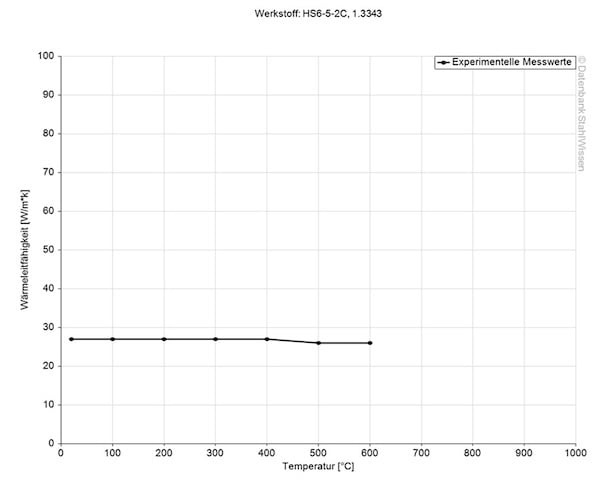
1.4841 Heat conductivity
The heat conductivity for stainless steel is 15 W/(m*K) at room temperature.
1.4841 Thermal expansion coefficient
The coefficient of thermal expansion indicates how much the material can expand or contract when the temperature changes. This is very important information, especially when working with high temperatures or when there are significant temperature fluctuations during use.
Medium thermal expansion coefficient
Value 10-6m/(m*K)
At a temperature of
~ 17
20 – 100 °C
~ 18
20 – 800 °C
~ 19
20 – 1000 °C
~ 19.5
20 – 1200 °C
1.4841 Specific heat capacity
The specific heat capacity for stainless steel 1.4841 at room temperature is 0,5 J/kg*K. This value indicates how much heat is required to heat a certain amount of material by 1 Kelvin.
1.4841 Specific electrical resistance
The specific electrical resistance for stainless steel 1.4571 can be found in the following table. Electrical conductivity is the reciprocal of specific resistance.
Specific electrical resistance
Value (Ohm*mm2)/m
At a temperature of
~ 0.9
20 °C
EXCELLENT CHEMICAL RESISTANCE EVEN AT HIGH TEMPERATURES OF UP TO 1100°C – BS 314 S 25!


1.4841 Procedure
1.4841 Heat treatment
Heat treatment determines material properties. It should therefore always be carried out with care. Properties such as strength, toughness, surface hardness and temperature resistance are determined, which in turn can extend/improve the service life of parts, tools and components.
Heat treatment includes solution annealing, soft annealing, normalising, stress relief annealing, but also tempering, hardening and quenching or tempering.
1.4841 Solution annealing
Heat the material evenly to a temperature of 1050 – 1150 °C and finish the process of with a quenching in water or a quick cooling in air.
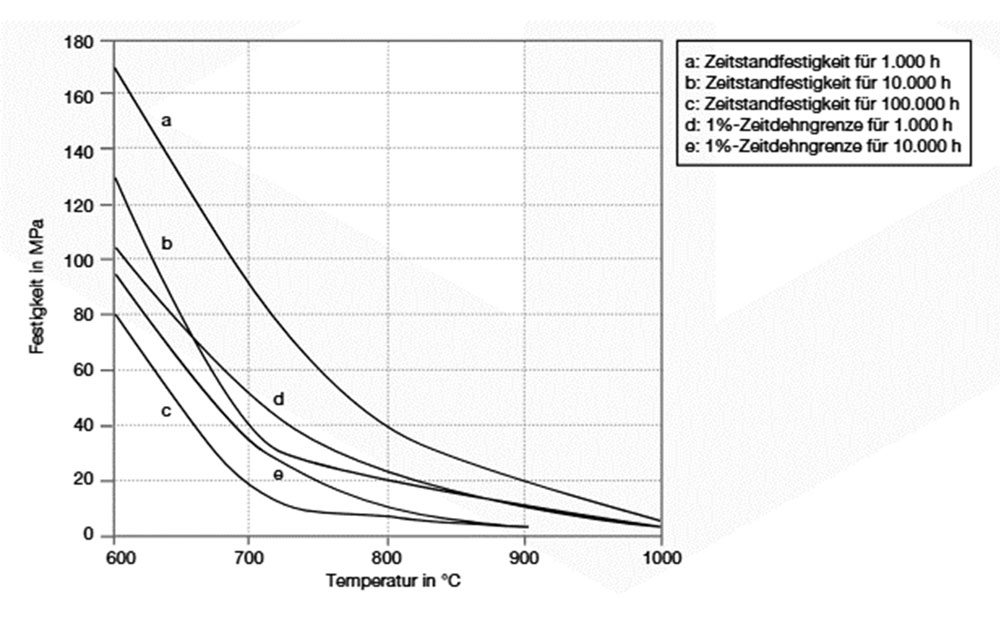
The following diagram shows mechanical properties at higher temperaures in the solution annealed state.
1.4841 Hardening
1.4841 Quenching
Austenitic steels are quenched to prevent the formation of chromium carbides and ensure optimum corrosion resistance. Unlike martensitic steels, austenitic steels do not harden during quenching. Quenching should always be carried out with the desired applications and next steps in mind.
- Water
- Air

1.4841 Surface treatment
Although austenitic, stainless 1.4841 is corrosion-resistant, some surface treatments can further enhance this property or be used for aesthetic purposes. When selecting a surface treatment, the applications for which the tools or parts will be used and the properties they require should be taken into account. Here is a selection of surface treatments that can be used for 1.4841:
1.4841 Pickling
Pickling removes impurities, scale and rust from the surface by immersing the 1.4841 material in a solution of nitric acid and hydrofluoric acid. Pickling leaves a matt surface and can help to restore corrosion resistance, e.g. after welding.
1.4841 Polishing
After buffing, the 1.4841 can be polished to a high gloss by hand or machine. Ensure that your working environment is dry and dust-free before beginning this process. When polishing this material, care should be taken to ensure that all contaminants have been removed from the surface so as not to scratch it during polishing. Be careful not to over-polish the material and to use the correct polishing tools and aids. Polishing removes the finest contaminants from the surface, which could otherwise become the starting point for corrosion.
1.4841 Laser and electrochemical texturing
To reduce friction or enhance adhesion, laser and electrochemical texturing produce a surface pattern promoting these.
Laser texturing allows specific areas to be precisely textured by removing material from the workpiece using laser pulses.
In electrochemical texturing, a substrate is connected as a positive electrode in an electrochemical cell. This circulates the electrolyte fluid, resulting in electrochemically etched indentations.

1.4841 Processing
1.4841 Dimensional changes
All materials undergo dimensional changes during heating and cooling, including the 1.4841 stainless steel. When the material is both heated and subjected to high stress, this can lead to a reduction in tension, which in turn may cause dimensional changes. It is important to take these changes into account when tight tolerances are required for the dimensions of the finished pieces.
1.4841 Sub-zero treatment
Cryogenic treatment is often carried out to convert martensite into austenite. The already austenitic 1.4841 can benefit from this treatment to stabilise the austenitic structure, improve mechanical properties, relieve stresses or increase corrosion resistance.
1.4841 Forging
Heat the work pieces to a temperature range of 1175 – 1000 °C. When finished forging quickly cool them in water or air.
1.4841 Welding
Since austenitic steels have only 30% of the thermal conductivity and a lower melting point than unalloyed steels, austenitic steels should be welded with less heat input than unalloyed steels. To avoid burning through or overheating thinner parts, it is recommended to use a higher welding speed. Stainless steel 1.4841 has a much higher coefficient of thermal expansion than unalloyed steels. In conjunction with the poorer thermal conductivity, greater distortion is to be expected.