1.8550 - AT A GLANCE
What kind of steel is the 1.8550?
The steel grade 1.8550 also known under its chemical discription 34CrAlNi7-10 is a nitridable steel and will be delivered in the tempered condition. This steel grade is being used where high wear resistance is needed. Nitriding gives this grade a higher surface hardness which can reach approx. 950 HV (approx. 68 HRC). The 1.8550 finds its use in machine and plant engineering but also in the automotive industry as well as for plastic processing operations.
Properties
The 1.8550 is an CrAlNiMo alloyed steel when processing plastics as well as for the automotive industry.
This steel grade is delivered in the tempered condition and gets used often for parts in mechanical engineering. For even better wear resistance and a better corrosion resistance the 1.8550 can be nitrided. The nitrading process can achive a nitriding hardness of approx. 950 HV (approx. 63 HRC).
- Nitriding steel
- Engineering steel
- Tempered
- High tensile strength
- High toughness
- Good fatigue strength
- Good machinabilty
- Surface hardenability
- Wear resistant
- Nitridable
- Difficult to weld
Applications
The tempered 1.8550 finds its use in many different industries and applications. It often gets used for parts with high wear.
- Mechanical engineering
- Plastic processing
- Automotive industry
- Plant engineering
- Engine construction
- Piston construction
- Drive technology
- Cam Plates
- Camshafts
- Pinion shafts
1.8550 Standard values
Chemical composition:
| C | Si | Mn | P | S | Cr | Mo | Ni | Al |
|---|---|---|---|---|---|---|---|---|
| 0.30 - 0.37 | 0.0 - 0.40 | 0.40 - 0.70 | 0.0 - 0.025 | 0.0 - 0.03 | 1.50 - 1.80 | 0.15 - 0.25 | 0.85 - 1.15 | 0.8 - 1.2 |
Chemical designation:
34CrAINi7-10
Working hardness: max. 68 HRC (nitiriding hardness)
Delivery condition:
max. 323 HB
1.8550 Physical properties
What group of steel does the 1.8550 belong to?
- Nitriding steel
- High grade structural steel
Is the 1.8550 a stainless steel?
No, the 1.8550 is not a stainless steel in the classical sense.
Is the 1.8550 corrosion resistant?
No, the 1.8550 is not corrosion resistant. To be corrosion resistant a steel has to have a minimum massfraction of 10,5 % of chromium. The 1.8550 has a mass fraction of 1,5 – 1,8 % of chromium.
Is the 1.8550 magnetisable?
The 1.8550 is a ferromagnetic steel and can be magnetised. For milling or grinding, this steel grade can therefore be placed on a magnetic clamping plate.
1.8550 Wear resistant
For its wear resistance the 1.8550 receives a 6 on a scale where 1 is low and 6 is high.
1.8550 Technical properties
is the 1.8550 a knife steel?
Although the 1.8550 has good hardness and wear resistance with a tough core, it is not a suitable knife steel. A knife steel should have consistent hardness in order to have good cutting performance. It should be easy to resharpen and have good corrosion resistance. For knife making, another grade of steel should be considered, one whose machinability, sharpness, cutting performance and corrosion resistance have been specifically developed to make good knives.
1.8550 Working hardness
The working hardness for the 1.8550 is at 68 HRC.
1.8550 Density
At room temperature the nirtriding steel 1.8550 has a density of 7,8 g/cm3.
1.8550 Tensile strength
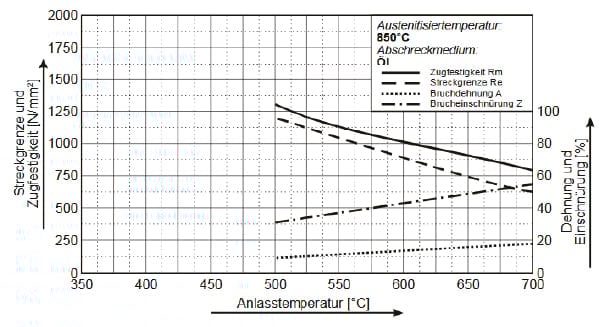
The 1.8550 has a tensile strength of approx. 1095 N/mm². To obtain these findings, a tensile test is carried out to show how much force is required to stretch or elongate a sample before it breaks.
1.8550 Yield strength
The yield strength indicates how much stress can be applied before a material undergoes plastic deformation. Beyond this point, the material does not return to its original shape when the stress is removed, but remains deformed or even breaks. The yield strength for 1.8550 in the tempered condition is 650 N/mm².
1.8550 Machinability
On ascale where 1 is low and 6 is high the 1.8550 receives a 3 for its machinability.
1.8550 Heat conductivity
The heat conductivity for the high grade structural steel 1.8550 is 33,7 W/(m*K) at room temperature.
1.8550 Thermal expansion coefficient
The following table shows the expansion or contraction at different temperatures, which can be very important for work at high temperatures or with significant temperature fluctuations.
Medium thermal expansion coefficient
Value tempered
10-6m/(m*K)
At a temeprature of
12.1
20 – 100 °C
12.7
20 – 200 °C
13.2
20 – 300 °C
13.7
20 – 400 °C
1.8550 Specific heat capacity
The specific heat capacity of this nitriding steel at room temperature is 0.46 J/kg*K. This value indicates how much heat is required to heat a certain amount of material by 1 Kelvin.
1.8550 Specific electrical resistance
The specific electrical resistance for this steel grade can be found in the following table. Electrical conductivity is the reciprocal of the specific electrical resistance.
Table of the specific electrical resistivity
Value (Ohm*mm²)/m
At a temperature of
0.31
20 °C
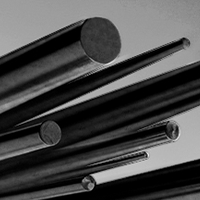
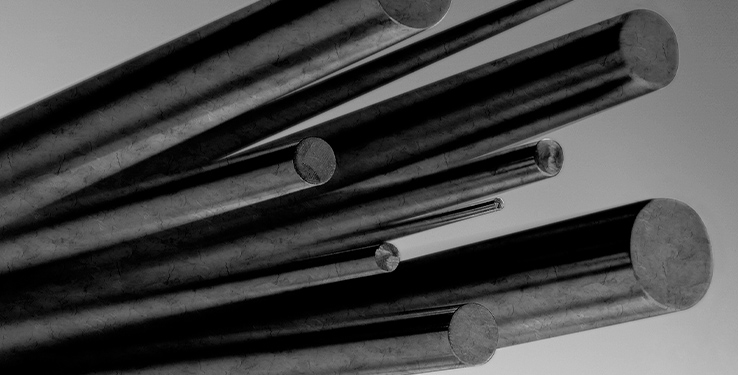
ROUND STEEL – IN BLACK!
1.8550 Procedure
1.8550 Heat treatment
During heat treatment, material properties are determined. Therefore, this should always be carried out with care. Properties such as strength, toughness, surface hardness and temperature resistance are determined, which in turn can extend/improve the service life of parts, tools and components.

Heat treatment includes solution annealing, soft annealing, normalising, stress relief annealing, but also tempering, hardening and quenching or tempering.
1.8550 Annealing
To anneal the 1.8550 it is evenly heated to a temperature of 650 – 700 °C followed by cooling down in air.
1.8550 Normalising
To normaise the 1.8550 heat it evenly to a temperature of 860 – 900 °C and then cool it back down in air.
1.8550 Stress relieving
The 1.8550 arrives in a tempered condition and can be stress-relieved in this condition at 30–50 °C below the tempering temperature.
1.8550 Tempering
To temper the 1.8550 material, it is heated evenly to a temperature of 580–660 °C and held at this temperature for approximately one hour. It can then be allowed to cool slowly in the air.
1.8550 Hardening
To harden the 1.8550 heat it evenly to a temperature of 870 – 930 °C and quench it afterwards.

1.8550 Quenching
After hardening the 1.8550 can be quenched slowly in the following medium:
- Oil
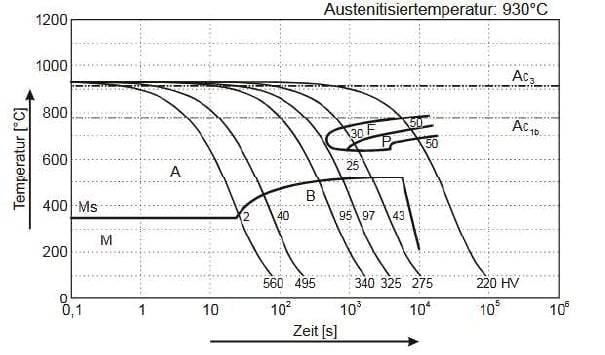
1.8550 Continous TTT-diagram
This diagram shows micro-changes over time at different temperatures. These are important in heat treatment, as they provide information about the optimal conditions for processes such as hardening, annealing and normalising.
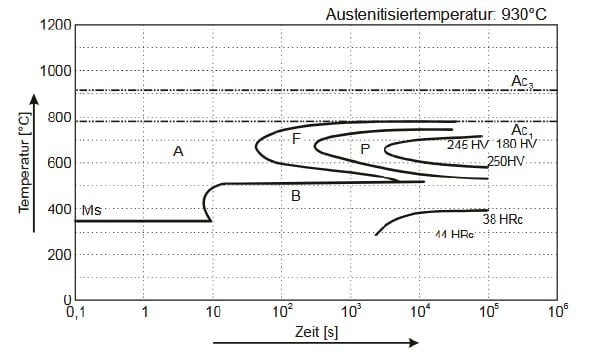
1.8550 Isothermal TTT-diagram
This diagram shows the structural changes at the micro level over time at a constant temperature. It shows at what temperature and after what time different phases, e.g. perlite, martensite or bainite, begin to form.
1.8550 Surface treatment
1.8550 Nitriding
The introduction of nitrogen into the material surface creates a hard and wear-resistant layer that increases wear resistance and service life. The thickness of the nitriding layer should be carefully considered to suit the respective application.
1.8550 Case hardening
During case hardening, carbon diffuses into the surface of the material, thereby increasing its surface hardness and improving its wear resistance while maintaining a tough core.
1.8550 Phosphating
In this process, a phosphate solution is sprayed onto the component or it is immersed in a phosphate solution. The resulting phosphate layer on the component improves corrosion resistance and can also form the basis for further coating, such as painting.
1.8550 Processing
1.8550 Electrical Discharge Machining (EDM)
In general, a material is eroded in order to produce workpieces from a single piece. Erosion can be used to produce dies or more complex shapes. There are various methods of eroding different materials, such as wire erosion, spark erosion or die-sinking erosion.
1.8550 Forging
The material 1.8550 is heated evenly to a temperature range of 850–1050 °C for hot forming and then shaped. The material should then be allowed to cool slowly in still air. Finally, heat treatment and tempering can be carried out.